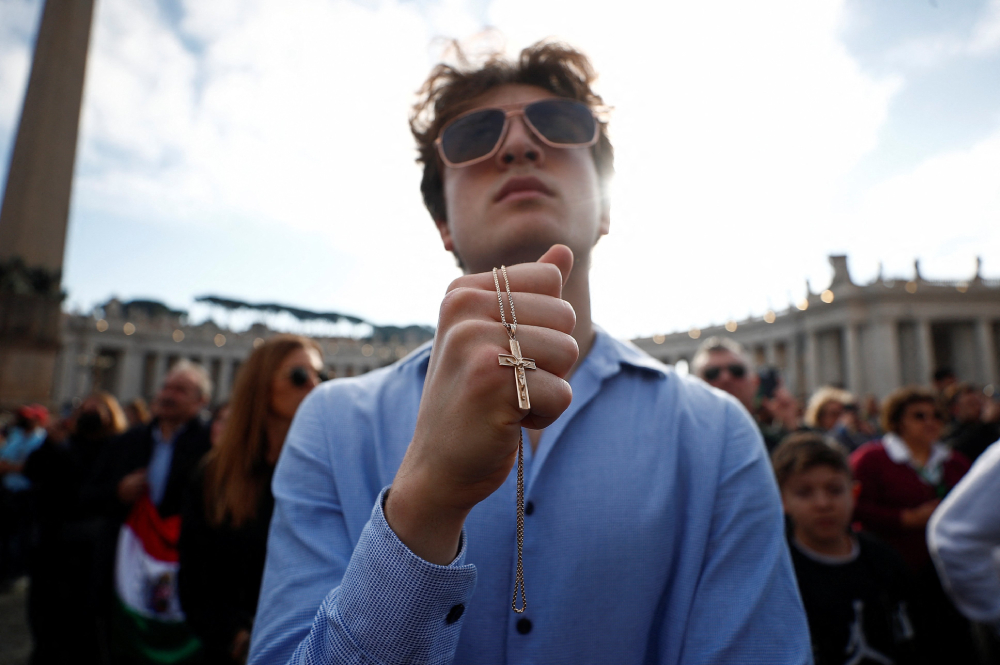
A man holds a chain with a crucifix as Pope Francis prays the Angelus at the Vatican on the World Day of Peace Jan. 1, 2023. (OSV News/Reuters/Guglielmo Mangiapane)

by Brian Fraga
Staff Reporter
Join the Conversation
Send your thoughts to Letters to the Editor. Learn more
Two years ago, St. Pius X Church in Granger, Indiana, had nine adults enter the Catholic Church at the Easter Vigil. Last year, 34 people went through the parish's Order of Christian Initiation of Adults program.
By the end of this summer, 73 adults at St. Pius X Church will have come into full communion with the Catholic Church since last fall, said Will Kuehnle, the parish's director of Christian initiation.
"I know a lot of people are focused on the numbers [of converts], but our job isn't about the numbers. I think our job is to be faithful with the harvest that God is giving us at this time," Kuehnle told National Catholic Reporter.
Across the country, Catholic parishes in metropolitan areas and in rural communities have reported surges this year in converts, with the numbers doubling in cities such as Los Angeles, Tallahassee, Florida, and Tulsa, Oklahoma. According to Hallow, a Catholic prayer app, the average American diocese received 38% more converts this year than in 2025.
Though official statistics for 2026 will not be available until next year's edition of the Official Catholic Directory is published, the anecdotal evidence suggests that the Catholic Church in the United States could be poised for its biggest gain in adult converts in several years.
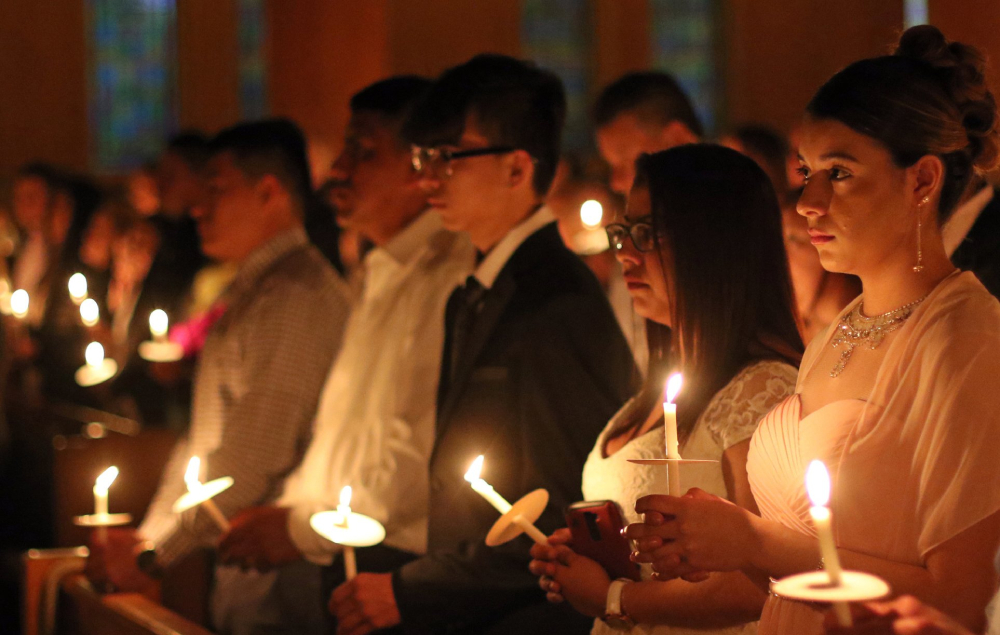
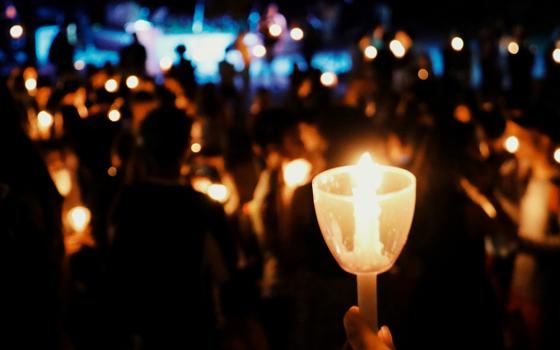
Catechumens are pictured in a file photo holding candles during the Easter Vigil at St. Hugh of Lincoln Church in Huntington Station, New York. (OSV News/Gregory A. Shemitz)
"I love the tradition of the Catholic Church," said Kaylee Goetz, 26, a teacher who was baptized and confirmed this year at Immaculate Conception Church in Richmond, Missouri, during the Easter Vigil. She did not attend church growing up, but said the Catholicism of her father's family appealed to her.
"I moved back home after college and met my fiance, and he's Catholic. That for me was the confirmation that it was time" to join the Catholic Church, Goetz told NCR.
Stories of young adults like Goetz converting to Catholicism have caught the attention of secular and Catholic news outlets, and have prompted several commentators to opine that the church is enjoying newfound appeal among Millennials and Gen Z Americans eager for community and a deeper sense of meaning than what secularism can provide. Some have suggested that the apparent increase in converts could even be a sign of revival.
But while the numbers of adult converts are trending upward, the reality is that the Catholic Church in the United States is still bleeding members.
According to the Pew Research Center, 12.8% of all U.S. adults are former Catholics: people who say they were raised Catholic but no longer identify as such. By comparison, about 1.5% of all adults in the United States are converts to the Catholic faith.
"If you look at that as a ratio, then it means there are 8.4 former Catholics for every convert to Catholicism," said Gregory Smith, a senior associate director of research at Pew Research Center who studies religion's role in American public life.
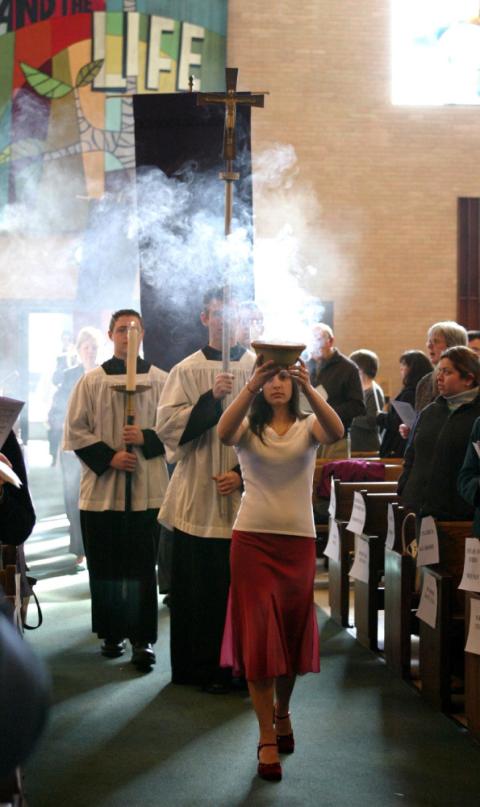
Lola Yellico leads the opening procession during the Rite of Election at St. Joseph Church in Ronkonkoma, New York in 2005.The Rite of Election, celebrated annually in cathedrals and churches around the world on the first Sunday of Lent, formally acknowledges the readiness of those preparing to receive the sacraments of initiation — baptism, confirmation and the Eucharist — at the Easter Vigil. (CNS/Gregory A. Shemitz)
"And that ratio of the number of people having left the church to the number who have joined it is more lopsided for Catholics than for any other group that we're able to look at in our surveys," Smith told NCR.
If one looks at long-term statistical trends in Catholicism, "they're almost all heading in a negative direction," said Ryan Burge, a former Baptist pastor and political scientist who studies and writes about trends in American religion.
"Whether it's baptisms, confirmations, first communions, all those numbers don't look good, especially baptisms," said Burge, who told NCR that not only are there fewer priests and women religious today than 60 years ago, but also the numbers of infant baptisms — 480,905 baptisms in 2024 — are significantly lower than what they were in 1965, when 1.24 million babies were baptized.
"And that's when America was a lot smaller population-wise," Burge said. "So you can't look at those numbers and say things are in a good spot."
In 2024, the most recent year for which data is available, the Center for Applied Research in the Apostolate, or CARA, at Georgetown University reports that 34,501 adults were baptized into the Catholic Church. That figure was up from 2020, the pandemic year, when only 25,356 were baptized, but still down from 2019, when 35,799 adults were baptized.
"Even with these recent increases, what they're doing is bringing us back to a level of adult entries [into the Catholic Church] that is more consistent with what we saw prior to the pandemic, or even prior to 2010," said Mark Gray, a senior research associate and director of CARA Catholic Polls.
According to CARA, the number of adults entering the Catholic Church declined steadily from 2014 — when just under 45,000 adults were baptized — through 2020, when just 25,356 adults were baptized. That trend largely mirrors similar downward trajectories during that same timeframe with infant and minor baptisms and with baptized Christians coming into full communion with the Catholic Church.
But beginning in 2021, according to CARA, the number of adult baptisms has gradually been increasing, growing from roughly 26,000 in 2021 to 27,500 in 2022. It increased to 30,000 in 2023 and hit 34,501 in 2024.
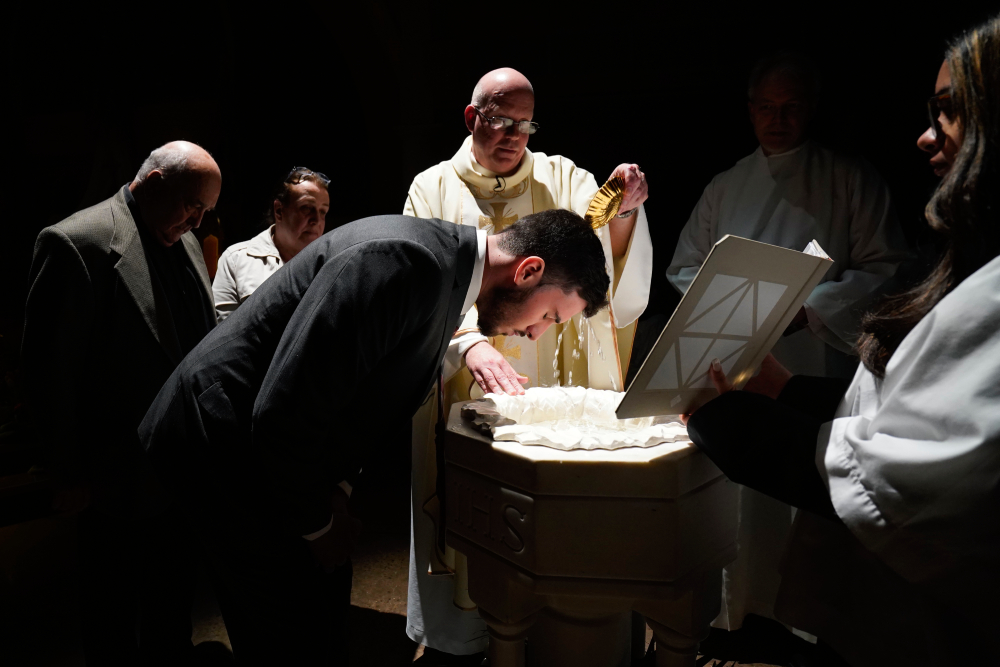
Nicholas DeRosa is baptized by Father Patrick Riegger, pastor of St. John the Evangelist Church in Center Moriches, New York, during the Easter Vigil April 8, 2023. Some U.S. dioceses and universities are indicating record numbers of people joining or receiving full initiation into the Church. (OSV News/Gregory A. Shemitz)
"We're starting to see a pattern," Gray said. "So when you put together the pieces of these anecdotes with the pattern we're seeing, it wouldn't surprise us that you would have an increase, not only in 2025, which we'll learn about this summer when the [Official Catholic Directory] is published, but if current trends continue, it wouldn't surprise us to see more in 2026 again."
What seems to be happening, Gray added, is that the Catholic Church in the United States is returning to a period where it again could see more than 100,000 adults enter the church every year, which he said "would not have been surprising in the early 2010s."
"We'll see in the data if there is an unusual increase instead of what an expected increase would look like," Gray said.
Susan Timoney, a professor of practice in pastoral studies at The Catholic University of America in Washington, told NCR that she was not ready to characterize the recent anecdotal signs of surging converts as a trend.
"I think we need to see a few more years of this kind of growth," said Timoney, who noted though that the early signs indicate that young adults appear to be driving the conversions in the Northeast. She credited that in part to the priority that many dioceses have given to fostering young adult ministry programs.
Advertisement
"I like to think that some of that is reflected in this surge of young people entering the church," Timoney said. "And this also complements research that you read on young people's desire for community and intergenerational relationships."
The communal aspect of Catholicism was indeed a draw for Katiangelys Morell Altoro, 26, who was baptized and confirmed at Our Lady of Mount Carmel Church in New Bedford, Massachusetts during the Easter Vigil.
"I made sure I wore waterproof makeup because I knew I was going to do a lot of crying," Altoro said. "It was so emotional. You could feel the Lord's presence in the support of the Catholic community at that moment. It makes me emotional now just talking about it."
Kuehnle, the parish director of Christian initiation in Indiana, said many of the new converts at his parish are unbaptized young adults in their 20s with little to no prior religious affiliation.
"I think they all share a sense that Catholicism is real, and that they want something real," said Kuehnle, 30, who entered the Catholic Church when he was 19. Kuehnle said he became Catholic because he "knew it was true."
"That's all it was," he said. "And why am I still Catholic? Because it's true."