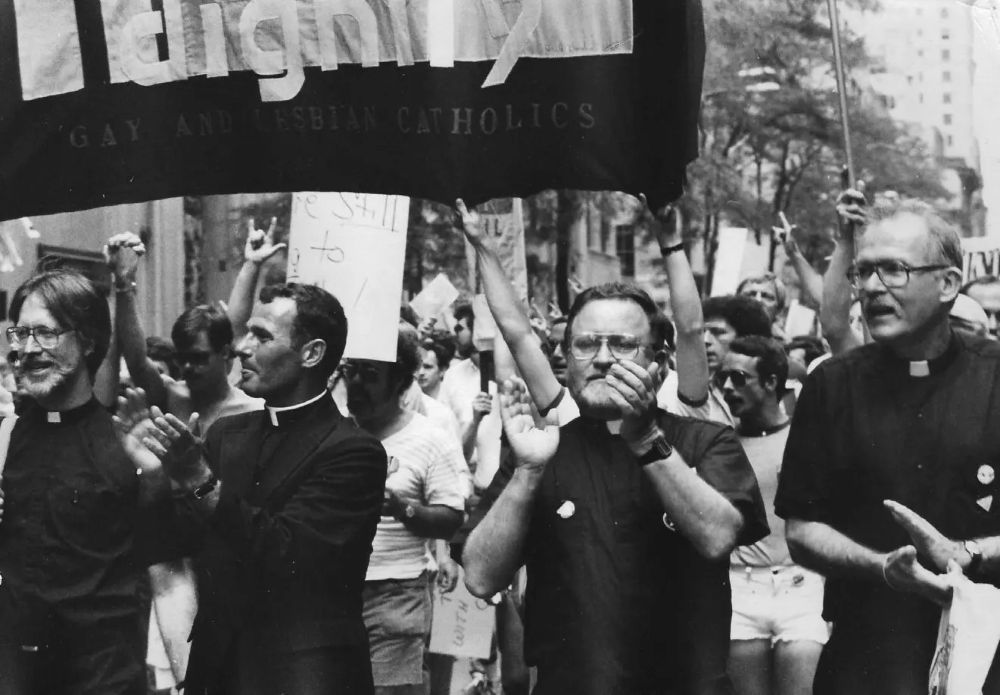
Fr. John McNeill, second from right, marches with Dignity in the gay pride parade in New York City on June 27, 1982. (Courtesy of Charles Chiarelli)

by Ryan Di Corpo
Join the Conversation
Send your thoughts to Letters to the Editor. Learn more
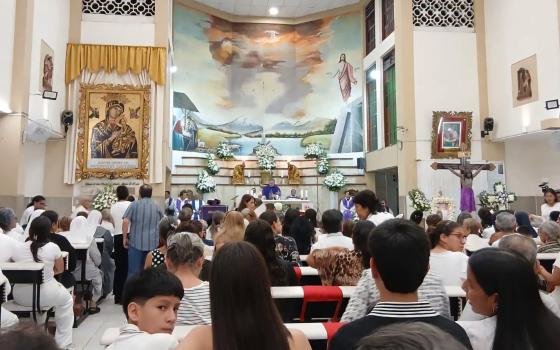
On the night of March 7, 1987, some 1,000 gay Catholics and allies crammed New York's Church of St. Francis Xavier, a Jesuit parish near Washington Square, for a final vigil before marching, lit candles in hand, several blocks through the streets of Manhattan to what is now the Lesbian, Gay, Bisexual and Transgender Community Center in the West Village. Fr. John McNeill, a gay priest who had co-founded the New York chapter of Dignity 15 years earlier, addressed the crowd.
As HIV/AIDS stole their loved ones by the thousands, LGBTQ Catholics in the 1980s had built a haven at the historic church, close to the former St. Vincent's Hospital, which operated the first AIDS ward on the East Coast. The parish offered weekly liturgies sponsored by Dignity, the national group for gay Catholics. The church filled with hundreds of people seeking community and support amid the bleakest days of the crisis.
But after the Vatican in October 1986 warned Catholic bishops not to recognize any pastoral program that challenged magisterial teaching on homosexuality, New York Cardinal John O'Connor pressed the Jesuits at St. Francis to evict Dignity from its longtime spiritual home.
"Let us leave with dignity, remembering that Christ, too, was expelled from his church," McNeill said.
The 61-year-old priest knew something about expulsions. Two months prior, he had been removed from the Society of Jesus following years of pastoral ministry to gay Catholics and public statements embracing homosexuality as a gift from God.
Fifty years after the publication of McNeill's groundbreaking book, The Church and the Homosexual, it's important to recall the former Jesuit's commitment to opening the conversation about gay Catholics, decades before Pope Francis shifted the church's tone on ministering to LGBTQ Catholics.
In its genuine concern for the spiritual and emotional well-being of gay people, the book is the cornerstone of modern pastoral ministry for LGBTQ Catholics. It is often cited as the first book-length argument from a Catholic perspective in favor of same-sex relationships.
A watershed book
McNeill had spent much of the early 1970s researching and writing his scholarly but accessible book re-examining the biblical sources, natural law tradition and cultural contexts on which Catholic doctrine prohibiting homosexual acts relies. Referencing modern psychology, emerging sociological data and McNeill's extensive pastoral interactions, the book contends that sexual activity between same-sex partners "could be morally justified if it could be expressive of genuinely constructive human love."
This was a radical statement for the time, challenging long-held views of homosexuality.
The American Psychiatric Association until 1973 considered homosexuality a form of "sexual deviation." LGBTQ people faced persistent harassment and violence from police; gay bars were subject to repeated raids by vice squads; and aversion therapy offered nausea-inducing drugs and electric shocks to "cure" homosexuality. A 1967 CBS poll found that two-thirds of Americans approached the topic of homosexuality "with disgust, discomfort or fear."
McNeill finished the manuscript in early 1974, but the Society of Jesus, then led by Fr. Pedro Arrupe, stalled its publication until the text was approved by a committee of scholars and theologians.
After the theological commission greenlit the manuscript, it was sent to Rome to be studied by another round of scholars. Its publication was further delayed by the 1975 release of Persona Humana, a Vatican declaration on sexual ethics that chided society's "unbridled exaltation of sex" and stated that "homosexual acts are intrinsically disordered."
After numerous edits, including notations on where McNeill deviated from church teaching, his Jesuit provincial superior, Fr. Eamon Taylor, granted the imprimi potest ("it can be printed") in January 1976. The book was published seven months later.
"It was a watershed book," Loretto Sr. Jeannine Gramick, co-founder of New Ways Ministry, told the National Catholic Reporter. "It presented this historical development of the church on sexual ethics, and it presented why the current teaching about the intrinsic immorality of same-sex behavior could be challenged."
Fr. William Hart McNichols — a Catholic iconographer, openly gay priest and former Jesuit — said he bought the book "right away" as a 27-year-old student at the former Weston Jesuit School of Theology in Cambridge, Massachusetts.
"It laid the groundwork for anybody to do any kind of [LGBTQ] ministry," he said in an interview. "I don't remember anyone being very negative about it."
The book pushed its 50-year-old author into the media spotlight with appearances on "Today" and "The Phil Donahue Show." The New York Times predicted the book would spark "considerable debate on the causes and morality of homosexuality."
Expulsion
But McNeill's fortunes declined sharply in the summer of 1977, one year after the book was published, when the Vatican barred him from writing or speaking publicly on homosexuality and directed him to ask his publisher to remove the imprimi potest.
The silencing came one week before he was scheduled to speak at the Dignity convention in Chicago. McNeill opted to obey Rome's instruction and not address the conference. "At the same time," he later wrote, "I decided to enter into a process of prayer and discernment to try to discover what God's Spirit wanted me to do."
Jesuit Fr. Daniel Berrigan, the poet and peace activist, published a full-throated defense of McNeill in Commonweal magazine. In an article titled "The Leveling of John McNeill," he wrote:
The Jesuit McNeill, on the threshold of distinction, an expert in ethics, a man well loved, held in respect — such a one begins speaking up on behalf of — homosexuals. … He takes a few of these people by the hand, and leads them into the very center of the circle, the circle let us say, of worship, of brother- and sisterhood. … In Christ, he says, there is neither hetero nor homo, but one Body, His own.
Two years later, in 1979, McNeill addressed some 600 people as the keynote speaker at the Dignity convention in San Diego. There he struck a balance between what he could not say, in obedience to Rome, and what he would continue to say. His speech, according to an NCR article, focused on the accomplishments of Dignity, the group he had co-founded, as "a means for the gay Catholic community to support one another openly."
Advertisement
While he agreed to refrain from public commentary on homosexuality, McNeill chose to continue leading pastoral ministry efforts with the gay community and counseling people through his psychotherapy practice in New York at the former Institutes of Religion and Health, an interfaith center that trained clergy in therapy.
But he changed his mind in October 1986 after the Congregation for the Doctrine of the Faith released a letter to Catholic bishops that has since been dubbed the "Halloween Letter."
The document chastised gay "pressure groups" that worked to change Catholic doctrine, stated that same-sex desires were inherently "self-indulgent," claimed that the idea of expressing gay love through sex threatened the rights of the family, suggested that violence could be reasonably expected to occur in response to pro-gay civil rights legislation and blamed gay activists for endangering public health during the AIDS epidemic.
The result was devastating: Hundreds of people left Dignity, either joining non-Catholic faith groups or leaving religion entirely.
By the end of 1986, more than 24,000 people had died of AIDS in the United States.
Warned that he would face expulsion from the Jesuits, McNeill nevertheless decried the CDF letter as "cruel." He issued a critical statement on Nov. 7, 1986, to The New York Times and the National Catholic Reporter.
In January 1987, he received word of his expulsion. The final decree was issued in April.
Gramick remembers the pain and disappointment of McNeill's expulsion. "He was a prophet, and prophets always have to suffer," she said. "It was not a mark of honor for the Jesuits to expel him. They did not stand up for him, as I believe they should have."
Mary Hunt, a feminist theologian who preached retreats with McNeill at Kirkridge, in the Pocono Mountains, said the Jesuits owe him an apology.
The USA East Province of the Jesuits did not respond to NCR's request for comment.
McNeill in his autobiography wrote that the West Side Jesuit Community, where he lived in Manhattan, stood by him, publishing a joint statement that removing "S.J." from his name "will not strike him from our hearts as a brother in Christ."
"I am still a priest and loyal Catholic," McNeill, who remained a priest but could not practice public ministry, wrote. "And I shall always be a Jesuit in spirit and feel a special bond of love and respect for the Society of Jesus."
'An active willingness to hear'
In 2013, two years before McNeill's death at age 90, the church installed the first Jesuit pope.
From the start of his pontificate, Pope Francis initiated a dramatic shift in the church's attitudes toward LGBTQ people without altering doctrine. Through private and public gestures and off-the-cuff remarks ("Who am I to judge?") that shocked and delighted LGBTQ Catholics, the unconventional pope transformed the pastoral posture of the global church to emphasize mercy and inclusivity before, but not instead of, moral judgments and doctrinal statements on sexual ethics.
Promoting "the culture of encounter," Francis met with representatives from both New Ways and Dignity, transgender sex workers and a gay survivor of clergy sexual abuse the pope would befriend. Francis also met several times with Jesuit Fr. James Martin, founder of Outreach, an LGBTQ ministry launched by America Media in 2022.
It is hard to imagine these developments in the church and the Jesuits without the decades-long efforts of an unflagging priest who stepped outside the bounds of magisterial teaching and endeavored to improve Catholic perspectives on LGBTQ people at significant personal cost. He was a priest who prioritized the marginalized, worked to erase divisions and pioneered a church rooted in the recognition of Christ in others; a priest who led LGBTQ Catholics, in the words of Daniel Berrigan, "into the very center of the circle." Or, as Francis said, a church open to "todos, todos, todos."