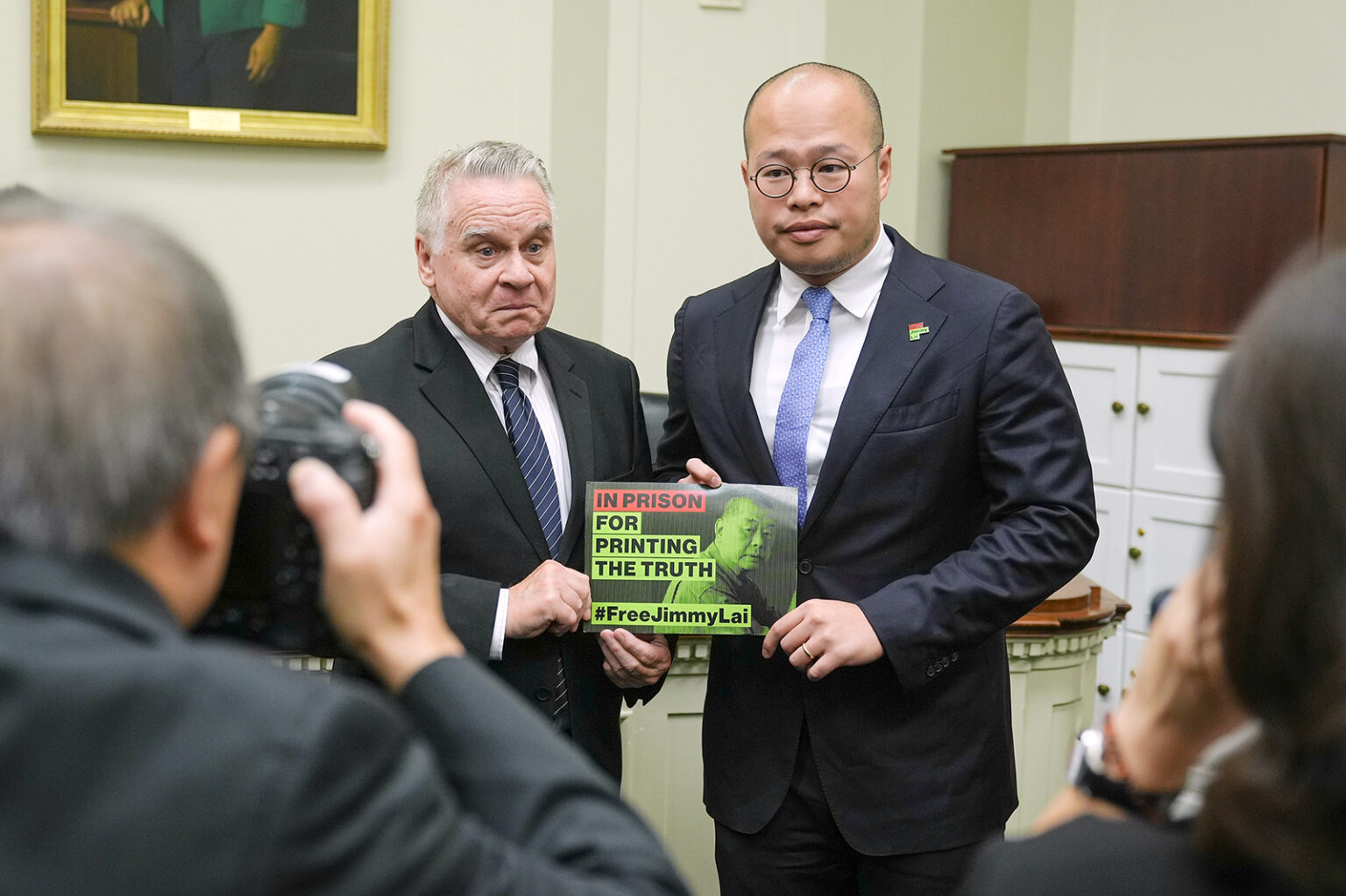
Sebastien Lai, right, and Rep. Chris Smith, R-N.J., pose for a photo after a Congressional Executive Commission on China regarding the continued imprisonment of his father Jimmy Lai on Capitol Hill, Wednesday, Sept. 16, 2026, in Washington. (AP/Mariam Zuhaib)

Aleja Hertzler-McCain

Religion News Service
Join the Conversation
Send your thoughts to Letters to the Editor. Learn more
As he visited Washington on Wednesday (Sept. 16) to testify before the Congressional-Executive Commission on China about his father's imprisonment in Hong Kong, Sebastien Lai said the Vatican could play a more vocal role to help his father, journalist Jimmy Lai.
" It would definitely help for the pope to say my father's name," Sebastien Lai said at an event for journalists organized by Georgetown University's Initiative on Catholic Social Thought and Public Life. " The head of the Catholic faith has incredible moral power, especially in a case where it concerns a Catholic," he said.
Earlier this year, a Hong Kong court sentenced 78-year-old Jimmy Lai to 20 years in prison after he was convicted of violating a national security law imposed by the government in Beijing. Lai, a critic of the Chinese government, had founded a pro-democracy newspaper, Apple Daily. Its leaders said it was forced to shut down after government pressure in 2021.
Sebastien Lai said that his father's health is deteriorating after nearly six years in solitary confinement. " He now has heart issues. His nails fall off. His teeth are rotting. During the summer, the heat, he bleeds all over his body because of his rashes" because "he's essentially baking in his cell," said Lai of his father, who is diabetic.
After public outcry, Jimmy Lai is now "sporadically" able to receive Communion, though at first authorities claimed it would not be possible while he was in solitary confinement, Sebastien Lai said.
The Chinese government didn't immediately respond to a request for comment.
Relations between the Catholic Church and China have been fraught, historically, and there are no formal diplomatic relations between the two sides. No pope has ever set foot on Chinese soil. For decades, Chinese Catholics have been divided between state-recognized communities overseen by the government-controlled Chinese Catholic Patriotic Association and an "underground" church whose bishops, priests and faithful remained faithful to Rome, often at risk of persecution.
Meanwhile, China appointed its own party-approved bishops to lead the official Catholic church in the country.
But as China's global influence grew and Catholics continued to face restrictions, the Vatican sought to secure a deal with the Chinese government. The Sino-Vatican deal, signed under Pope Francis in 2018, was presented as an effort to begin a dialogue with China and unite the underground church and the official church.
Advertisement
Critics condemned the agreement as muzzling the Vatican's ability to call out human rights violations by the Chinese government and a betrayal of the underground church. Although its terms remain secret, the agreement is believed to give Beijing a significant role in the appointment of bishops in China by offering a list of candidates to the Vatican while reserving final approval for the pope.
" The Vatican has a very complicated relationship with China, but in the end, we look to the pope as a compass," said Sebastien Lai. " If you look at my father's case, it's very black and white," he argued.
In a 2025 interview with Elise Ann Allen of Crux, Pope Leo XIV signaled continuity with Francis' China policy "in the short term," but he left open the possibility of future changes to the agreement as he consulted Chinese Catholics "on both sides."
So far, 18 Chinese bishops have been ordained since the agreement was signed, with four of them being appointed by Leo this summer. The bishop of Hong Kong, Cardinal Stephen Chow Sau-yan, said in a homily in May that while the deal "has not achieved very ideal results," the "mutual understanding between both sides is increasing."