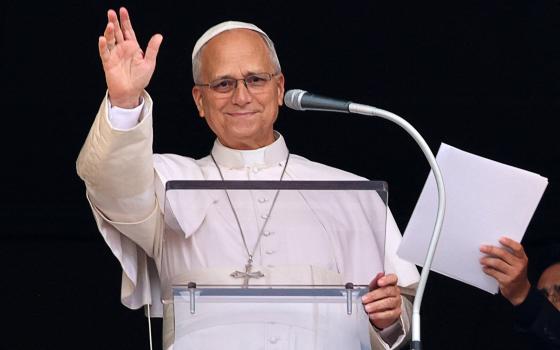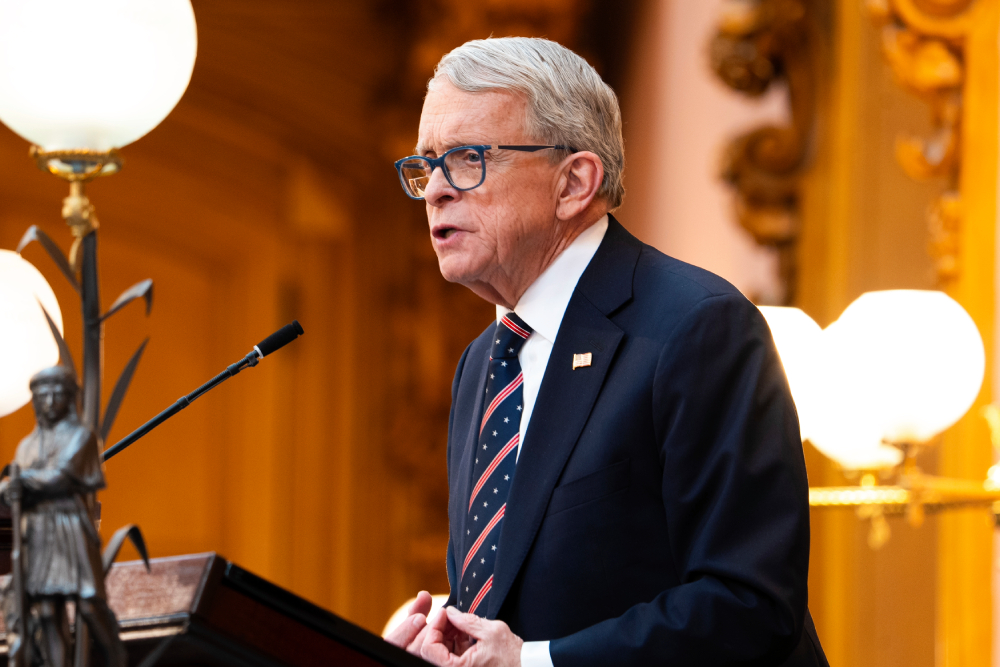
Ohio Gov. Mike DeWine gives the State of the State address in the Ohio House chambers at the Ohio Statehouse on Wednesday, March 12, 2025, in Columbus, Ohio. (AP/The Columbus Dispatch/Pool/Samantha Madar)

by Peter Feuerherd
Join the Conversation
Send your thoughts to Letters to the Editor. Learn more
Gov. Mike DeWine, the other Catholic politician from Ohio, beyond Vice President JD Vance, is a non-household name beyond the Buckeye State.
DeWine, a Republican, has supported Catholic social teaching on contentious issues such as the death penalty and immigration, bucking the consensus of his party.
Governor since 2019, DeWine is a career politician, an unpopular label these days. First elected as a Reagan Republican to the U.S. House in 1984, he weathered the tumult of the President Donald Trump era, carefully keeping the Republican brand while distancing himself at times from MAGA orthodoxy.
DeWine might well be the Republican anti-Trump. Unlike the president, he is relatively short in physical stature at around five feet eight inches tall, soft-spoken, with a style that seeks to persuade rather than incite. He rarely picks fights. He won re-election handily in 2022 with over 62% of the vote, but as he exits office due to term limits his approval rating in Ohio stands at 26%, according to an Emerson poll.
"While he supports Donald Trump, there have been times he was not on board, particularly in his rhetoric and style," noted Christopher Devine, a political science professor at the University of Dayton who has followed DeWine's career.
The Ohio governor has staked out positions sometimes at odds with the national party. During the COVID-19 pandemic, DeWine endorsed restrictions opposed by more high-profile Republican governors, such as Ron DeSantis of Florida.
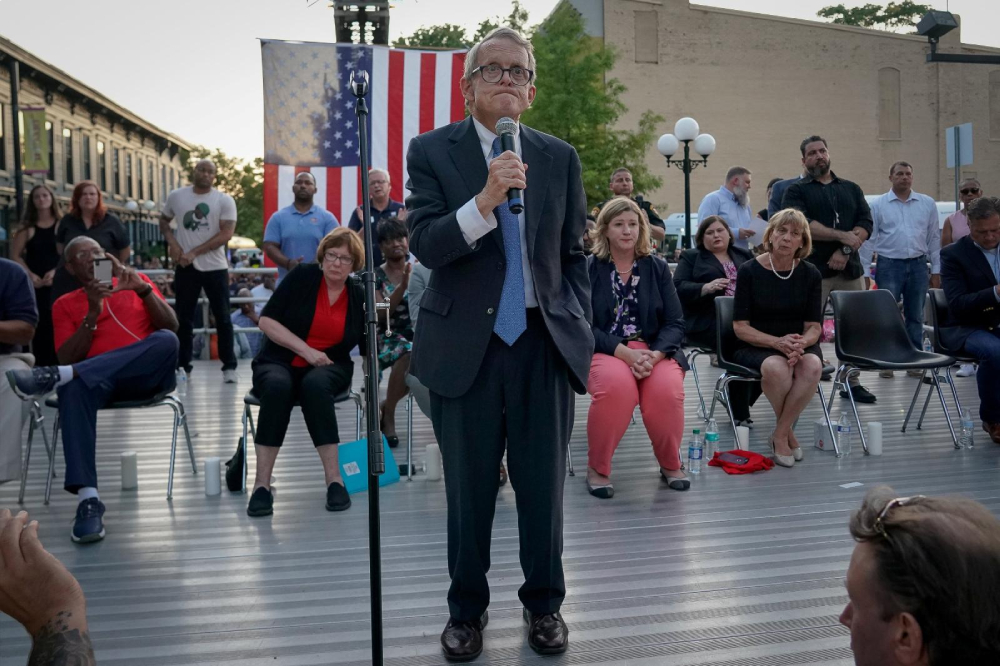
Ohio Gov. Mike DeWine in Dayton in 2019. (OSV News/Reuters/Bryan Woolston)
While Trump's falsehoods about Haitian refugees eating pets in Springfield, Ohio, caught national attention during a 2024 presidential debate, DeWine defended the newcomers, even as Trump's attacks on the Haitians were repeated by the vice president.
In an op-ed published in the New York Times Aug. 10, DeWine defended the Haitians in Springfield, who are now threatened by the Trump administration's removal of temporary protected status, an action that could trigger thousands of deportations to their poverty-stricken and dangerous home country.
In the article, DeWine repeated what he has said ever since the Haitians, who now number over 10,000 in a city of about 60,000 residents and counting according to estimates, came to Springfield. He wrote that the refugees, who came to Ohio legally, are a boost to the region's economy by filling jobs and paying taxes.
"Haitian nationals have played a major role in the city's economic comeback," wrote DeWine, a cradle Catholic who referenced his Irish immigrant ancestors who settled in Yellow Springs, Ohio, in the 19th century. The small town is a tiny liberal-minded community 10 miles from Springfield, a blue Democratic dot in Ohio's Republican swing in recent elections.
In the Times piece, DeWine left an olive branch for the president, arguing that only Trump could provide the leadership to reform the immigration system, much like it took an anti-communist like President Richard M. Nixon to open U.S.-China relations in the 1970s. "We need sensible laws about who can live in the U.S. The president can get them passed," DeWine wrote.
Unlike Vance — a Catholic convert known to tangle publicly with two popes on issues such as immigration and the obligation of Catholics towards the wider community — DeWine largely supports official church stances.
While nearing the end of his second term, DeWine, 79, is barred from running for a third term by the state constitution. Toward the apparent end of his public life, DeWine remains outspoken on issues with a moral dimension as a new governor will take office in January.
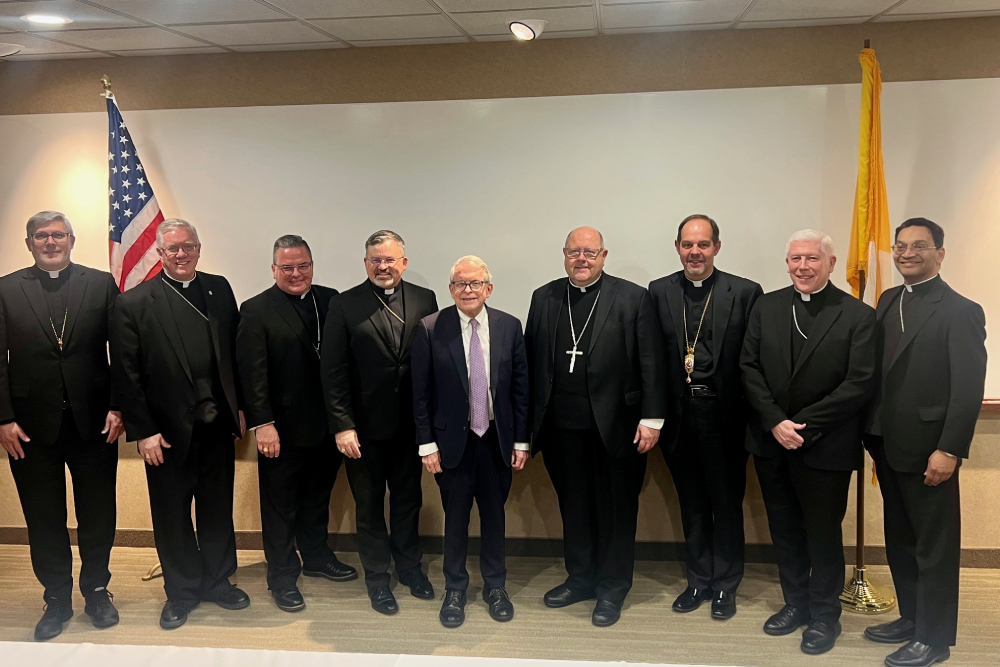
Ohio Gov. Mike DeWine is pictured with Ohio bishops, March 2026. (Courtesy of Ohio Catholic Conference)
Brian Hickey, executive director of the Ohio Catholic Conference, the public policy arm for the state's bishops, said the governor's positions on the death penalty and immigration go beyond a
burst of moral decision-making as he leaves the governor's mansion in Columbus and no longer needs to worry about facing the voters.
"We've been speaking with him about immigration issues and the death penalty in almost every meeting since he has been governor. Over the past few years, that included extra communication with him and his staff on the Haitian population and ensuring they received the support necessary to integrate into Ohio's communities," Hickey said.
He said the governor aligned with the state's bishops on other issues, including child tax credits, anti-abortion legislation, and support for low-income families with children in Catholic schools. DeWine also allied with the bishops in opposing increased gambling access.
Hickey credited the governor for fighting the backlash against Ohio's Haitians. Ohio's bishops have argued against narratives that the presence of the Haitians is to blame for crime, joblessness for native Ohioans, and rising costs.
"DeWine has provided true leadership in combating those narratives and speaking out about their contributions to the common good and the reality they would face in Haiti," Hickey said, adding that DeWine has "worked hard with local officials to ensure native community members and newcomers receive the support they need."
Hickey said the governor does not share his Catholic faith publicly but said it is "reflected in many of his comments and actions."
DeWine did not respond to requests for an interview by NCR and hasn't expounded in detail about how his faith affects his politics, preferring to couch his political stances in the language of practical concern about Ohio's economy and criminal justice system. DeWine and his wife Frances, the parents of eight, are a regular presence at Catholic Masses around the state.
Advertisement
Unlike Vance, DeWine doesn't quote St. Augustine and other church thinkers. Catholic teaching is rarely, if ever, invoked in his public statements. "The impact is implicit rather than explicit," Devine, the University of Dayton politics professor, said.
On the death penalty, the Ohio governor, a former state attorney general and prosecutor, changed his stance from support to opposition, arguing it is no longer an effective crime deterrent. DeWine refused to sanction executions during his tenure as governor.
In a statement outlining his opposition to the death penalty, DeWine argued for legal protections for life in Ohio, from pre-birth to natural death, a view that echoes Catholic teaching from the popes to the state bishops.
Divine Providence Sr. Alice Gerdeman, a member of the Congregation of Divine Providence in Melbourne, Kentucky, and the Ohio Sisters Justice Network and a longtime advocate for immigrants and death row inmates, credited DeWine for keeping his promise not to execute any of the 113 Ohio Death Row inmates on death row. But she noted that he has backed away from a full commutation of inmates' planned executions.
Still, on the death penalty and refugee issues, the governor remains largely in accord with the state's bishops, and Gerdeman, for one, believes that stems from his faith.