An American flag flies with a pride flag outside of a home in Wilton Manors, Fla., Thursday, June 29, 2023. (AP photo/Lynne Sladky)

Join the Conversation
Send your thoughts to Letters to the Editor. Learn more
Editor's note: Infographics from the Public Religion Research Institute, based on data from the PRRI American Values Atlas, 2015 and 2025, are included in the story below. To view a full-size image of each graphic, click its thumbnail image.
A new national survey from the Public Religion Research Institute (PRRI) finds that LGBTQ Americans are younger, more likely to identify as Democrats and liberals and far more likely to be religiously unaffiliated than the general population, while broad public support for LGBTQ rights remains strong but uneven across political, religious and geographic lines.
The report, released on March 19 and based on interviews with more than 22,000 Americans, offers one of the most detailed snapshots of how attitudes toward LGBTQ issues have evolved over the past decade. It also highlights emerging divisions — particularly by party affiliation, age and views tied to religion and Christian nationalism.
One in ten Americans identify as LGBTQ, the report notes, with the share rising sharply among younger generations. Twenty percent of Americans ages 18 to 29 identify as LGBTQ, compared with 11% among those 30 to 49, 5% among those 50 to 64, and 4% among those 65 and older.
The demographic profile of LGBTQ Americans also differs significantly from the population at large. According to the survey, 40% identify as Democrats, compared with 28% of all Americans, and 51% describe themselves as politically liberal — nearly double the national share of 26%. A majority, 51%, are religiously unaffiliated, compared with 27% of Americans overall.
Melissa Deckman, CEO of Public Religion Research Institute, said the findings are part of a broader, long-running effort to track American attitudes.
The institute has focused in particular on three questions: nondiscrimination protections, same-sex marriage and religiously based service refusals. The large sample size, Deckman said, allows for a more detailed breakdown across religious groups than most surveys.
Broad support, with divisions
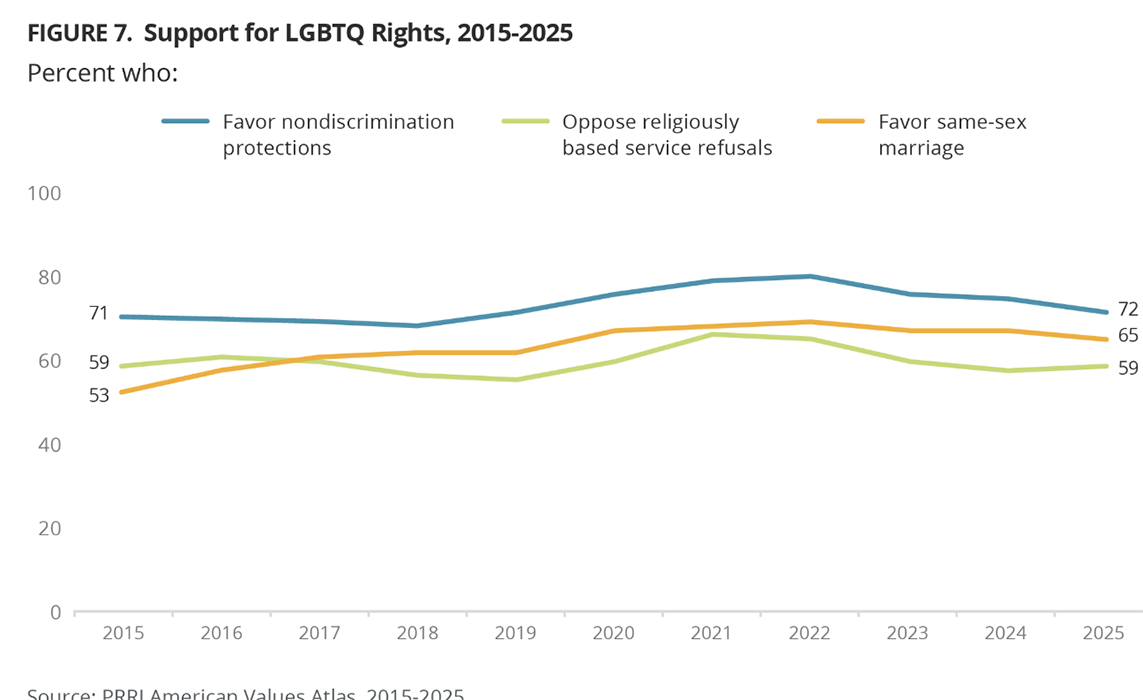
Across the country, support for LGBTQ rights remains widespread, especially for nondiscrimination protections. The survey finds that 72% of Americans support such protections, including 90% of Democrats, 76% of independents and 56% of Republicans.
Support is also strong among most religious groups, with particularly high levels among the religiously unaffiliated and non-Christians. Even among people of faith, majorities back protections for LGBTQ individuals.
At the same time, the report underscores that views are far from uniform. State-level differences are pronounced. Massachusetts, Maryland, Alaska, and the District of Columbia show some of the highest levels of support for nondiscrimination protections, while Mississippi, Wyoming and Arkansas rank among the lowest.
Similar geographic divides appear on other issues, including same-sex marriage and religiously based service refusals.
Same-sex marriage and religious refusals
Support for same-sex marriage remains higher than a decade ago, at 65% nationally, compared with 53% in 2015. Democrats and independents show strong support — 83% and 69%, respectively — while Republicans remain divided, with 49% in favor.
Only two states, Mississippi and Arkansas, fall short of majority support for same-sex marriage.
Opposition to allowing businesses to refuse service to LGBTQ people on religious grounds stands at 59% overall. Here again, the partisan divide is clear: 82% of Democrats oppose such refusals, compared with 60% of independents and 35% of Republicans.
Deckman said these questions reflect longstanding tensions between religious freedom claims and civil rights protections.
Religion and internal differences
The report highlights significant variation within religious communities, particularly among Christians. While majorities of most groups support nondiscrimination protections and same-sex marriage, levels of support differ by denomination and racial composition.
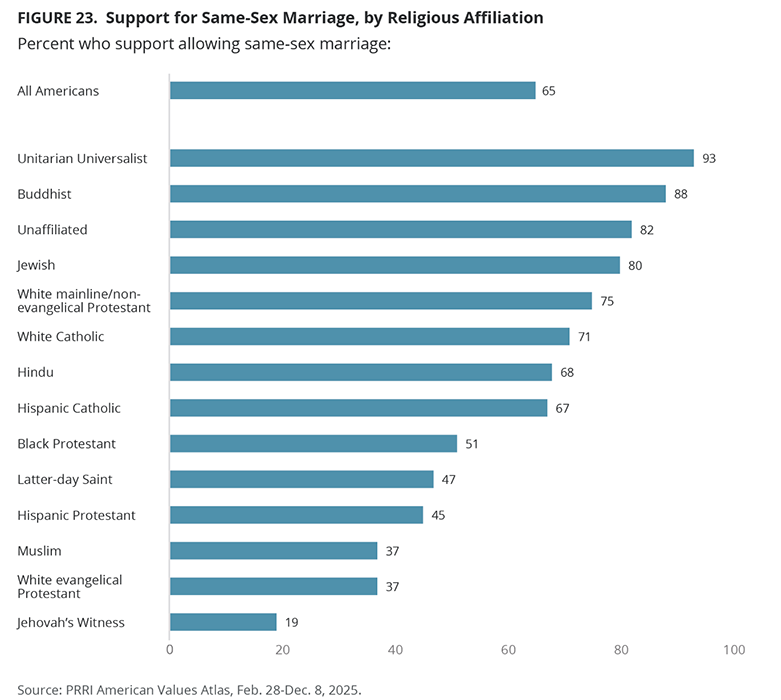
Majorities across all religious groups support nondiscrimination laws for LGBTQ people, with the highest levels among the religiously unaffiliated (82% and non-Christians (79%), followed by Christians of color (71%) and white Christians (66%).
Support has fluctuated over time: among white Christians, it rose from 67% in 2015 to 76% in 2022 before declining to 66% in 2025. A similar pattern appears among Christians of color, whose support dropped from a 78% peak in 2022 to 71%.
Within religious subgroups, notable differences persist. White evangelical Protestants are the least likely among white Christians to support nondiscrimination protections (54%), compared with 74% of both white mainline Protestants and white Catholics, while 67% of Latter-day Saints express support. Among Christians of color, Hispanic Protestants show the lowest support (59%), compared with 73% of Black Protestants and 77% of Hispanic Catholics.
Attitudes also diverge sharply around religiously based refusals. Among white Christians, white evangelical Protestants (31%) and Latter-day Saints (44%) are the least likely to oppose allowing businesses to refuse service to LGBTQ people on religious grounds, compared with 55% of white mainline Protestants and 56% of white Catholics.
Among Catholics, support for LGBTQ rights reflects broader trends but also internal diversity.
"I think one thing that comes from these reports year after year is that there is no monolithic position on LGBTQ rights," Deckman said. "And in fact, we find among most Americans of faith, there's broad support for nondiscrimination protections and marriage equality."
She noted that attitudes among Catholics have evolved over time, shaped both by broader social changes and by shifts within the Church.
"I think the official church doctrine is one that opposes marriage equality for gays and lesbians," she said. "But I do think it's notable that with Pope Francis, and by all accounts with Pope Leo, although he's relatively new in the papacy, you do see that there's been a softening of support toward LGBTQ Americans in a lot of ways."
Deckman added that personal relationships also play a role.
"We've seen an increase in support for rights for LGBTQ Americans to same-sex marriage, in part because many Americans, including Catholics, have family members or have friends who are LGBTQ, and that has led to a growing number of level of support for rights for LGBTQ Americans, writ large Catholics included in that," she said.
Differences also emerge between white Catholics and Hispanic Catholics, though they are less pronounced on LGBTQ issues than on topics such as immigration. Hispanic Catholics tend to be somewhat more supportive, a pattern Deckman attributes in part to shared experiences of marginalization.
Advertisement
Transgender rights: broad support, specific divisions
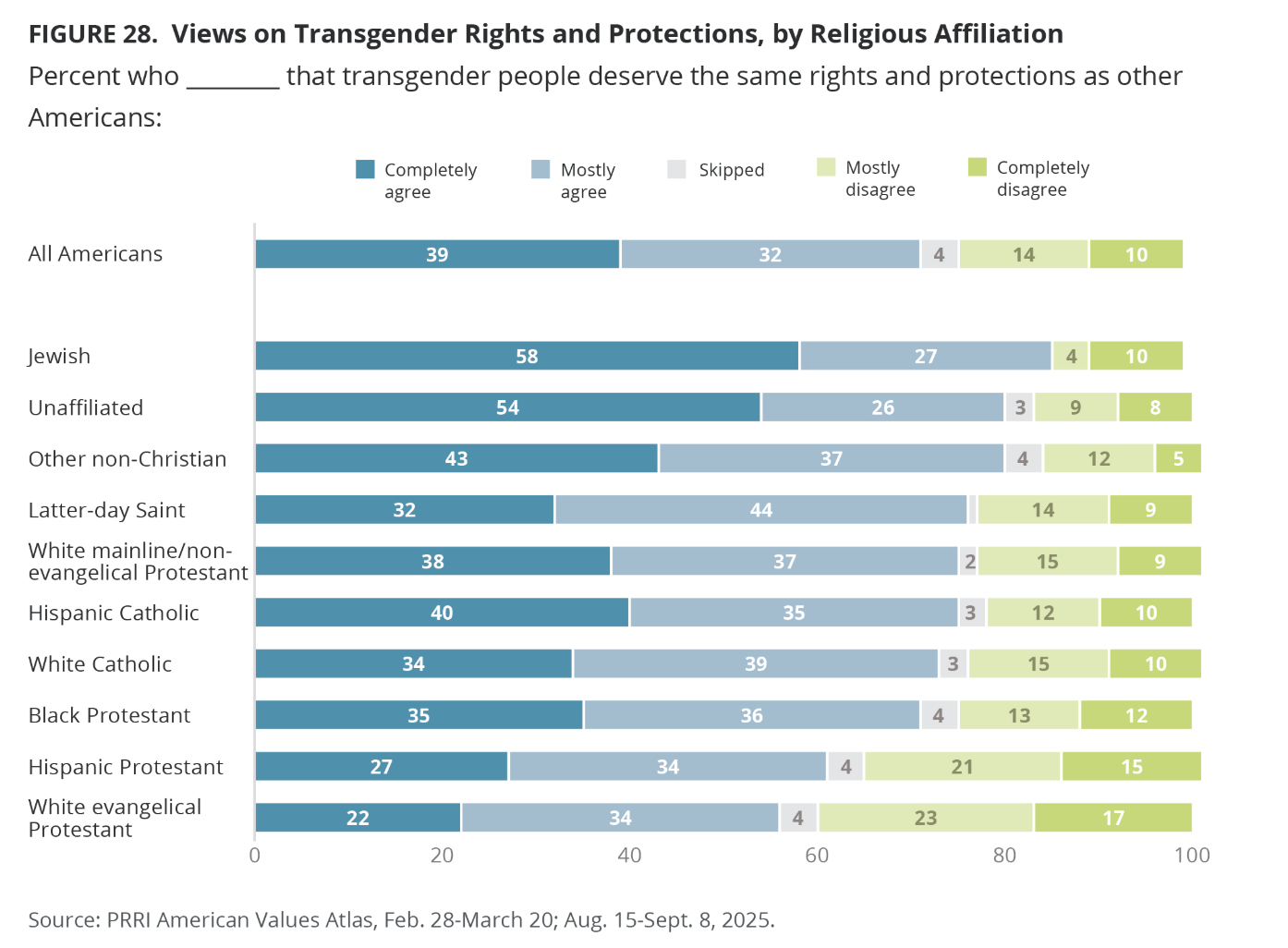
One of the most complex findings in the report concerns attitudes toward transgender Americans. A large majority — 71 % — agree that transgender people "deserve the same rights and protections as other Americans." This view is held by 88% of Democrats, 77% of independents, and 57% of Republicans.
Solid majorities also across nearly all religious groups say that transgender Americans should receive the same rights and protections as others. Support is highest among Jewish Americans (85%), members of other non-Christian religions (80%), and the religiously unaffiliated (80%).
It remains strong, though somewhat lower, across many Christian groups, including Latter-day Saints (76%), Hispanic Catholics (75%), white mainline or non-evangelical Protestants (75%), white Catholics (73%), and Black Protestants (71%). Smaller majorities of Hispanic Protestants (61%) and white evangelical Protestants (56%) also express agreement, reflecting a broad — if uneven — consensus across religious traditions.
A sharper divide emerges when these views are examined through the framework of Christian nationalism. Among adherents, only 40% agree that transgender people deserve equal rights and protections, a figure that rises to 60% among sympathizers, 76% among skeptics, and 92% among those who reject Christian nationalism.
At the same time, a majority of Americans — 56% — support laws requiring transgender individuals to use bathrooms corresponding to their sex assigned at birth. White Christians (67%) and Christians of color (61%) are more likely than non-Christians (45%) and unaffiliated Americans (38%) to support laws requiring transgender individuals to use bathrooms corresponding to their sex at birth rather than their gender identity.
Within these groups, white evangelical Protestants (78%) report the highest levels of support, followed by white Catholics (62%) and white mainline Protestants (60%).
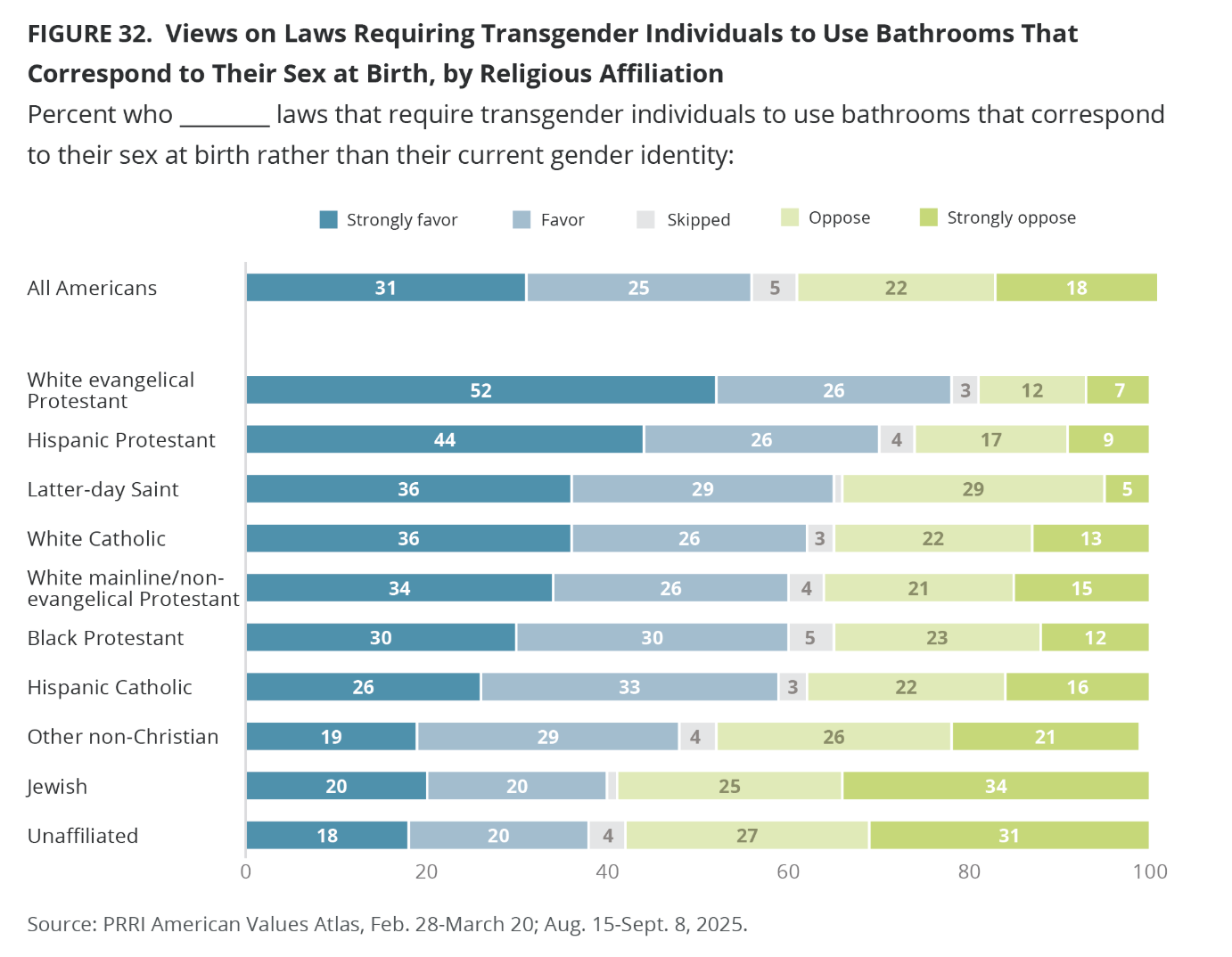
Deckman said this apparent contradiction reflects the difference between general principles and specific policies.
"I think in some ways the devil is always in the details," she said. "When you ask about the specific policy concerning transgender Americans, there tends to be less support for those rights, and so the bathroom bills are a great example."
She pointed to a shift over the past decade, driven largely by political dynamics.
"In reality, the last couple of years, you've seen within the Republican Party a clear targeted attempt to limit the rights of transgender Americans," she said. "And so I think the larger political context, especially for Republicans, has been one where transgender issues and transgender rights, from their perspective, have gone too far."
The result, she said, is increasing polarization.
Generational shifts
While younger Americans are more likely to identify as LGBTQ, the report finds some signs of declining support for certain LGBTQ protections among younger cohorts, particularly young Republicans.
Support for nondiscrimination protections among Americans ages 18 to 29 has fallen from 80% in 2015 to 70% in 2025. Among young Republicans, the decline is sharper, dropping from 74% to 50%.
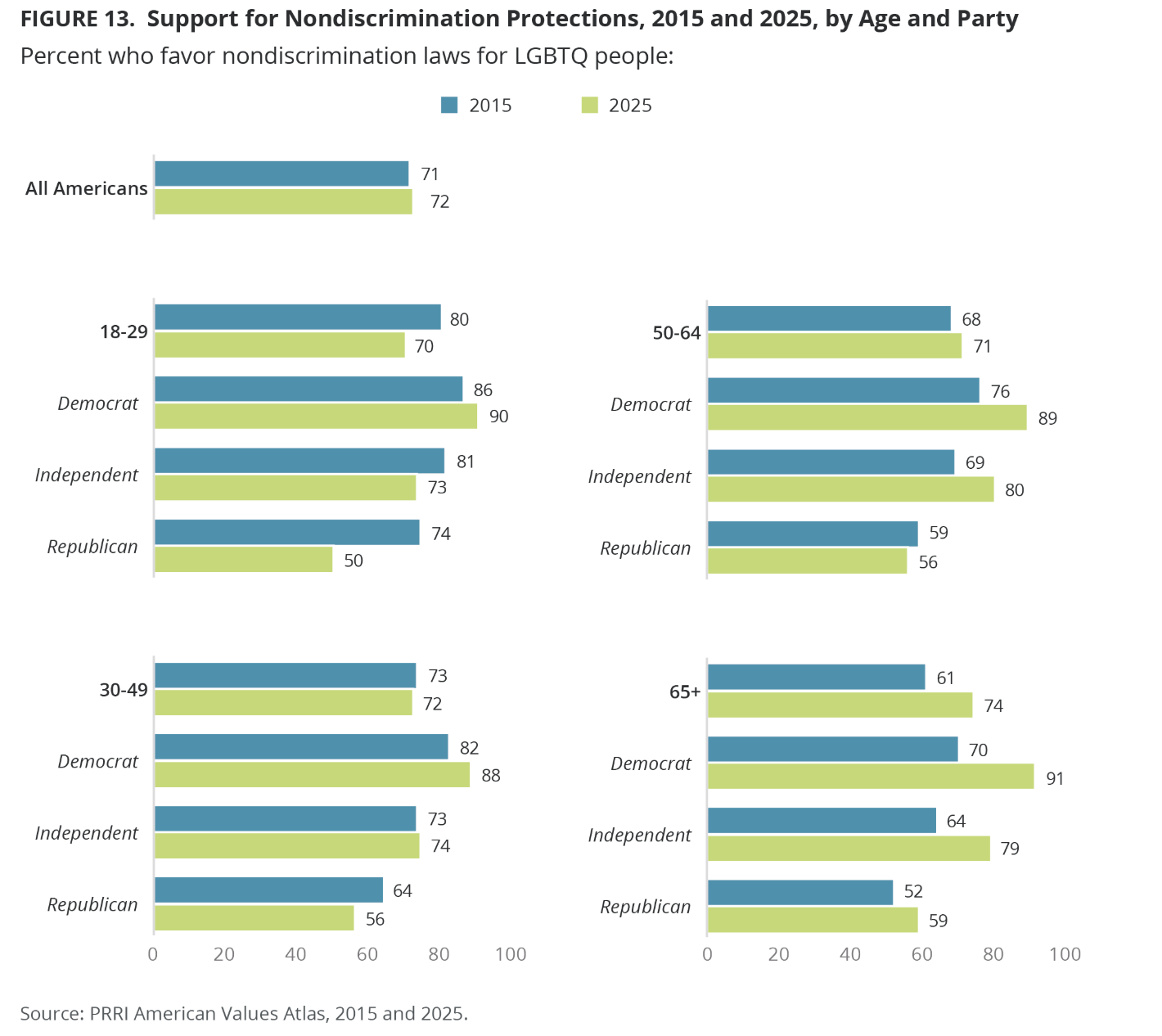
"That was, to me, a very striking finding," Deckman said. "I had the team go back and look at what young Republicans felt a decade ago on non discrimination — just plummeting right to a little bit more than half."
The shift challenges earlier assumptions that younger generations would steadily drive more liberal attitudes within the Republican Party.
"I think a decade ago, the thought that younger Republicans would be a moderating influence on the party overall, that's really not been the case at all," she told the National Catholic Reporter.
Instead, she added, those who remain in the party appear more conservative.
"Those that are staying, I think, are more conservative when it comes to a range of issues, whether it's reproductive rights or whether it's, as you see here, nondiscrimination or LGBTQ rights," Deckman said.