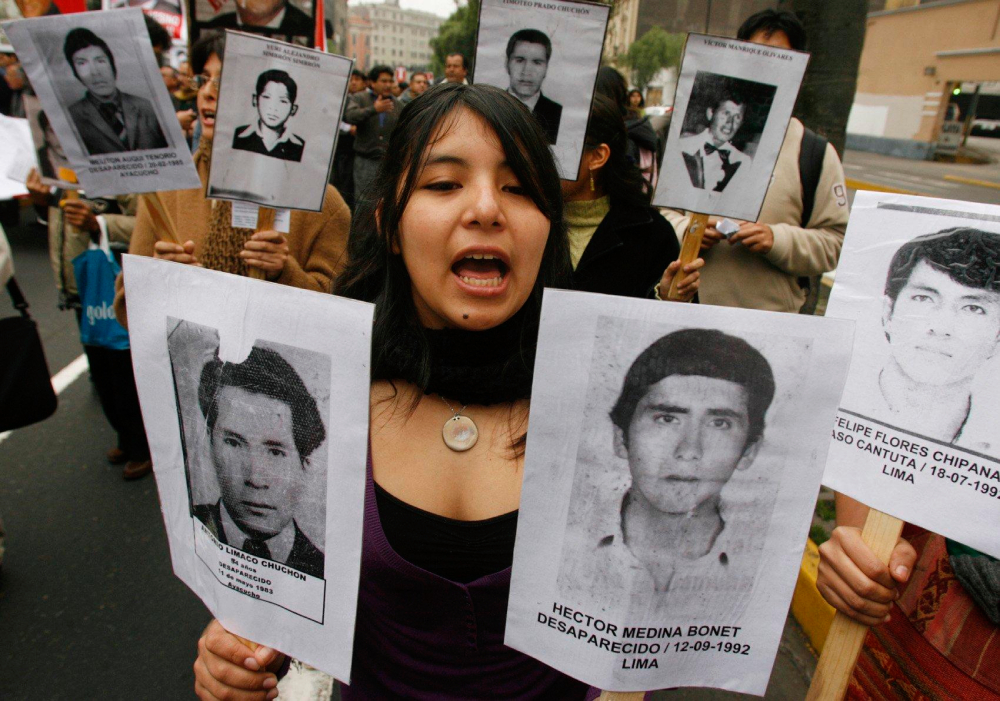
During a march in Lima, Peru, Sept. 27, 2007, a woman carries pictures of people murdered during the term of former Peruvian President Alberto Fujimori. Chile extradited Fujimori Sept. 22, 2007, paving the way for a trial in Peru. (CNS/Reuters/Pilar Olivares)
by Eduardo Campos Lima
Join the Conversation
Send your thoughts to Letters to the Editor. Learn more
A group of Peruvian bishops released a public letter this fall condemning the approval of a law giving amnesty to military and police agents who perpetrated crimes against humanity between 1980-2000.
The law exempts armed state officers who "took part in the fight against terrorism" from legal responsibility during the years when the communist groups Sendero Luminoso (Shining Path) and Túpac Amaru Revolutionary Movement waged guerrilla warfare against the Peruvian government.
While the Commission of Truth and Reconciliation that studied that period's violence between 2001-2003 concluded that most deaths and disappearances were caused by Sendero Luminoso (about 54% of the 69,280 victims), the participation of the armed forces was also significant, resulting in 20,000 victims.
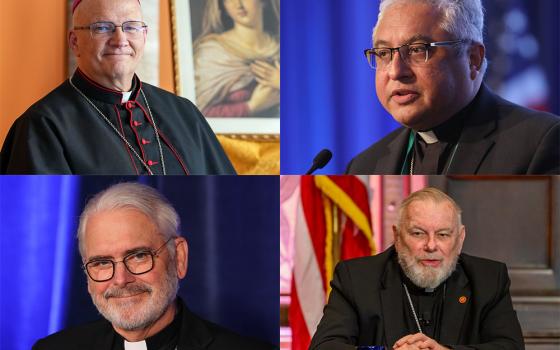
Twelve bishops signed the document against this amnesty in September, including Cardinal Carlos Castillo, archbishop of Lima and Cardinal Pedro Barreto, archbishop emeritus of Huancayo and president of the Ecclesial Conference of the Amazon.
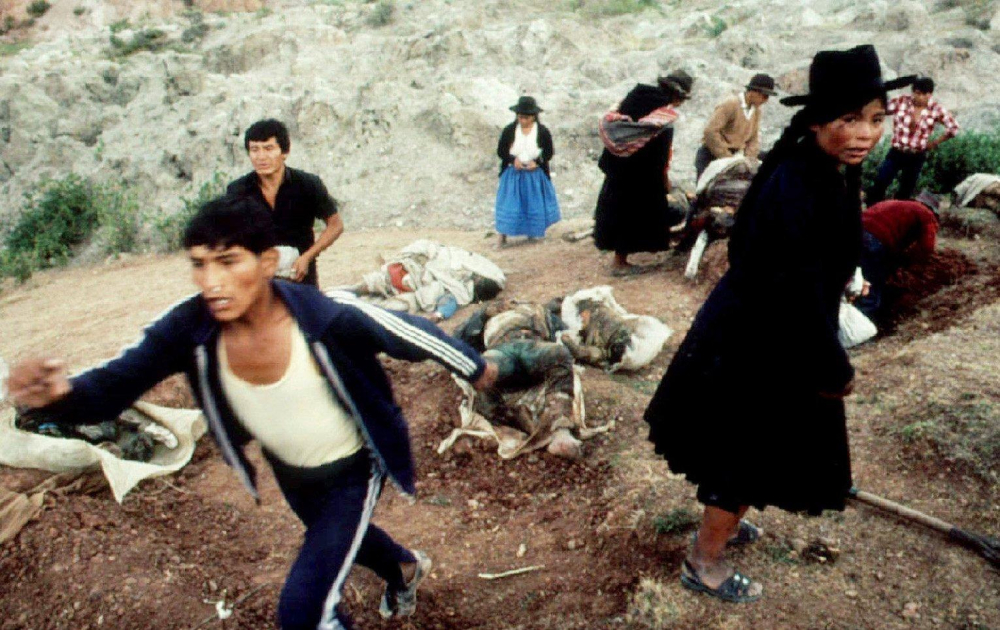
A bride turns away from a mass grave in the rural village of Soccos, Peru, in this file photo from 1983. Gunmen from the Maoist Shining Path murdered the bridegroom and all the guests at the wedding as part of their war against the Peruvian government that began in 1980. In 2003, Peru's Truth and Reconciliation Commission found that 69,000 people died in two decades of rebel and state-sponsored violence that ripped apart the Andean nation. (CNS/Reuters)
In the letter, the bishops say they "consider this law to be contrary to justice, as it encourages impunity for crimes against humanity, including forced disappearances, extrajudicial executions, rape, and torture."
The signatories emphasized that, according to the Commission of Truth and Reconciliation, Sendero Luminoso was the major perpetrator of these crimes and human rights violations. But they lamented that, in the context of war, "some among those who had the duty of taking care of their brothers put aside their responsibility and responded to the barbarity of terrorism with equal barbarity."
"[We] are seriously concerned that, while each case of those who committed crimes can be studied on the basis of age, an amnesty has become widespread, potentially allowing impunity for those who have committed crimes," the statement read.
They also asked all Peruvian judges "who have in their hands the possibility of establishing a form of control over that rule," not to apply such a law.
The approval of the Amnesty Act by the Congress and by then-President Dina Boluarte has especially impacted the families of the victims of massacres perpetrated by the state against civilian victims.
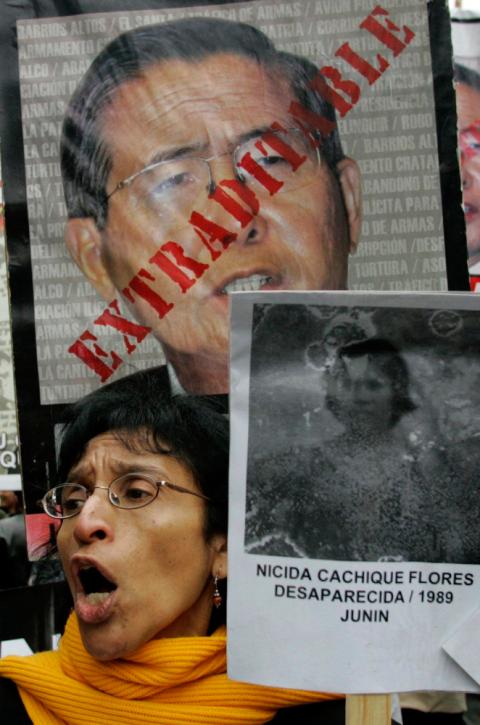
During a march in Lima, Peru, Sept. 27, 2007, a woman carries a picture of a victim murdered during the term of former Peruvian President Alberto Fujimori. Chile extradited Fujimori Sept. 22, 2007, paving the way for a trial in Peru. (CNS/Reuters/Enrique Castro-Mendivil)
That's the case with Carmen Amaro, whose brother, Armando Amaro, was a victim of the La Cantuta massacre. In 1992, a professor and nine students of the National University of Education Enrique Guzmán y Valle, known as La Cantuta, in Lima, were kidnapped, murdered and their bodies were thrown into a mass grave. Their remains were later exhumed and destroyed.
"He was 25 and studied electronics. He lived on campus in order to spend less money. Our family was poor," Amaro told the National Catholic Reporter.
Armando was captured by Grupo Colina (hill group), an elite platoon of the army's intelligence unit under President Alberto Fujimori (1990-2000). Colina included about 50 officers and was, in practice, a death squad.
On the night of July 18, 1992 the army group was assigned the task of detaining university students who had allegedly been involved in the Tarata bombing two nights before, when Luminoso exploded a car that killed 25 people and injured 250 in the Miraflores neighborhood.
However, none of the students had previously been investigated by the army's intelligence in connection with any communist guerrillas and none of them had any kind of involvement with the Tarata bombing.
"But everybody in the university was called a terrorist. We were low-class people coming from distant provinces. The victims, moreover, were students' leaders," Gisela Ortiz, whose brother, Luis Enrique, was also among the victims, told NCR.
The students and the professor were taken to a deserted area and were tortured. Most of them were killed with a shot in the neck. They were buried together. On the following day, noticing that the bodies hadn't been adequately hidden, Colina agents exhumed and burned them, then took them to other graves.
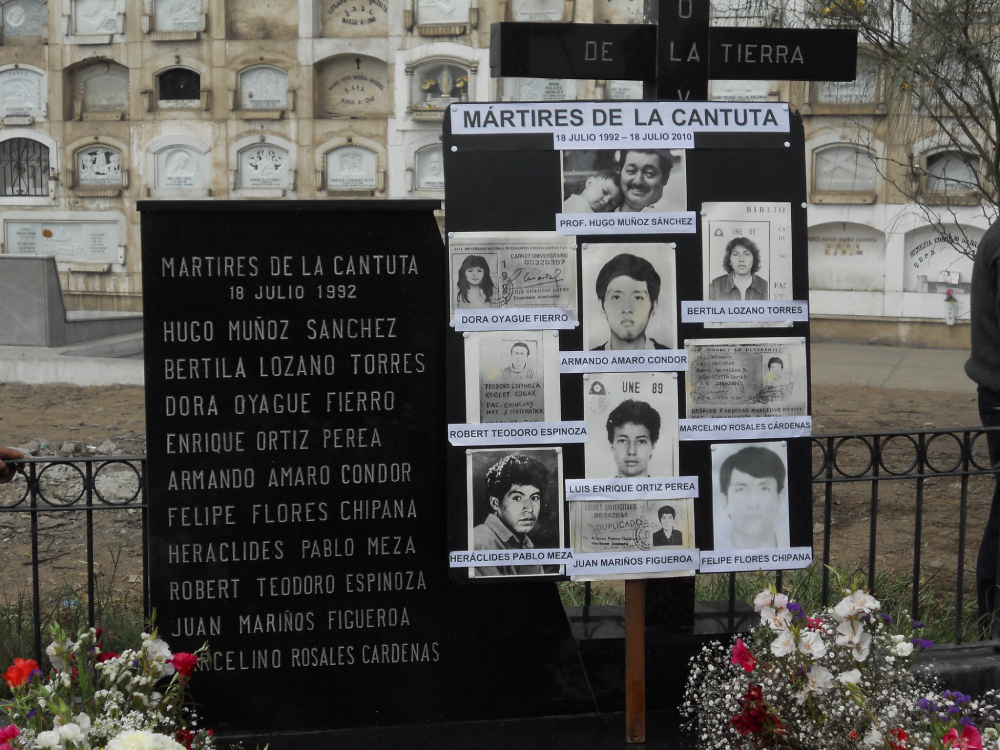
A tombstone for 10 victims of the La Cantuta massacre who were disappeared on July 18, 1992 by President Alberto Fujimori's Grupo Colina. (Flickr/The Advocacy Project/Karin Orr/CC BY-NC-SA 2.0)
"But they left several pieces of evidence in the previous grave, including parts of the bodies – and my brother's entire body," Ortiz said. For more than a year, the 10 victims were considered to have disappeared, since nobody knew they had been killed.
"Information was released concerning the graves and a magazine published a story about it. In August of 1993, they found two sets of keys. One of them pertained to Armando," Carmen said. All the family could bury was a bone fragment measuring 1 inch.
From the start, relatives of La Cantuta victims — as well as other massacres — had to deal with a smear campaign operated by the Fujimorist segment. That's been so common in Peru that a word was created to describe it: "terruquear", or the act of calling somebody a terrorist in order to demoralize him or her — at times, with the intent of justifying his or her murder.
The "terruqueo" affected even people like Gisela's brother, Enrique, a practicing Catholic. He was a 21-year-old student of physical education, known among his colleagues for his solidarity.
"He would lend shorts and sneakers to poor colleagues who couldn't buy them, so they were able to accompany the practical classes," Gisela recalled.
Advertisement
Their family lived in the Amazonian region, where the context of Sendero Luminoso and state repression was unknown for many people.
"It traumatized the whole family. I'd ask myself: 'How can God allow such a thing to happen to a good person like my brother?'" Gisela recalled.
She found among a few priests the support she needed to go on. One year after Enrique's disappearance, a priest who understood the seriousness of the situation agreed to celebrate a Mass in his honor, something that would continue for the next 20 years.
"In 1994, when the victims' remains were exhumed by the state, the church offered to keep them at the catacombs of the Saint Francis Church, in Lima," she added.
Priests like Fr. Gustavo Gutierrez, one of the major intellectuals of the Liberation Theology movement, and Cardinal Augusto Vargas were among the clergy members who supported the families over the years.
"Believing in God gave me the strength to keep going. But mine is a God of justice and remembrance, not Boluarte's God of impunity," Gisela Ortiz affirmed.
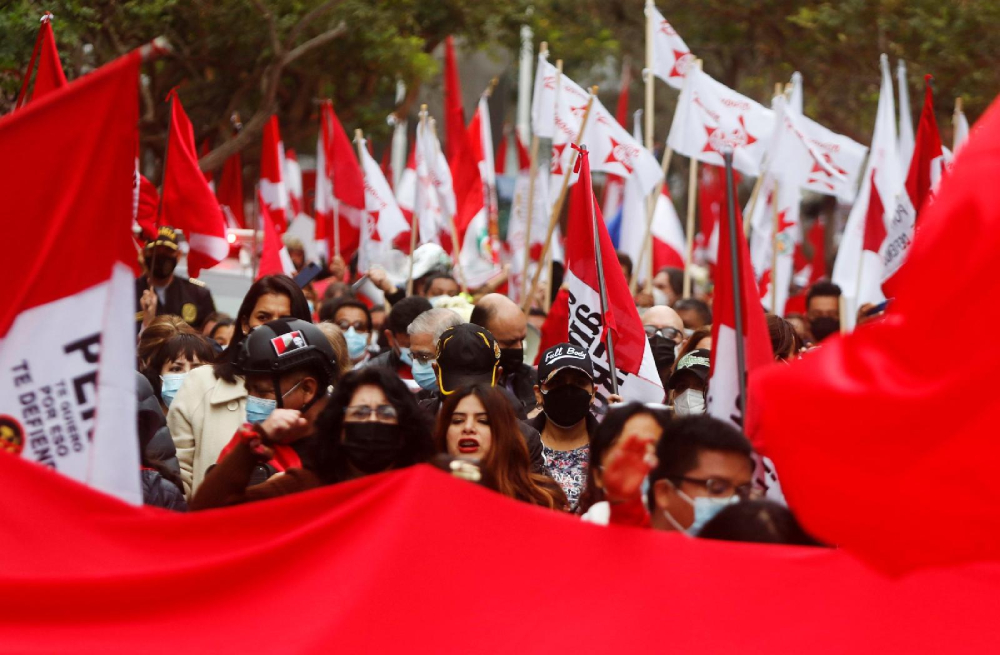
People gather Sept. 12, 2021, in Lima, Peru, to commemorate the 29th anniversary of the capture of Abimael Guzmán, founder of Peruvian rebel group Sendero Luminoso (Shining Path). Guzmán died Sept. 11 at the Callao Naval Base, where he was serving two life sentences. (CNS/Reuters/Sebastian Castaneda)
Spanish-born Fr. José Mantecón Sancho, known as Father Chiqui, is one of the clergy members who have been accompanying the victims' relatives for years. In his opinion, relevant efforts have been made to heal the Peruvian society, but not for reconciliation.
"I think it has been put aside. We have to listen to those who suffer. Unfortunately, the Amnesty Act interrupts that path," Chiqui argued.
He emphasized that the victims' families, as well as human rights activists of different perspectives, are being "terruqueados" for demanding justice and criticizing the new legislation.
"It's a sign of fascism," Chiqui affirmed, adding that the most basic rights, like that of burying a relative, are being forgotten.
The families of the victims of massacres that occurred from 1980 to 2000 had ups and downs when it came to seeing justice. While a few agents were investigated and detained in the 1990s, Fujimori in 1995 managed to approve an amnesty, which was only invalidated in 2001 after the fall of his government.
For years, that amnesty was invoked by the defendants in order to avoid penalties. But many of them, including Fujimori, went to trial and were sentenced for those crimes.
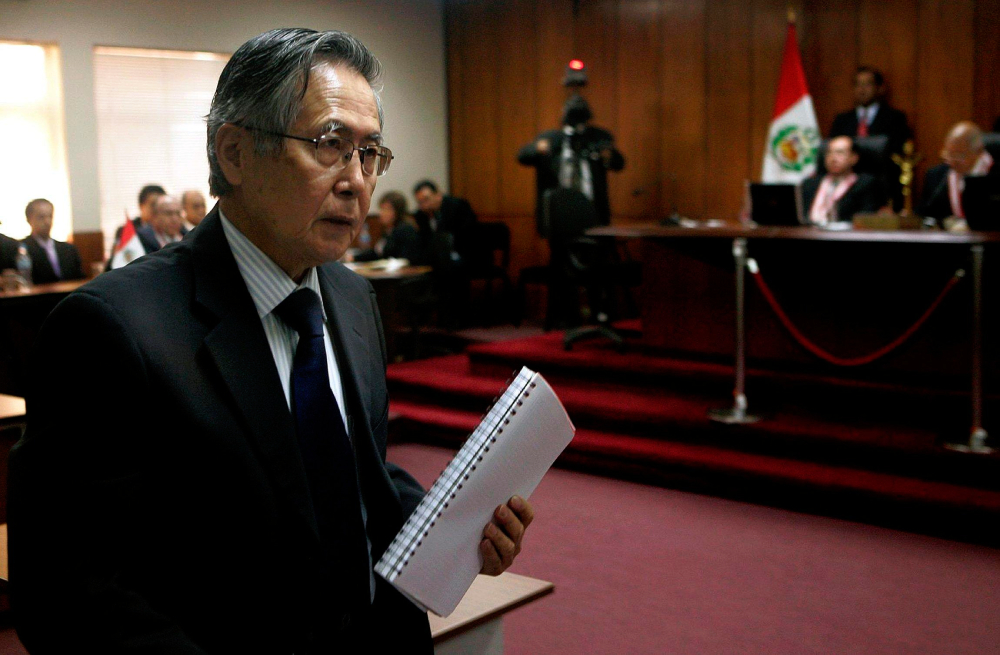
Former Peruvian President Alberto Fujimori stands after being sentenced during his trial at the Special Police Headquarters in Lima, Peru, April 7, 2009. Fujimori was convicted and sentenced to 25 years in prison. It was the first time a democratically elected Latin American president was found guilty of rights abuses in his own country. A three-judge panel convicted him of ordering a military death squad to carry out two massacres that killed 25 people during his 1990-2000 rule, when he was battling guerrilla forces. (CNS/Reuters/Rafael Cornejo Andina)
The current amnesty benefits officers who managed to avoid legal penalties for all those years, including fugitives. It will also take out from prison agents who are older than 70 and still didn't serve all their time (and didn't pay damages to the families of their victims.) Human rights organizations estimate that the law impacts at least 156 closed cases and 600 ongoing ones.
According to Rolando Ames, a retired sociology professor at the Pontifical Catholic University of Peru and a founding member of Bartolomé de las Casas Institute — an NGO that congregates experts in different areas and was created by Gutierrez — the current Congress is dominated by Fujimorists and politicians who are interested in protecting the interests of former Colina members.
Ames, one of the members of the Commission of Truth and Reconciliation, said there is much more polarization now than 20 years ago. That's why one can see so many people on social media, including so many Catholics, reaffirming the Fujimorist idea that La Cantuta victims were terrorists and somehow deserved their fate.
"Many Catholics in Peru are under the weight of our colonial past. They profess Catholicism and practice the rites, but don't accompany the most reflexive historical evolution of the church," he argued.