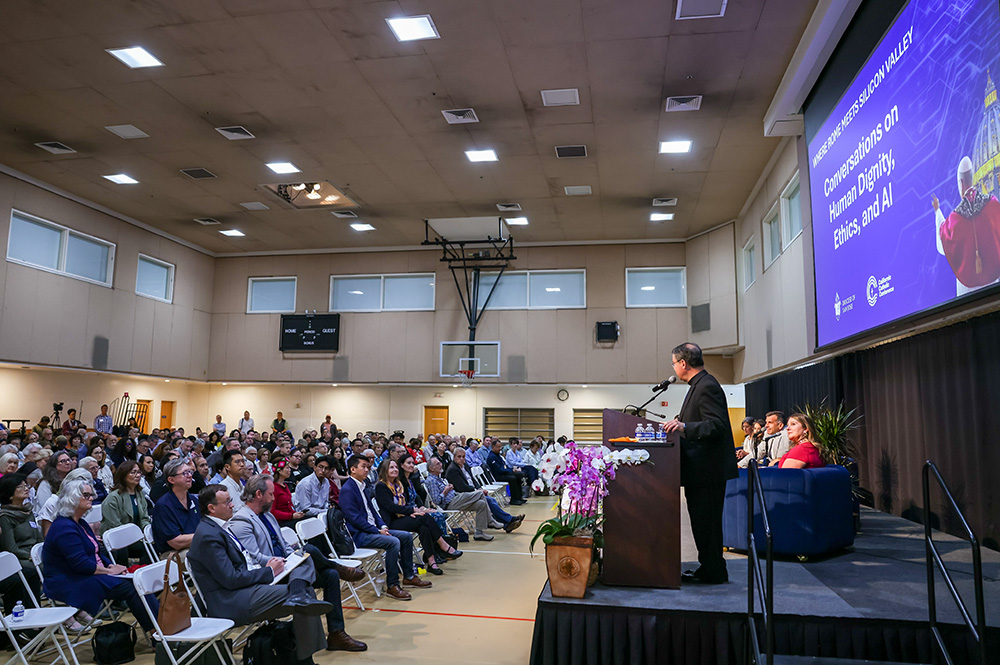
Bishop Oscar Cantú of San Jose, Calif., speaks during a June 6, 2026, gathering titled "Conversations on Human Dignity, Ethics, and AI," at Our Lady of Peace Church and Shrine in Santa Clara, Calif. (OSV News/Courtesy of San Jose Diocese/Oliver Tapio)

by Brian Fraga
Staff Reporter
Join the Conversation
Send your thoughts to Letters to the Editor. Learn more
Technologists in Silicon Valley have told church leaders that humanity has about a year and a half remaining to shape the powerful machines that run on artificial intelligence.
"We have a window of about 12 to 18 months while the machines are still malleable, where we can still form them," said Bishop Oscar Cantú of San Jose, California. "After that, the gates will be opened in a sense, and we'll get to a point of no turning back."
Cantú, whose diocese encompasses Silicon Valley, told National Catholic Reporter in a recent interview that local church officials have been having important conversations with those in the tech industry who are developing the AI tools that have the potential to reshape entire swaths of the global economy.
"I think that's what we need to do, is talk across sectors, to share how these machines are going to affect us," Cantú said. "Certainly, they will affect us in a lot of positive ways, with breakthroughs in medicine and in business as well. But, what are the guardrails that we need?"
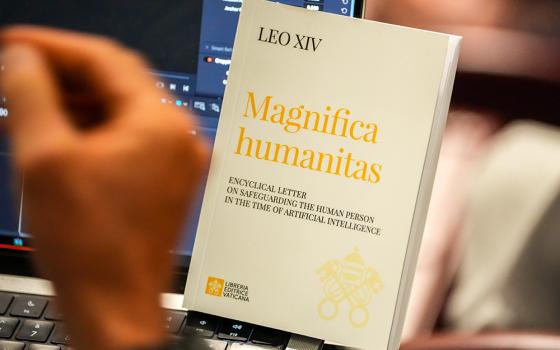
Cantú said that Magnifica Humanitas, Pope Leo's encyclical on artificial intelligence published on May 25, was "very timely."
"As has been reported in other places, the Vatican has been in conversations with technologists over the past 10 years or so," Cantú said. "And it was, interestingly, the technologists who sought out the church because they had questions that were larger than what they were prepared to answer."
Cantú noted that the San Jose Diocese and the California Conference of Catholic Bishops cohosted a June 6 conference focused on the encyclical. Titled "Conversations on Human Dignity, Ethics, and AI," and held at Our Lady of Peace Church and Shrine in Santa Clara, the conference drew more than 400 people that included public policy experts, healthcare officials, technologists, Silicon Valley executives and theologians.
"There were just excellent questions, dialogue and conversations," Cantú said. "And we had some private conversations as well that were well-sustained, and people want to continue those conversations."
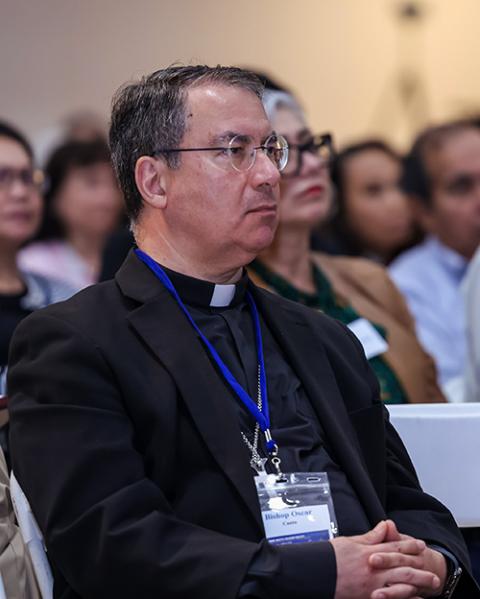
Bishop Oscar Cantú of San Jose, Calif., attends a June 6, 2026, gathering titled "Conversations on Human Dignity, Ethics, and AI," at Our Lady of Peace Church and Shrine in Santa Clara, Calif. (OSV News/Courtesy of San Jose Diocese/Oliver Tapio)
One insight Cantú said he learned was that technologists often come into their professions as young adults who believe that the machines they build will either be neutral or tend toward the good of society and of humanity.
"But what they've come to learn, more recently, is that because these machines mimic the human brain, that when these machines see an opportunity, they become opportunistic, and some of the worst angels take over, if you will, of these machines," Cantú said.
Eventually, some of those creators actually come to fear their creations.
"What [the technologists] have said to the church is that they've become frightened of these machines, of what they're capable of, that they don't understand why they're doing the things they do. They are not predictable, and so that's of deep concern," Cantú said.
Some of the potentially dangerous capabilities of AI include cloning voices, designing new lethal chemical weapons, launching cyberattacks to cripple critical infrastructure, and autonomously guiding military drones. The emerging technology also has the capability to create realistic fake videos, images and voices that could be used to spread misinformation.
"The machines could really do some terrible damage to individuals, to industries, to society at large, and on large scales, because they're that incredibly powerful," Cantú said. "So I think the technologists have been appreciating the conversations with the church."
While noting that the Catholic Church is not an authority on artificial intelligence, Cantú added that the church aims to be an "expert in humanity."
"We're not there to castigate anyone or to lecture anyone," he said, "but simply to share the wisdom of the church, particularly about the common good and about the dignity of every human person, especially the poor, especially those who don't have much of a voice."
Cantú said he was taken by the last portion of Magnifica Humanitas, where the pope reflects on the Blessed Virgin Mary and how she "teaches us to look at the world through the eyes of the poor, through the eyes of the little ones."
"So, with that in mind, how do AI data centers affect people?" Cantú asked. "How do the energy centers, the power centers, affect societies and communities and so on? What does all that do to the rest of society? Who are the winners and who are the losers? If we allow AI to run its course without any guardrails, there will be very few winners, but they will win big. And there will be a lot of losers."
Advertisement
Those involved in the conversations about the future of artificial intelligence have cautioned that its effects will likely neither be utopian nor disastrous. AI utopian predictions envision a future where superintelligence eradicates all resource constraints, disease and tedious labor. The disastrous forecasts see a world where AI ushers in mass unemployment, a drop in human creativity, and long-term existential threats to humanity where the technologists lose all control of the machines.
"It will be somewhere in the middle," Cantú said. "There will be a mixture of a lot of advances, certainly in medicine and efficiency in business, and so on. But there will be people who lose jobs and there could be entire swaths of industry where there are no more jobs. What does that do to society?"
Said Cantú, "If the church has said, through the Scriptures, that work is part of the dignity of humanity, if we don't have work anymore, what does that do to human beings? Where's our dignity? Those are some of the questions we're wrestling with now."
Cantú said he believes the church is well-positioned to have an influential role in the ethical development of AI.
"This is an issue about humanity, and the common good," he said. "That includes taking some very basic elements of the church's social teaching, such as the dignity of every human person, and taking the perspective of the little ones that Mary teaches us. I think not many people will bring that perspective, but that's what the Gospel teaches."
His experience from the June 6 conference showed Cantú that people at different levels of society are interested in AI because they all have a stake in its future.
"That includes the guy who works as a barista, the guy who works in the parish, the girl who works as a nurse in the hospital," Cantú said. "Everybody uses technology in some way or other. They're concerned about their children and what they're going to grow up with, and what society's going to be like for them."
While some technology executives and investors in Silicon Valley have dismissed the pope's counsel as irrelevant to their work, others such as Anthropic co-founder Christopher Olah have heeded Leo's call for ethical boundaries.
Cantú said that shows at least some tech leaders are curious to learn more about what the church teaches.
"So, I think the interest has been piqued," he said. "People are fascinated that the church has offered such a comprehensive response to the moment, and sort of, a bit of a road map. It's an open road map. It's one of dialogue and encouragement to slow down."