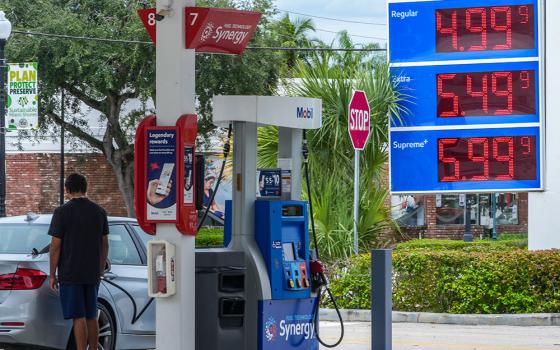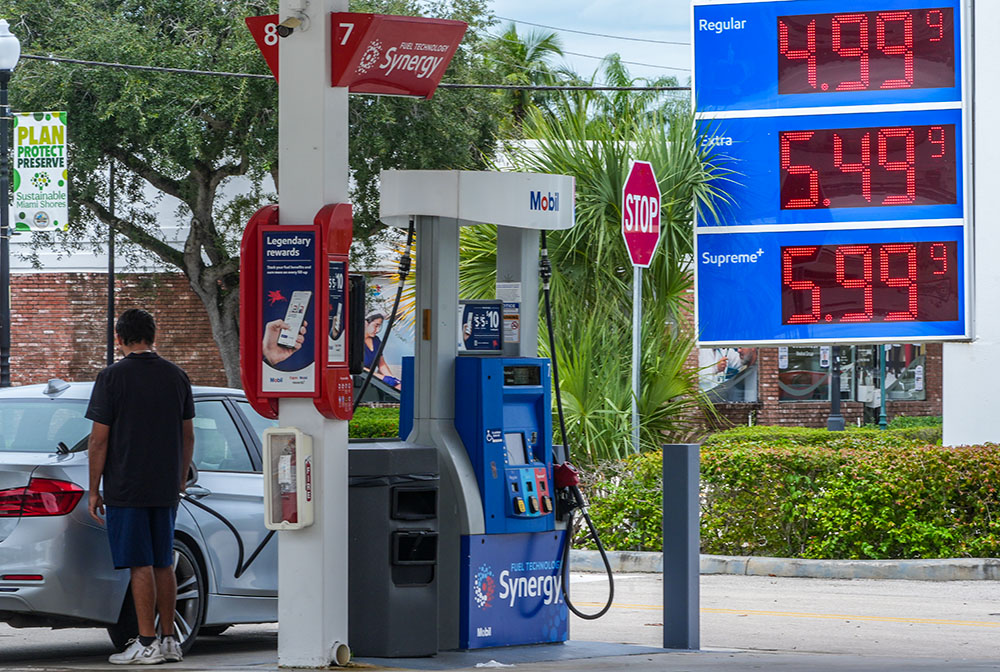
Prices are displayed at a gas station Tuesday, Sept. 29, 2026, in Miami. (AP/Marta Lavandier)

by Brian Fraga
Staff Reporter
Join the Conversation
Send your thoughts to Letters to the Editor. Learn more
These days, it costs at least $50 for Jason Miller to fill up his midsize SUV at the gas station.
"That's a lot of money," Miller said. "Everything is more expensive. Groceries are more expensive. A lot of folks are struggling to get by, myself included."
Miller, 41, a St. Louis resident who works for Call to Action, a Catholic reform group, told National Catholic Reporter that some days it feels like the nation's economy "is being held together with toothpicks and Band-Aids."
"All the money flows to the top while most Americans are struggling financially," said Miller, who mentioned the economy as a leading issue for him as the Nov. 3 midterm elections draw near.
With skyrocketing prices for gas and energy, stagnant wages and housing costs that are squeezing middle- and lower-income families, polling suggests that Miller is one of countless American voters who are frustrated by the state of the United States' economy.

A recent Pew Research Center survey indicates that the economy ranks as the top voting issue this year across the political spectrum: 84% of registered voters — including 88% of those who support Democrats and 82% who back Republicans — say it is very important to their vote.
"Far and away, the economy is the No. 1 issue for voters," said Geoffrey Layman, the chairman of political science at the University of Notre Dame.
Layman told NCR that gas prices in particular — the average price of a gallon of regular gasoline was $4.27 as of Oct. 20 — appears to be the most salient factor for voters, who attribute the higher price at the pump to President Donald Trump and what they see as an unnecessary war in Iran.
"Obviously, global oil markets are more complicated than that," Layman said. "But I think voters, when they see what prices are now for a gallon of milk, for eggs and other items, they are likely to lay all that at the foot of a president who ran against a sitting president on the issue of inflation, who said he was going to take care of it.
"Especially with gas prices, I think voters have made a very direct link to the actions of the president," Layman said.
Interviews with Catholic voters indicate that their concerns about the economy encompass related issues such as affordability, wages, housing costs, healthcare expenses, the cost of raising children, food insecurity and whether economic policies protect low-income families.
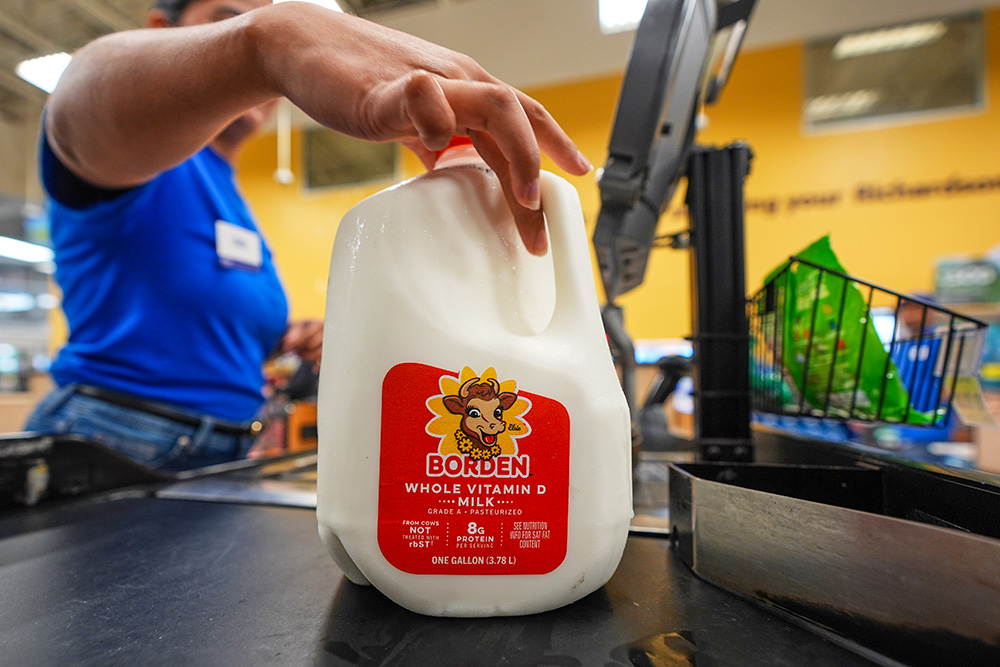
A cashier rings up a gallon of milk at a grocery store in Dallas April 15, 2026. (AP/LM Otero)
"It's a big struggle because everything is going up," said Lupita Garza-Grande, 48, a resident of Plantation, Florida, located north of Miami.
Garza-Grande, a librarian, told NCR she has been "looking for deals" amid an economy where several local businesses and restaurants have shuttered their doors in recent weeks.
Alberto Ivan GildeLamadrid-Turpeau, 47, a corporate recruiter who lives in Queens, New York, told NCR that the economy is "very" important to him as a voter.
"Healthcare, housing, it's all insane," he said. "I am looking at increases on everything from rice to toilet paper. The only things that have come down in price are eggs and Lay's potato chips."
Fran Rossi Szpylczyn, who lives near Albany, New York, is one of those voters who blame the Trump administration for what feels like an affordability crisis.
"Gas is so high. Food is so high. Prices have just risen so much on everything," Szpylczyn said. "The debt has risen so much under the current regime that I just feel like having a change to put the brakes on some of these things is called for."
Advertisement
Szpylczyn, 68, a pastoral associate at the Church of the Immaculate Conception in East Glenville, New York, also told NCR that her concern for the economy is intertwined with people's well-being and their ability to access healthcare and housing.
"For me, the economy ties in to how we are taking care of people," Szpylczyn said.
Don Weigel, 72, a Catholic deacon who lives in the Diocese of Buffalo, New York, said he is especially concerned about cuts to the social safety net, and what the rise of artificial intelligence could do to wide swaths of the workforce.
"I think the employment issue is going to continue to be huge," Weigel said. "I think AI is the strongest factor that's going to affect our job situation going forward, and if we don't set some standards, if we don't have some guardrails, we're going to have a whole lot of people on the unemployment line. And then we are cutting the safety net for those people."
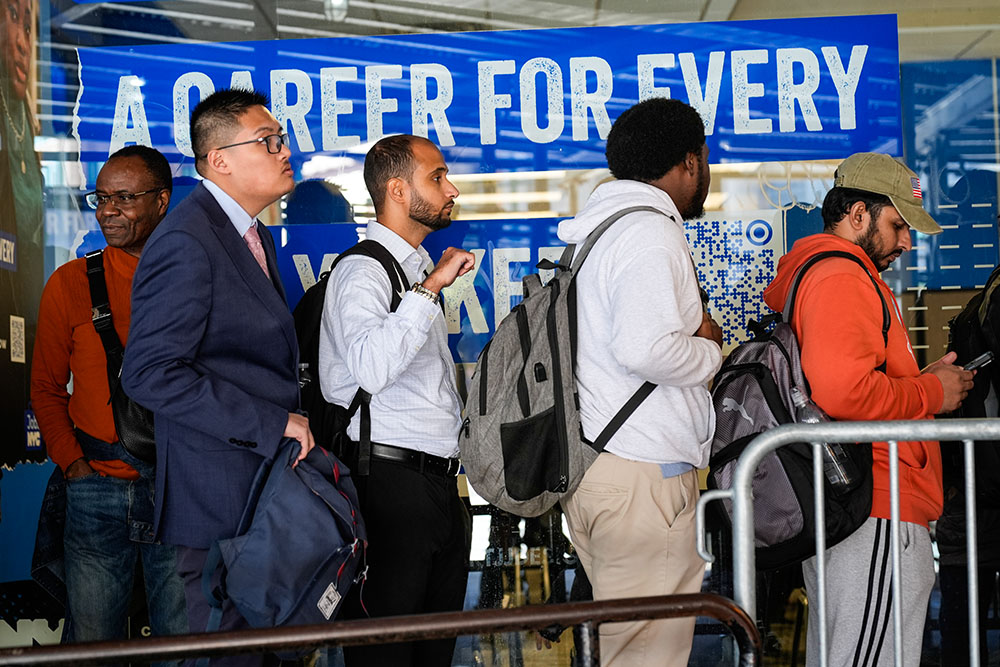
Job seekers wait in line at a job fair in New York Oct. 5, 2026. (AP/Seth Wenig)
In Albuquerque, New Mexico, Jason Rodarte, 49, a public school teacher who teaches civics and economics to middle and high school students, told NCR that many of his students see their parents struggling in an economy where unemployment is high and well-paying jobs are hard to come by.
"A lot of these kids don't have a lot of hope, and they're just starting off," Rodarte said.
William Hemsworth, a public school teacher in Tucson, Arizona, who is raising teenagers and lives in a dual-income household, told NCR that the affordability issue is "a big one" for him with Election Day approaching.
"It seems like everything from healthcare, dental and car insurance, is going up 10 to 15%, but our wages are going up less than 2 %," Hemsworth, 46, said. "There's a balancing act in trying to provide the best for our children without going into debt doing it."
Despite the economy seemingly spinning out of control, Hemsworth added that he doesn't believe either major political party seems to care. The campaign advertisements he has seen on television are spinning "the same talking points and scare tactics" that he is tired of in politics.
"And it's both sides," said Hemsworth, a registered independent voter who is also looking for candidates who espouse "basic human decency" and treat people like they are human beings worthy of respect.
"Unfortunately, we're not seeing a whole lot of that," he said.