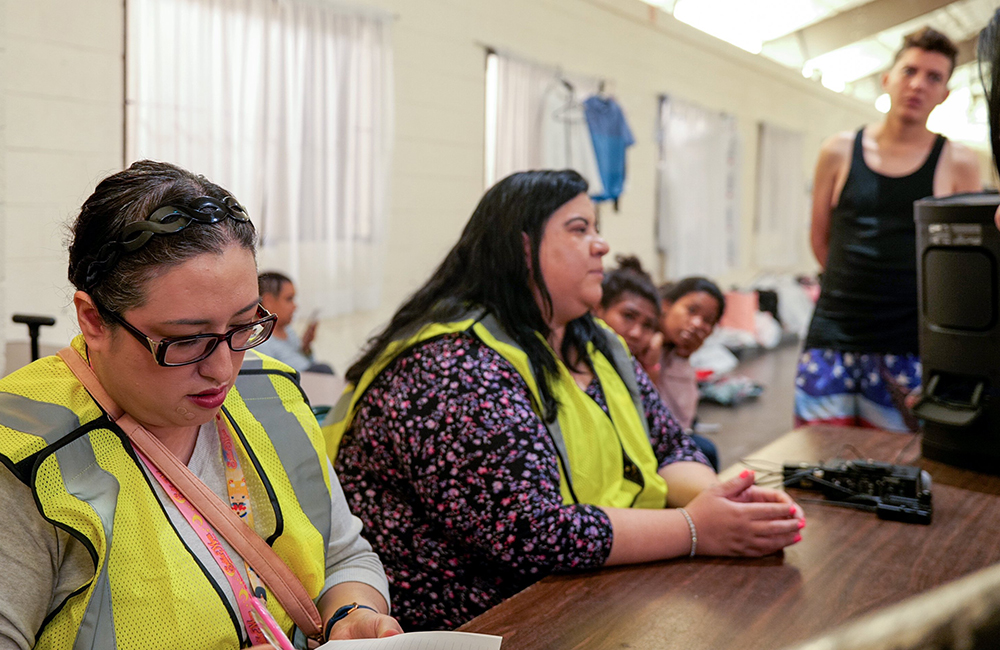
Imelda Maynard, director of legal services of Estrella del Paso (formerly Diocesan Migrant and Refugee Services), and Melissa López, executive director, provide legal information to migrants in a migrant shelter in El Paso, Texas. (OSV News/Courtesy of Diocesan Migrant and Refugee Services, Inc. of El Paso)

by Brian Fraga
Staff Reporter
Join the Conversation
Send your thoughts to Letters to the Editor. Learn more
U.S. immigration laws are being ignored, reinterpreted and selectively enforced under the second Trump administration, an attorney who serves migrants and refugees told the National Catholic Reporter.
"I think that's the biggest thing that people need to understand," said Imelda Maynard, the director of legal services for Estrella del Paso, a ministry of the Diocese of El Paso that provides free legal services to migrants and refugees.
"This is the canary in the coal mine," Maynard said in a recent interview with the National Catholic Reporter. "And if you don't think it's going to affect you because it hasn't affected you right now, well, it's only a matter of time before it hits close to home."
Maynard discussed the major change she has seen in federal immigration enforcement and the impact that the Trump administration's immigration policies have had on Estrella del Paso. She also spoke about what people in federal immigration detention facilities need from organizations like hers, and why she believes everyone should be concerned about the government's immigration crackdown.
The interview has been edited for purposes of length and clarity.
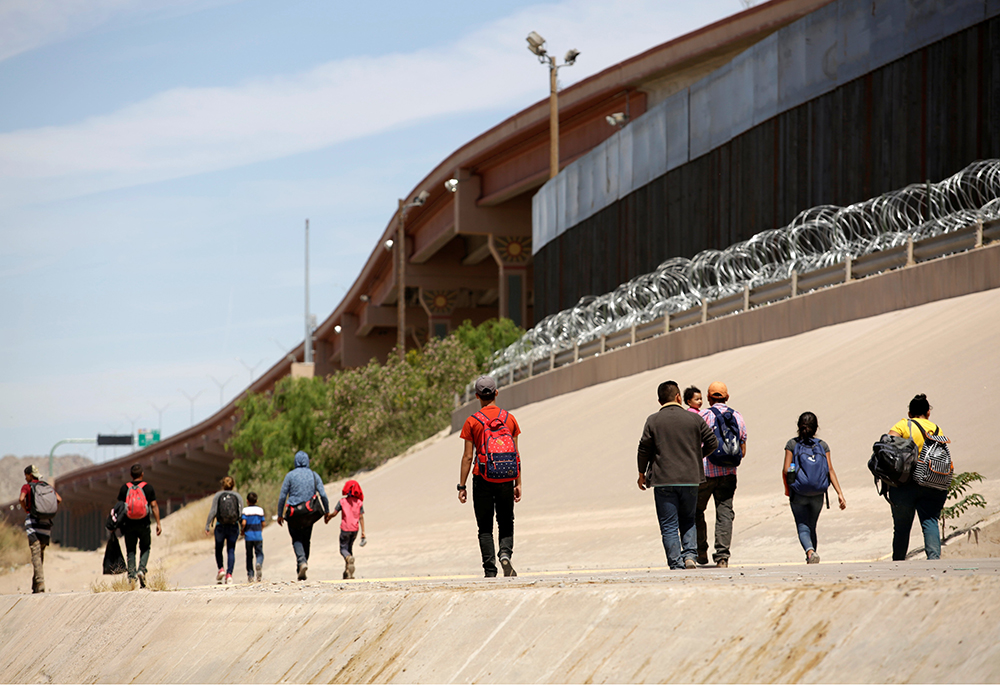
Migrants walk after crossing the Bravo River at the border line between Ciudad Juarez, Mexico, and El Paso in Texas, U.S., as seen from Ciudad Juarez, May 9, 2019. (CNS/Reuters/Jose Luis Gonzalez)
NCR: What is a major change you have seen regarding immigration enforcement since President Donald Trump returned to office?
Maynard: During [the first Trump administration], the rhetoric was surrounding lawful immigration. It was definitely attacking the border but it mostly concentrated on recent asylum seekers. It concentrated on those processes and shrinking that pool of applicants. This time around, it's all immigrants. Not just the undocumented, but the documented as well.
What has that meant for Estrella del Paso?
The blanket policy has caused more work for us. For example, we have an affirmative legal services unit that helps people who are essentially seeking to fix their papers through family-based immigration. All of those clients, for the most part, entered on visas and they're in the process of fixing their papers here in the U.S. Traditionally, those populations were not in any danger of detention. They were not in any danger of being placed in removal proceedings because, ultimately, they're going to fix their papers. It's just a matter of timing for the government to process their applications.
Well, now they are in danger. Even if they're in status the moment they apply, because it's taking the government so long to process their applications, they go out of status at some point and then they're fair game [for detention]. So we're having to tell those folks, "You really need to be careful with where you're traveling. You really shouldn't be traveling outside of El Paso because of the interior checkpoints." It's this really indiscriminate picking up of anyone and everyone who is an immigrant.

Imelda Maynard (Courtesy of Imelda Maynard)
How have U.S. Immigration and Customs Enforcement's tactics changed over the past year?
ICE has always been a little complex to work with. But at least before, individual officers had more discretion to determine things like, "Yes, we're going to release your client who has severe medical issues," or "We're going to parole them out of custody since there's no reason to detain them." Or for a long time, it was a policy that ICE would not detain pregnant women for obvious reasons. That's no longer the case. Like I said, it's anyone and everyone. It doesn't matter if they're sick. It doesn't matter if they're pregnant. Now it's just detain, detain, detain.
There's a lot of re-detentions of people. They didn't do anything wrong, but just because [ICE can arrest them], they did. For example, there's a huge population of Cubans. They entered the country lawfully, the way they were supposed to. But then they get picked up by ICE. And usually, it's at workplaces. And they're like, "I showed [the ICE agents] my work permit that said, 'I am lawfully able to work,' and they still picked me up."
What do you say to people who suggest that a lot of these problems can be solved by migrants just following the country's immigration laws?
I think you have a lot of people even here [in El Paso] who are like, "Well, if people would just follow the law." And my response is, "No, you don't understand. A lot of the people in [immigration detention facilities] did, and they still find themselves there."
There's a lot of people who don't understand why they're detained. Because again, a lot of these people had work permits. They were in process. But they were picked up in court and they're like, "Why am I here? I was doing everything the way I was supposed to."
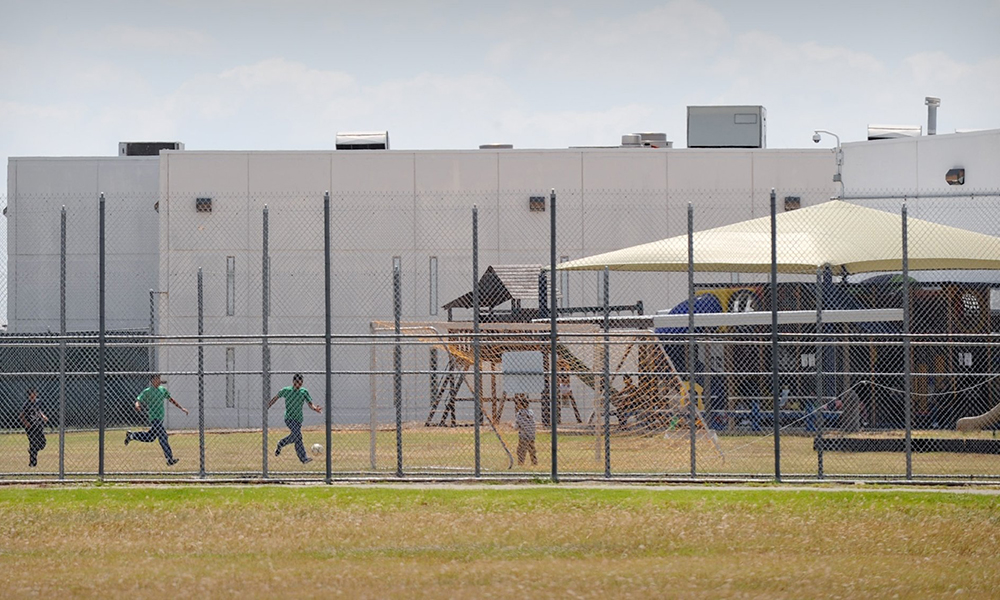
Children are pictured in a file photo playing in a double-fenced playground area outside the T. Don Hutto Family Residential Facility in Taylor, Texas. (OSV News/Bahram Mark Sobhani)
It's a challenge to make people understand that this is not about following the law; it's about selective enforcement of the laws on select groups of people. And that's not OK. [Federal immigration authorities] are ignoring the law when it's not convenient and when it doesn't fit their narrative. That's the thing people need to see. When the law does not serve their purposes, then the law doesn't matter, or it's fake news, or it's activist judges. We can't live in a country like that. That puts everyone in danger.
What is an example of federal immigration laws being ignored or applied incorrectly?
The best example is the issue of bonds. Traditionally, legal precedent has been that if you enter the country unlawfully, you can request a bond hearing before an immigration judge. Last year, [federal immigration authorities] rewrote their policies to say that all these people who arrive don't qualify to request a bond in front of an immigration judge. So that requires recourse to federal court. And the federal courts are like, "[Federal immigration authorities] are wrong. Your interpretation of the law is just plain wrong." And so [immigration courts] are granting the bond hearings, but again, you have to take that extra step.
Our organization is having to get our people licensed in federal court to do that kind of thing, which is more expensive for us. It all just adds a level of complexity to everything that really doesn't need to be there. It's about weaponizing bureaucracy to be difficult, to overwhelm, so that people just give up.
Advertisement
What do people in immigration detention need from an organization like Estrella del Paso?
In detention, what is needed most is information. People need legal consultations to know, "Is it worth it for me to potentially be in detention for months fighting my case, or is it better if I just go ahead and take voluntary departure, especially if the government is offering a monetary incentive to do so?"
Some people have really strong cases where it's like, "No, you should really fight it out." Some people's cases may be weaker where it's like, "Look, to be real with you, in the circuit law that we have, your chances of winning are very low."
But with that said, the government is appealing everything, which means that even if you win your case, there's a likelihood you will still be detained while it goes up on appeal. So people need to know that to make informed decisions on what they feel is best for themselves.
Why do you think everyone should be paying attention to what the federal government is doing with regard to immigration enforcement?
The biggest thing is reminding folks that while all this may not have affected them yet, but when it does, they will understand how big the system is and how necessary it is to stand up to it now before it's too late. We're trying to create consciousness for people. You need to care about what's happening to other people because eventually it's going to affect everyone. When you're starting to question people's citizenship, it's an issue. When you're arresting citizens, even though they're showing you their passports, that's an issue. Because then at that point, no one is safe.