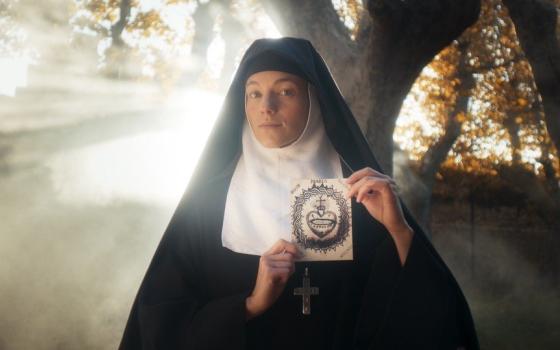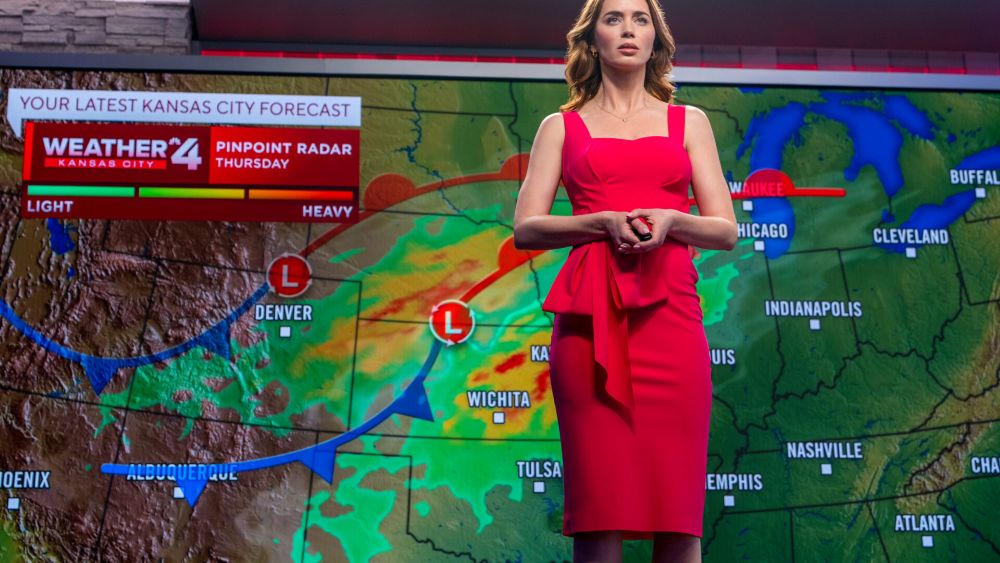
Emily Blunt portrays Margaret Fairchild, a TV meteorologist, in Steven Spielberg's science fiction thriller "Disclosure Day." (Universal Pictures and Amblin Entertainment )

by Zachary Lee
Join the Conversation
Send your thoughts to Letters to the Editor. Learn more
There's never a convenient time for an alien invasion, but in Steven Spielberg's new "Disclosure Day," the timing couldn't be worse.
In the director's latest science fiction epic, global tensions are high and nuclear war hovers on the horizon; everyday people are stockpiling resources in preparation for the inevitable devastation to come. Amidst all of this, cybersecurity expert Daniel, played by Josh O'Connor ("Wake Up Dead Man"), flees his workplace with information he's been paid to protect. In hand is irrefutable proof of the existence of aliens — and proof that the United States government, through companies like Wardex, has interacted with and even experimented on extraterrestrials on earth.
Spielberg handles the disclosure as one of the final truths capable of stirring people out of their individualized lives. It is news so poignant, so disruptive to the established order that Daniel and his girlfriend Jane (Eve Hewson), a former nun, are willing to risk their reputations and lives to leak the information to the world. Meanwhile, the CEO of Wardex is equally determined to stop them at all costs, and kill them if necessary.
While hiding from Wardex, Jane confronts Daniel about the implications of leaking the information. She insists that human beings need to believe in God as a supreme being, and fears that a revelation of extraterrestrials — "actual supreme beings" — would shatter people's faith. But Daniel is determined and presses forward, connecting with a larger whistleblower network spearheaded by another former Wardex employee, Hugo (Colman Domingo).
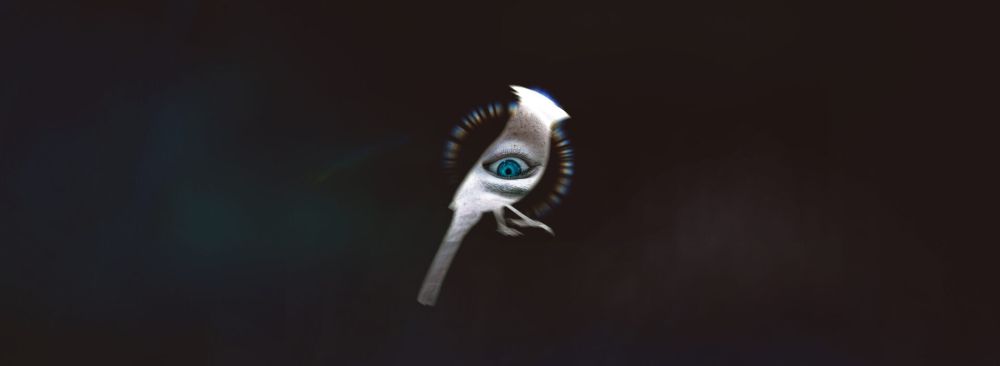
In "Disclosure Day," Steven Spielberg uses alien presence to probe and refine ideas about faith. (Universal Pictures and Amblin Entertainment)
Spielberg and screenwriter David Koepp deserve kudos for saying the quiet part out loud, so to speak; for it's true that acknowledging the existence of aliens would likely disrupt the religious sphere. Wisely, the film doesn't lambast Jane for her fears but instead uses religion itself to address them. When Jane and Daniel take sanctuary in a convent, Jane asks Sister Maura (Elizabeth Marvel), "If you found out we weren't alone, would that frighten you?"
Sister Maura offers her own question in response: "Why would He make such a vast universe yet save it only for us?" In the character of this middle-aged nun we are presented with a faith that is living and active; a faith that can be deepened, not dismantled, by new revelations. Hers is a blueprint for people of faith hoping to offer solace to a world that craves certainty but gets instability instead.
Advertisement
Janusz Kamiński's cinematography too supports the obliteration of the line between the sacred and secular, believer and unbeliever. There's no paucity of awe-inspiring shots in the film, but one of Spielberg's and Kamiński's favorites is the use of superimposition: the placing of faces upon each other. Even if two characters may be far away, through windows, the two share the same space. Through car windows and copious lens flares, human faces are superimposed onto each other and physical distances are cut down to size. We are more connected than we think.
The Christian tradition demands we find contentment with mystery. If faith is indeed "the assurance of things hoped for, the conviction of things not seen" (Hebrews 11:1), then we have a real gift to offer others in times when hope is in short supply. The friendship of Jane and Sister Maura offers a portrait of a faith community that does not demonize doubt but embraces it as a part of what it means to be in this world, grappling with a humanity we all share.
With "Disclosure Day," Spielberg has composed a benediction for all who hold faith: that we might find, and share, a contentment with the unknown.