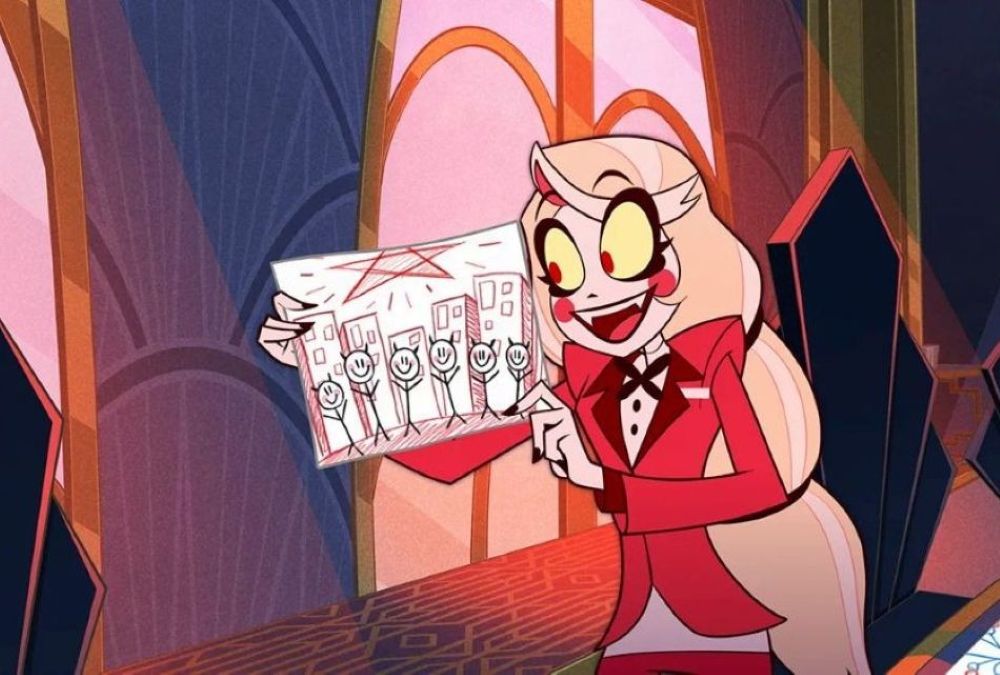
Created by animator Vivienne Medrano, Amazon Prime's "Hazbin Hotel" follows the gay daughter of Lucifer as she sets out to save the denizens of hell. (Prime Video)

by Jim McDermott
Join the Conversation
Send your thoughts to Letters to the Editor. Learn more
It's a premise that sounds straight out of a Catholic evangelist's playbook: A young, idealistic woman from a religious background sets out to convince people who have made serious mistakes in their lives that they can still change.
But in this case, there's a twist: The woman is Charlie Morningstar, gay daughter of Lucifer, and the population she sets out to save are the denizens of hell.
Created by animator Vivienne "VivziePop" Medrano, Amazon Prime's "Hazbin Hotel" has found a following for its wildly inventive animations, clever lyrics and Disney princess-but-in-hell concept. In the series' opening number, "A Happy Day in Hell," Charlie delivers a classic princess song about her dream to help people, while wandering through an endless slum filled with buildings on fire, random acts of violence and damned humans who have been transformed into animal-like demons.
The incongruity between Charlie's optimism and the moral darkness of her world is hilarious in a way that might make some Christians (and some Disney fans) uncomfortable. Characters on the show also regularly say and do things that you would never see in a Disney movie or hear about in the Gospels.
But in fact, Medrano seems interested in inviting the audience to consider perhaps the most challenging question of the Christian faith: Do we really believe in the possibility of redemption for everyone?
The characters that Charlie and her girlfriend invite into the hotel where they set up their spiritual rehabilitation center include the spider-like porn star Angel Dust, the mad scientist Sir Pentious, the alcoholic bartender Husk, a bomb-throwing Australian and more. Each gets big Broadway or pop-style numbers to sing and very funny, very adult lines to deliver.
But for as playful and sex-positive as Angel seems to be, underneath he's an addict and abuse victim who is haunted by the life to which he's given himself. Likewise, Sir Pentious, a largely silly figure with a trope-y villain accent and the body of a cobra proves to have a shockingly damning backstory that truly does beg the question of whether or not he should be able to ever be saved.
Medrano also gives that question voice via the angels of heaven, a furious, violent bunch who show up in hell once a year to massacre as many of the damned as they can. Their leering leader Adam sings, "Fair is fair, an eye for an eye." No matter the villainy of these characters, they nonetheless express a point of view to be found in Scripture, contemporary Christian sermons and, recently, the White House press room.
But like the very best preachers and writers, Medrano refuses to offer any easy answers. What makes "Hazbin Hotel" a bold, must-see show about faith and salvation is its insistence both that the path to redemption is brutally hard, and that it is completely possible for anyone.
Advertisement
After two seasons, and to the shock of the entirety of heaven and hell, one sinner has been redeemed and others seem on the way. Meanwhile, no matter how much love and acceptance he has been shown, Angel refuses to accept the possibility of his own salvation.
"Redemption’s not really for people like me," he tells his friends. "The last choice I ever got to make was when I sold my soul away." In the end, no one can save you until you're willing to try and forgive yourself.
It's notable that the hell of "Hazbin Hotel" is filled with characters who are gay, bisexual, pansexual or asexual, while everyone in heaven thus far seems to be straight. The association of being queer with being damned has been the experience of many, if not most, queer people raised in religious communities.
And yet Medrano, who was raised Presbyterian and is herself a member of the LGBTQIA+ community, turns that weight into wings. "Hazbin Hotel" is a love letter from a queer woman to other queer people, acknowledging what they've suffered and celebrating their audacious, individual beauty. Whatever their backgrounds or struggles, the queer characters of Charlie Morningstar's hell are vibrant, creative and often in loving relationships.
The series also serves as a hand lifted not in anger but compassion to the broader Christian community, an attempt to try and help religious people out of the impossible prison in which their beliefs around salvation and redemption have left them. It's true, we've all screwed up in terrible, hurtful ways. "You're a loser, just like me," Husk sings to Angel in the first season.
But as is frequently true in the Gospels, facing your mistakes is the path to freedom and community: "Just maybe if we eat shit together," Husk goes on, "things will end up differently."