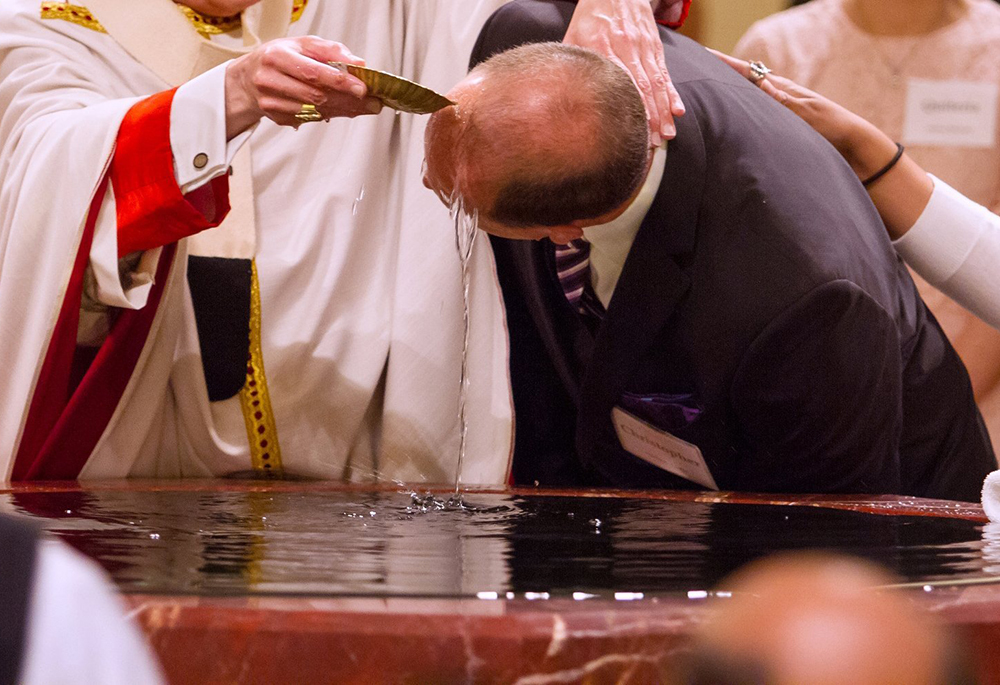
A file photo shows a catechumen being baptized during the Easter Vigil. (OSV News/Texas Catholic Herald/James Ramos)

by Brian Fraga
Staff Reporter
Join the Conversation
Send your thoughts to Letters to the Editor. Learn more
People who joined the Catholic Church this year wanted to grow in goodness and virtue, desired a deeper understanding of truth and sought a greater sense of inner peace, according to a new report released Thursday (June 18) by the Archdiocese of Chicago.
The new Catholic converts were also motivated by an interest in liturgy, tradition and the church's teachings, with more than half of them expressing a hunger for belonging and more meaningful relationships, according to the survey, which officials developed to understand what is driving the recent surge in conversions and how the church should respond.
"While this study represents an early effort to understand this growing interest in the Catholic Church, the findings already provide insights," the report's authors wrote in "Why Are So Many People Becoming Catholic? 20 U.S. Catholic Dioceses Collaborate to Study Emerging Interest in the Catholic Church."
The report is based on a survey that was administered from Feb. 22 to May 31 to 2,127 U.S. residents who participated in the Order of Christian Initiation of Adults (or OCIA) in 2026. According to the report, the project began as a local effort within the Archdiocese of Chicago, but the project expanded amid interest from other dioceses that resulted in a broader collaboration.
In addition to Chicago, 19 other dioceses and archdioceses participated, including Atlanta, Cleveland, Denver, Detroit, Los Angeles, Miami, New York, Phoenix, St. Paul and Minneapolis, Salt Lake City, San Francisco and Seattle.
The report consists of more than a dozen insights gleaned from the data, as well as related recommendations for parishes and dioceses that include the need to reduce barriers for individuals interested in exploring Catholicism and offering continued formation for people after they enter the church.
The report found that almost 30% of the respondents had no religious affiliation — often referred to as "nones" — before they began their journey into the Catholic Church. Most of the other respondents were almost evenly split between baptized Catholics who were completing their sacraments and Christians from other traditions.
The gender distribution among the respondents was fairly balanced, with approximately 46% men and 54% women. The report's authors noted that the data "contrasts with growing public discussion suggesting that recent increases in religiosity and OCIA participation may be disproportionately concentrated among adult men."
The respondents were relatively well educated. Across the millennial, Generation X and baby boomer cohorts, respondents reported higher educational levels than their peers nationally, according to the report.
As to why they wanted to become Catholic, 84% of respondents were interested in exploring a deeper spirituality or relationship with God as the "most important consideration" or one they "considered strongly," the two highest ratings.
More than three-quarters (77%) of respondents identified wanting to grow in goodness and virtue, with over 70% saying they desired a deeper understanding of truth and a greater sense of peace (72%). More than half said they had a hunger for belonging and more meaningful relationships, as well as a desire for healing or redemption from a personal challenge.
Many respondents also described experiencing the church as "a source of both stability and hope within an increasingly uncertain world. Several respondents described being drawn toward Catholicism for its ancient traditions and moral grounding, in contrast to what they perceived as an increasingly chaotic world," the report said.
Relatively few converts — less than 40% — said they were attracted by the church's stance on social issues or its charitable services to those in need.
The respondents' initial interest in the Catholic faith emerged through "relational entry points" — such as having a faith-grounded family and being invited to Mass — and "content/experience-driven pathways" that included an attraction to the liturgy and inspiration from faith-based books and digital content. The report said about 66% of respondents provided at least one example of digital content such as Catholic websites, podcasts, prayer apps and films.
Advertisement
Compared to other surveys in recent years, the respondents were less likely to cite dating or marrying a Catholic as a factor related to their participation in OCIA. Only about 26% of catechumens and candidates for reception into full communion this year said that dating or marrying a Catholic was a part of their journey to the church.
By comparison, the Center for Applied Research in the Apostolate at Georgetown University found that in 2007, 72% of Catholic converts said marriage was an important reason for becoming Catholic.
"The magnitude of the difference suggests that a broader set of factors motivated this survey's sample than prior years," the report's authors wrote.
Regarding their initial impressions of the church, most said they had either positive or neutral perceptions prior to becoming more interested in the Catholic faith. About 51% of the religiously unaffiliated reported that they either did not know much about or felt indifferent toward the church. Around 57% who were baptized Catholic before joining OCIA already held positive perceptions of the church.
"These findings align with prior Archdiocese of Chicago research indicating that the majority of young adults raised Catholic these days did not actively leave the Church but rather did not grow up in a regular practice of the faith," the report's authors wrote.
The most common reason — 46% — for why respondents chose a parish for OCIA was that it was the closest to where they lived.
More than three-quarters of respondents reported at least one barrier throughout their journey into OCIA. Those included fear-based barriers, such as concerns about disapproval from friends or family and feeling spiritually unprepared. There were also logistical barriers as some individuals said that OCIA previously had not fit their daily schedules.
The report advised dioceses and parishes to reduce those barriers, particularly the fear-based barriers that were more common among Gen Z respondents. Recommendations included accompaniment to help newcomers feel known, connected and comfortable entering parish life.
Other imperatives the report identified for parishes and dioceses included creating accessible pathways for faith exploration at the earliest stages of the faith journey, developing tailored formation and support for OCIA participants, offering post-OCIA formation and community for those entering the church, forming parishioners to invite others into opportunities for faith exploration and a greater investment at the diocesan level to support evangelization and formation efforts.