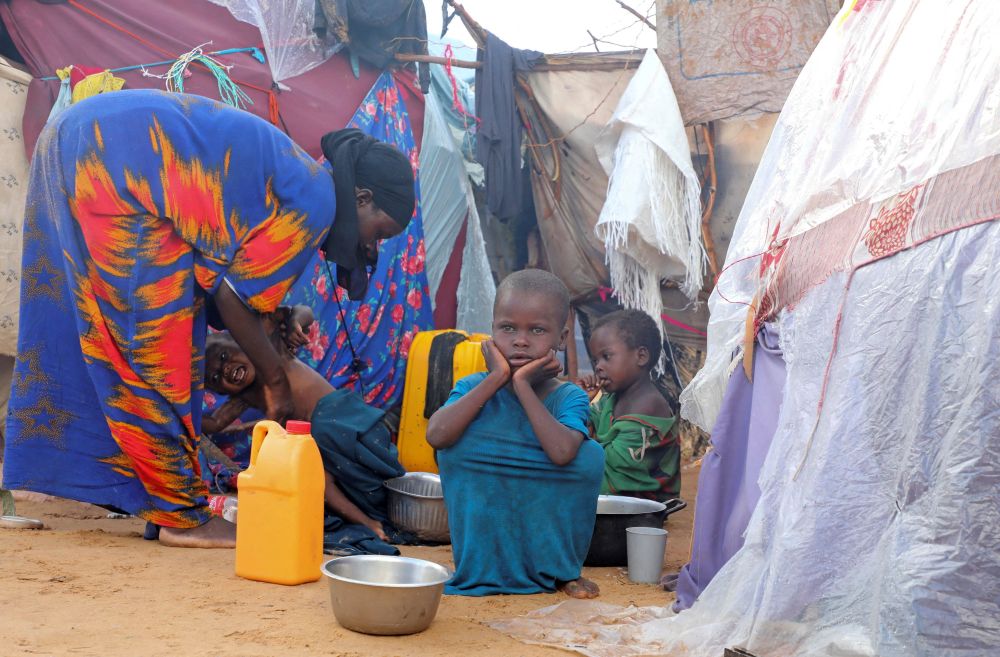
An internally displaced Somali family prepares breakfast outside their makeshift shelter in Mogadishu May 7, 2026. Experts say nearly 6.5 million people in Somalia are experiencing high levels of acute food insecurity and more than 1.8 million children are suffering from acute malnutrition because of recurrent drought, displacement, prolonged instability and insufficient resources. (OSV News/Reuters/Feisal Omar)

Join the Conversation
Send your thoughts to Letters to the Editor. Learn more
As global temperatures rise, the impacts of climate change are not limited to more extreme heatwaves, flooding and storms. It is also stunting children's growth and contributing to malnutrition, according to new research by the University of Notre Dame.
The study, published in June in the Proceedings of the National Academy of Sciences, found a direct association between human-caused climate change and increased childhood stunting, or impaired growth or development.
The researchers analyzed climate modeling and observed temperatures alongside demographic and health survey data from 2004-2020 for 34 African countries. They determined that every 1 degree Celsius of global temperature rise associated with human activities linked directly to a 3.45% increase in childhood stunting.
That equates to close to 7 million children, said Arun Agrawal, one of the study's co-authors and director of Notre Dame's Just Transformations to Sustainability Initiative.
"It's a significant proportion of the population being affected, and it's a significant effect on their life chances after they're born," he told EarthBeat.
Stunting, a key indicator of malnutrition, is commonly seen through a child's diminished weight and height. A variety of factors contribute to stunting, including poor diets, repeated infections and inadequate sanitation, as well as genetics, maternal diet and education, and access to healthcare.
Hotter temperatures can also play a role, both directly and indirectly. Droughts worsened by climate change, for example, strain agriculture production and food access, worsening nutrition for both children and expectant mothers. Increased heat can also place biological stressors on a child in utero, such as reduced blood flow through the placenta, Agrawal said.
"Couple that with reduced availability of food, and you get a double impact of climate change on stunting," he said.
In a press release on the study, Agrawal called climate change a "threat multiplier" on existing social inequalities facing vulnerable communities and the poorest households who lack the means to buy food elsewhere after a bad harvest, losing sources of both nutrition and income.
"We are seeing a direct physical translation of global emissions into child undernutrition. When extreme heat limits food availability and drives up prices, young children are the very first to suffer the biological consequences," he said. "Their developing brains and bodies simply do not get the fuel they need, cementing a cycle of intergenerational poverty before they even reach their fifth birthday."
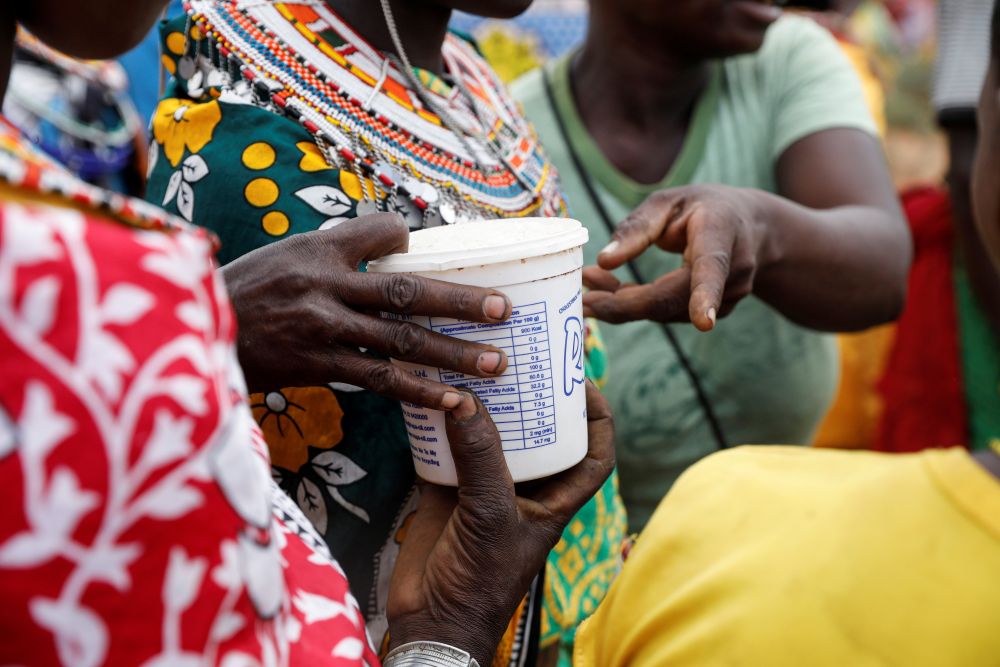
Women from the Samburu tribe receive a food donation during a drought in Oldonyiro, Kenya, Oct. 8, 2021. (CNS/Reuters/Baz Ratner)
According to the study, in 2022 approximately 149 million children were stunted globally, with the greatest concentration in low- and middle-income countries, particularly in sub-Saharan Africa where 41% of children face stunting.
The region is also among the most at risk from climate impacts, which has been struck in recent years with extensive droughts.
Climate change's disproportionate impact on vulnerable people — who have contributed the least to the problem but suffer the most, often lacking the means or resources to adapt or respond to extreme weather — has been the guiding message of the Catholic Church and other religious communities.
The vast majority of global warming is caused by the accumulation of greenhouse gases in the atmosphere emitted from burning fossil fuels (coal, oil and gas) by humans. The United States is the largest historical emitter, accounting for roughly one-fifth of total greenhouse gas emissions, and trails only China in present-day emissions.
Since the late 1800s, average global temperature has risen 1.3 C. Temperatures are on track to reach 1.5 C — a key threshold after which climate impacts are expected to rapidly worsen — sometime in the next decade, and between 2.3 C and 2.8 C by the end of the century if nations meet their stated climate plans under the Paris Agreement.
Prior studies have examined the relationship between rising temperatures and childhood stunting, but few have isolated anthropogenic warming to determine its specific role, said Nabin Pradhan, the study's lead author and a postdoctoral research fellow in Notre Dame's Keough School of Global Affairs. By doing so, they were able to uncover clearer evidence of connection between childhood stunting and human-induced climate change.
"Climate change impacts inequality, then inequality impacts stunting," Pradhan said.
The researchers suggested greater attention and investment in sanitation, maternal education and healthcare access in developing countries could improve child health and reduce stunting and its effects. That is a "significant role" that the Catholic Church and its vast network of hospitals and care facilities could play, Agrawal said.
"There's substantial evidence already that these effects of climate change on child health and on stunting can be mitigated by effective healthcare service provision and by making healthcare accessible to the poor and to people who are most at risk of these effects of climate change," he said. "So I think we have a very important role to play in helping those who are being disadvantaged and those who are being affected adversely by the rising temperatures and by climate change."
Agrawal, who earlier this year helped launch the Global Alliance for Laudato Si' with Notre Dame and the Vatican, said humanity is facing "a pretty serious situation where we are not paying attention" to the multitude of ways climate change is impacting the world, including people's health.
He pointed to the need for a greater focus on the common good, a theme emphasized by Pope Francis in his 2015 encyclical "Laudato Si', on Care for Our Common Home" as well as Pope Leo XIV in his first encyclical Magnifica Humanitas.
"I think the Catholic Church, under both Pope Francis and Pope Leo, shows us what we need to do to address the kinds of challenges that our study is showing, where people — vulnerable people, marginalized people — are facing because of climate change. We need to care for the common good."
Advertisement