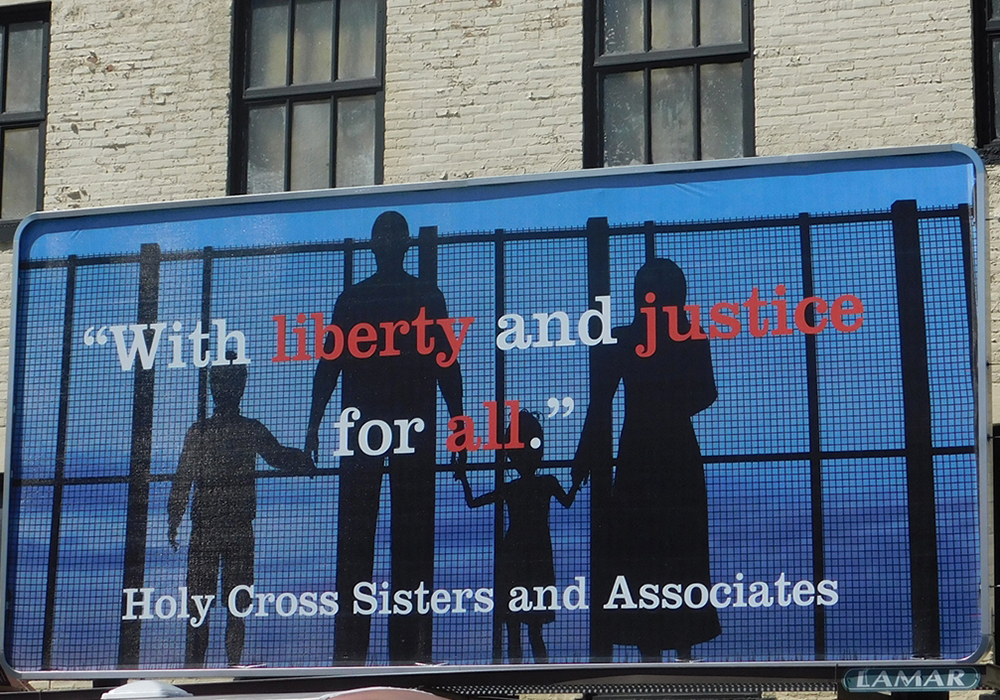
In this 2019 photo, a billboard sponsored by the Holy Cross Sisters and Associates is seen in Merrill, Wisconsin, to draw attention to the plight of immigrant families in the United States. (CNS photo/courtesy Holy Cross Sisters USA Province)

by Carol J. Dempsey
Join the Conversation
Send your thoughts to Letters to the Editor. Learn more
Today's first reading is taken from the book of Jeremiah, a text within the prophetic corpus of the Hebrew Bible/Old Testament. In its earliest form, the prophetic had its roots in the natural world, the first "word" of the Divine, that proclaimed the wonder, beauty and goodness of the Holy One and Creator of all.
Throughout recorded history, the natural world is the place of encounter with the Divine and has shaped spiritual narratives of diverse cultures worldwide. Ancient accounts of the prophetic are located among the Mari people who practiced shamanism. Native Americans speak of vision quests. Taoist sages tell stories of nature-centered revelations of the Divine. Aboriginal dreamtime stories recount sacred connections that occurred in the Australian outback. Sanskrit texts of ancient India describe rishis who found divine wisdom beneath sacred trees. Norse sagas detail profound encounters in primordial forests. Japanese Zen masters write about sudden enlightenment while contemplating cherry blossoms. Sufi mystics describe divine unity experienced in desert solitude.
The writings of Christian mystics such as Julian of Norwich, Meister Eckhart, Catherine of Siena, and even the musical compositions of Hildegard of Bingen all attest to the presence of the Divine encountered in the natural world.
All this is to say that the deepest experience of the prophetic is the encounter with the Divine, oftentimes through the natural world.
The prophetic is also a call and a vocation most often concerned with addressing issues of injustice and working for systemic, structural and attitudinal change in the face of oppression.
The book of Jeremiah provides us with a glimpse into the experience of what it means to embrace the prophetic vocation and mission as it relates to issues of justice. The character Jeremiah is compelled to address social, political and religious leadership, judicial officials, power brokers and those involved with a community's economy. The vocation is all-consuming and divinely driven. Such is the spirit that undergirds the work for justice.
Advertisement
This work can cost no less than everything, including the loss of one's life. We have only to remember the four churchwomen, Maryknoll Sr. Maura Clarke, lay missionary Jean Donovan, Maryknoll Sr. Ita Ford and Ursuline Sr. Dorothy Kazel, who supported the poor in El Salvador and were consequentially murdered; Archbishop Óscar Romero, who was assassinated for speaking out against social injustice and violence in the midst of the escalating conflict between the Salvadoran military government and the left-wing insurgents; and countless others who endured suffering and even death because of their work on behalf of justice.
In their 1971 document "Justice in the World," the World Synod of Catholic Bishops declared justice to be constitutive of the Gospel message. The four Gospels all portray Jesus as someone who worked untiringly for justice. He dealt with the social, political, religious and economic injustices of his day.
In today's Gospel account from Matthew, we hear Jesus foreshadowing his own death that took place outside the city walls of Jerusalem. His own Jewish people — the elders, chief priests and the scribes — would cause him the most suffering leading up to his crucifixion. Jesus challenged the attitudes, policies and positions of the leaders of his day, and they saw him as an affront to their social, religious and political power. Therefore, the solution was to get rid of him.
When Peter rebukes him for talking about his impending death, Jesus rebukes Peter and then teaches the disciples the lesson of their lives. To be a disciple of Christ is to live life as Jesus lived his life: working for justice, which means speaking truth to power. The fullness of the message comes to light during the Passover meal when, after breaking the bread and spilling out the wine, the command is given: "Do this in memory of me." Embracing the prophetic will make us and others uncomfortable, and for some, even cost one their life.
The prophetic work of justice today entails addressing the oppression done to the natural world, its many communities of life, and injustices within the human community. After all, the Divine dwells in the midst of all, waiting to be encountered.