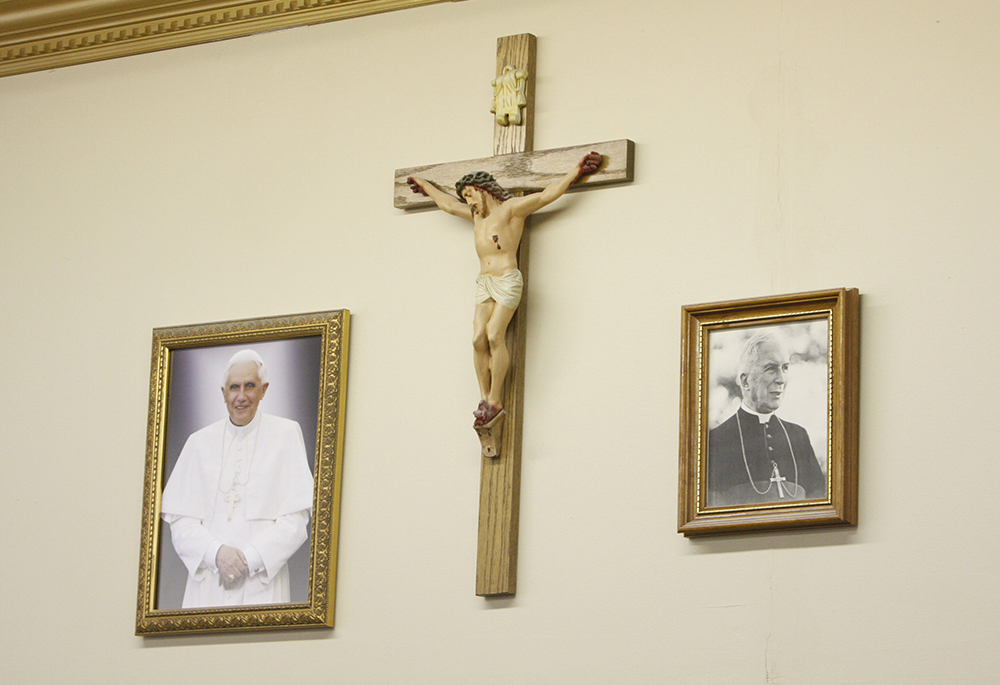
Portraits of Pope Benedict XVI and Archbishop Marcel Lefebvre, founder of the Society of St. Pius X, flank a crucifix in the community room at St. Michael the Archangel Chapel in Farmingville, New York, Feb. 1, 2009. (CNS/Gregory A. Shemitz)
by Brian Fraga
Staff Reporter
Join the Conversation
Send your thoughts to Letters to the Editor. Learn more
Until he was around 12, Louis Massett grew up in what he described was a normal American Catholic household.
He listened to rock music, watched television and went to the movies with his parents and siblings. His sisters didn't always wear dresses. But then the family began attending Mass with the Society of St. Pius X and, in Massett's words, everything changed — including their attire.
"You know, the girls only wear skirts or they should only wear dresses," Massett told National Catholic Reporter in a recent interview. "You had to get rid of your TV, don't listen to rock music, don't do this and don't do that or otherwise you weren't really a good Catholic."

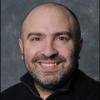
Photo of author Louis Massett (Courtesy of Louis Massett)
Massett, 53, recounts his formative years and experiences as a young adult immersed in the insular world of the traditionalist Catholic movement in a new autobiography entitled Traddyland: The Memoir of a Radical Traditional Catholic, which he self-published in late June.
The book was released just as the Society of St. Pius X was preparing to ordain four bishops without a papal mandate, in Écône, Switzerland on July 1. The next day, Pope Leo XIV excommunicated the new bishops and the two bishops who participated in the consecrations. The Vatican decree also declared SSPX priests schismatic and excommunicated, and invalidated some of the sacraments they administer.
Massett said he worked feverishly to finish the book amid the latest clash between the Vatican and the SSPX. He said he was not surprised that the international traditionalist organization defied Rome and ignored warnings that the consecrations would lead to excommunication.
"They're not Catholic. They're SSPX. And what that means is that they have branded themselves as something that is not Catholic," said Massett, whose book explores what he describes as a world where faith is weaponized and a small Kansas town becomes a hotbed of radical ideology.
In Traddyland, Massett recounts a journey where he attended the SSPX's boarding school in St. Marys, Kansas, and says he was ostracized from the community for speaking out against its leadership. In the book, he describes a cultish grip that he said the SSPX had on its members, along with highlighting the intersection of radical traditionalism, right-wing extremism and a divided Catholic Church in the United States. Critics of the group say that its members have used their influence to shift the direction of St. Marys toward a more conservative political bent.
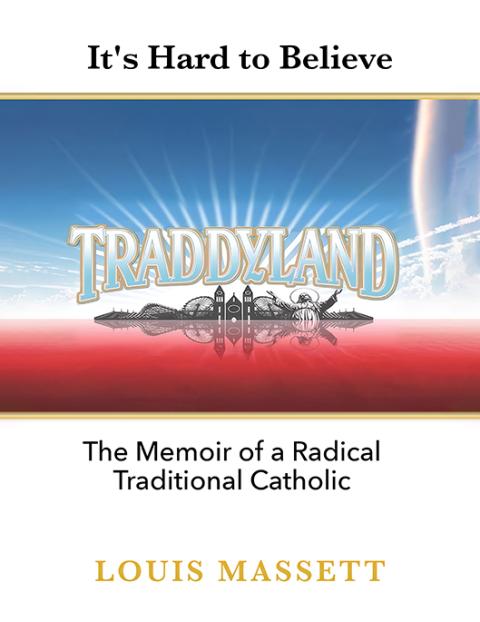
Cover of self-published book Traddyland: The Memoir of a Radical Traditional Catholic
The SSPX has also faced scrutiny and criminal investigations regarding allegations of child sexual abuse and the handling of accusations within its communities. The Kansas Bureau of Investigation investigated the group and sent its findings in July to the state attorney general’s office, which is reviewing the case for potential criminal charges.
James Vogel, a spokesman for the SSPX in the United States, did not return messages from NCR seeking comment.
Before joining the SSPX community, Massett recalled growing up in a loving home as the seventh of 11 siblings.
"It was so loving and I have so many fond memories," he said.
But he noticed something changing after his family immersed themselves in SSPX.
"I started to see how that love was calcified by this idea of faith or fidelity," he said. "There was this seriousness about preserving the faith to the point where it's like you lose your sense of love for the people that you're walking with on this journey."
Part of Massett's critique of SSPX, and other traditionalist Catholic communities, is that they are breeding grounds for conspiratorial thinking and anti-Vatican II attitudes.
"People who go into [traditionalist Catholic communities] are sometimes introduced to conspiracy theories and half-baked criticisms of the church that aren't quite spot on," he said. "And it generates this bitterness that you find in the traditional movement."
He said that the fault lies with leaders of those communities, not necessarily the people in them.
"I'm not trying to bash traditionalists," he said. "There are beautiful people in those communities, but in their camp, this is a problem."
Advertisement
"I really do believe that this book was meant to be written," Massett said. "If I hadn't gone through all that stuff, I would still be in the SSPX. You know, pain breaks people out of delusion. And it was the pains of these things that happened to me that brought me to the reality of the situation."
If there is one thing that he wants readers to come away with after having read the book, Massett said, it is that "love is the greatest thing."
"In the last chapter, I write about the road to Emmaus and how the disciples didn't recognize Jesus," he said. "For me, I had been on this walk my whole life, and it was in going through adversity that I finally realized I didn't recognize Jesus, who Jesus is and what Jesus is calling us to."
Though he used to defend the organization, Massett said his experiences crystallized for him the "reality that the SSPX has been in schism for 38 years," or ever since the Vatican first decreed in 1988 that the organization was schismatic when it consecrated four bishops. The Vatican lifted the excommunications in 2009, though the group remained in a canonically irregular position.
Massett said being in communion with the Catholic Church is about more than valid ordinations.
"The idea of the term apostle means someone who's sent or someone who has a mission. Well, the SSPX never had that," he said. "And that's where a lot of Catholics don't understand why they are in schism, why these acts are schismatic, and why it's such a problem in the church."
Massett said he went "into a dark place" for a time after he left the SSPX community as a young adult after having been ostracized from the community. He joined a rock band and stopped attending church. After realizing he was not any happier, he embarked on a spiritual journey where he attended Christendom College, a conservative Catholic college in Virginia.
During Pope Francis' pontificate, Massett said he "got caught up" in the tensions among conservative Catholics and started to "dabble" again with the SSPX. But in 2019, he said he left the group for good after an episode where he said members of the community betrayed him and his wife, which he details in the book.
"There's a lot of sadness and a lot of hardship in the book, but also God's grace," Massett said. "My mom said that God writes straight with crooked lines. And I think that that's true."
Today, he describes himself as a practicing Catholic with "both feet in the church" who has come to embrace the teachings of the Second Vatican Council. He works as a fundraiser for Students of Life of America, an anti-abortion organization.
"I try to consider myself a broad thinker," he said. "I'm not as ideological as I used to be. I recognize there's a big tent and there's a spectrum."
He said he tries to respect the backgrounds and experiences of others.
"I will talk to anybody in the church, wherever they are," he said. "But, you know, I think the most important ideal is that you love people, so that people can say, 'This person is not going to turn me away because they disagree with me.' They may even say crazy stuff. But I'm saying to them, 'Well, I think that's crazy, but I love you.' "