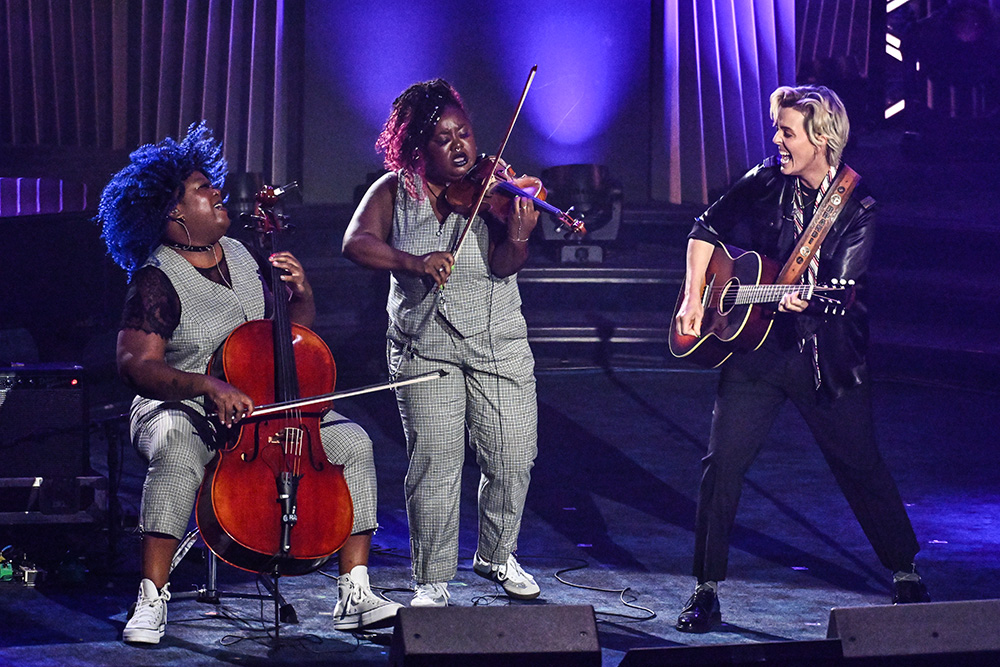
Brandi Carlile (right) performs with Monique Ross (far left) and Chauntee Ross of SistaStrings during the 55th annual Songwriters Hall of Fame Induction and Awards Gala at the Marriott Marquis Hotel on Thursday, June 11, 2026, in New York. (AP/Invision/Evan Agostini)

by Britt Luby
Join the Conversation
Send your thoughts to Letters to the Editor. Learn more
"Every good boy deserves fudge," my son said as he looked at notes from orchestra class, holding up a finger for each word. At 10, he's the same age I was when I learned to play the clarinet.
"Elvis' guitar broke down Friday!" I shouted, recognizing the mnemonic device for E-G-B-D-F and holding up my own five fingers. "You're learning the notes!"
It's been 30 years, but I can read music today because of those initial school lessons. I beamed with the hope that my son will always remember this new language.
A few days after this, I attended a Brandi Carlile concert with a friend. Shoulder to shoulder with strangers, I belted out the lyrics to "The Story" and got teary-eyed when we all sang Dolly Parton's "Coat of Many Colors," thousands of hands clapping to the beat. We felt connected to music, and to each other, once again. I couldn't help but think of my son, how delighted he would have been to see a cellist performing at a folk-rock show.
In "The Mother," Carlile sings of parenthood:
Oh, but all the wonders I have seen, I will see a second time
From inside of the ages through your eyes
At that moment, I realized that what I want for him is not just the ability to read notes, but the ability to feel what happens when people gather around something beautiful.
Advertisement
In graduate school, I studied pilgrimages to alleged Marian apparition sites. Informed by French sociologist Émile Durkheim, I researched how pilgrimage sites induce collective effervescence: the magic that happens when suddenly you feel less like an individual and more profoundly connected to all of the people around you. Perhaps you have felt this too: at a baseball game, or while line dancing, or, if you're lucky, at the Basilica of our Lady of Guadalupe in Mexico City.
As the crowd sang along with the singer on the stage, I felt that old Durkheimian spark I had chased throughout my research, the collective effervescence that makes strangers feel like kin. It washed over me in a way I had not expected. Parenting can make your world feel small, narrowed to routines and responsibilities. But in that stadium the world widened for me again, not so very different from experiences I've had during Mass.
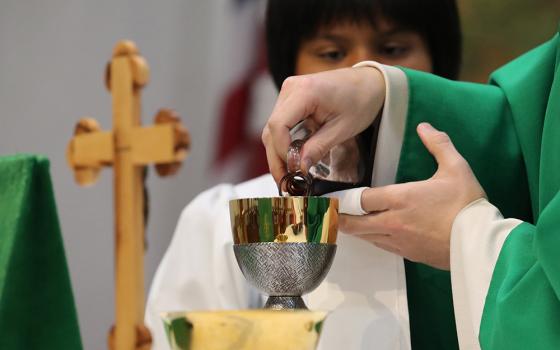
The same swell in my chest that comes when a congregation sings "One Bread, One Body" rose as I lent my voice to join in Carlile's "Crowded Table." The similarity reminds me that communion is not only a doctrine, but a human ache to be gathered and held by something larger than ourselves.
The church has a word for this: koinonia. A mysterious grace binding us together, not by agreement but by shared presence. It's the sense that, for a moment, we are more than individuals standing side by side.
The crowd transformed into an accidental congregation there in that stadium. No one had planned it, no one had rehearsed it, yet there we were: breathing together, singing together, becoming something larger than ourselves. It's the same spiritual hunger that drives us into parish halls and pilgrimage sites: the desire to be gathered, to be held, to belong.
My son is learning how notes become a song. I am continuously learning and relearning how people become a Body. And this is the quiet prayer I carry for both of us: that wherever we go — a sanctuary, a stadium, a school orchestra concert — we will recognize the Spirit's work of gathering. I pray we will know communion when we feel it, and we will trust beauty as one of the ways God speaks to us.