(Dreamstime/Pamela Mcadams)

by Sr. Mary M. McGlone
Join the Conversation
Send your thoughts to Letters to the Editor. Learn more
Relationships between civil authorities and Christians have been tricky since the time of Jesus. Perhaps the most important political event in church history was Constantine's ambiguous conversion. Scholars question whether Constantine accepted Christianity out of faith or for political advantage. Whatever his motives, he did not receive baptism until he was on his deathbed, apparently so that his lifestyle would not have to change and his sins could be forgiven once his opportunities to do what he wished had passed.
More importantly, the process Constantine began by legalizing Christianity evolved into the imposition of the Christian faith throughout the empire. That development brought previously unimaginable power to Christian leaders: No longer persecuted, they inadvertently became radically beholden to their civil protectors. Church leadership began to mirror the government they served. (Compare bishops' miters to imperial headdresses, for example.)
The imposition of Christianity also made people's motivation for baptism ambiguous: Was it out of true faith or was it more like a guarantee of the privileges of citizenship? Some theologians call the 1,700-year history that began in 312 the "Constantinian Captivity of the Church," meaning that church and state were so intertwined that Christianity lost its prophetic edge.
This brings us to today's story about Jesus and the folks who were so irrationally self-confident that they tried to trap him. First, for our own good, let's remember two cautions that this story illustrates: "Beware of people who begin a conversation with platitudes about what a great person you are!" and "Don't try to outwit Jesus; it's a hopeless endeavor."
Jesus' interrogators asked if they should collaborate with the Romans by paying taxes. How long did it take them to come up with this dilemma? How much time do people waste planning how to undo someone of whom they are jealous?
Jesus countered the group with a quandary that snared them far more than they had bargained for. Jesus deftly avoided pronouncing judgement about the tax that the empire demanded. Instead, he took their challenge in a far more profound direction. Dismissing the tax as superficial, he asked them about the purpose of their lives.
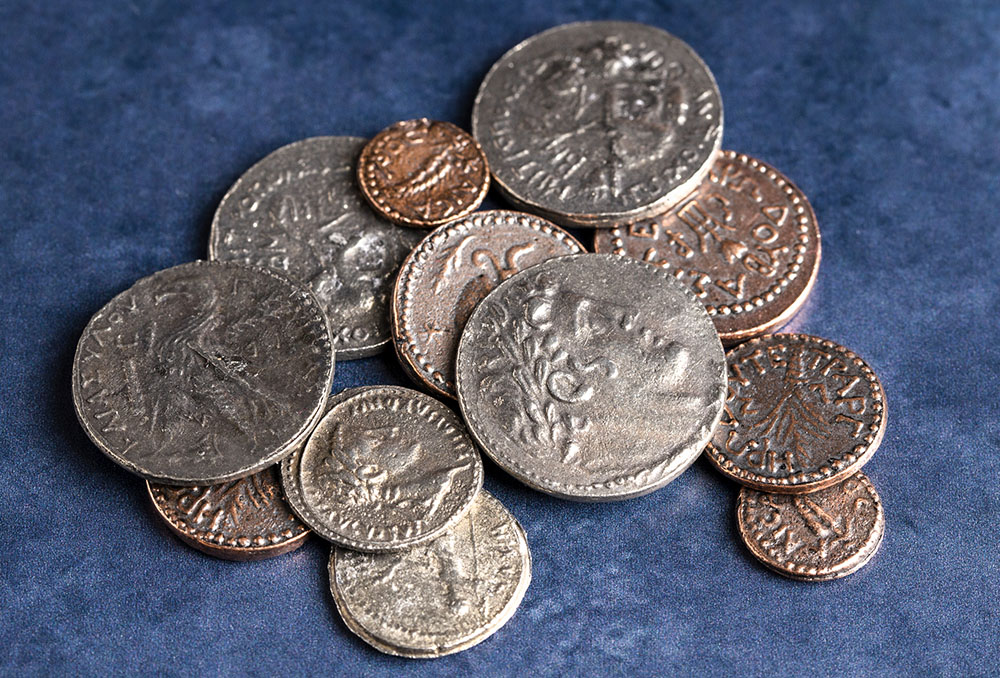
Phase one: It's easy to give Caesar whatever bears his image. Yet, a Jew of strict observance shouldn't even carry a Roman coin because it bore a graven image and proclaimed the emperor as high priest of a pagan religion that claimed Caesar as a god.
Jesus' comeback put the questioners in a pretty prickly position. As they looked at their coins they might have asked, "Why on earth did we start this self-incriminating conversation?" But the finale would outweigh round one so definitively that they would forget their original embarrassment.
Phase two: Citing the first commandment, Jesus said, "Give to God what belongs to God." The bystanders must have sniggered as the implicit question became obvious: "What exists that does not belong to God?" Caesar and politics pale in the light of our relationship with the Creator of the universe.
Jesus' response surpassed the question people asked him like a jet outpaces a moth. His response went to the heart of every religious tradition, asking, "What is your ultimate commitment?"
Advertisement
We might imagine Jesus looking at his disciples, the audience and his questioners in a way that challenged them all to search their hearts to discover what they believed most deeply and how they lived it out. The Liturgy of the Word calls us to ask the same question.
The combination of this Gospel with our first reading from Isaiah adds intensity to the message. Isaiah told a nationalistic people that a foreign emperor would act in God's name to save them from captivity. It was a blow for freedom and a blow to their pride; they would now be indebted to a pagan.
One of the challenges of today's Liturgy of the Word has to do with discernment of God's action in the world. Every nation and religious denomination tends to see themselves at the center of God's plan: "All that God wants for the world must come through us. We have the true faith." Isaiah's oracle reminds us that God doesn't put any one group in charge of the divine plan. God's ways mirror the universe God created. It has no center and no periphery.
Jesus' response to his contenders calls us to seek God's design. We cannot let our own miniscule interests detour us from seeking God's action and purpose for creation. "Give to God what belongs to God." In the end, isn't it simply a call to be open to God's ways over our own?
There's nothing we can give that does not belong to God, except for our collaboration in moving creation toward its destiny in God. Caesars will come and go. As we proclaim in the Creed, Christ's kingdom will have no end.