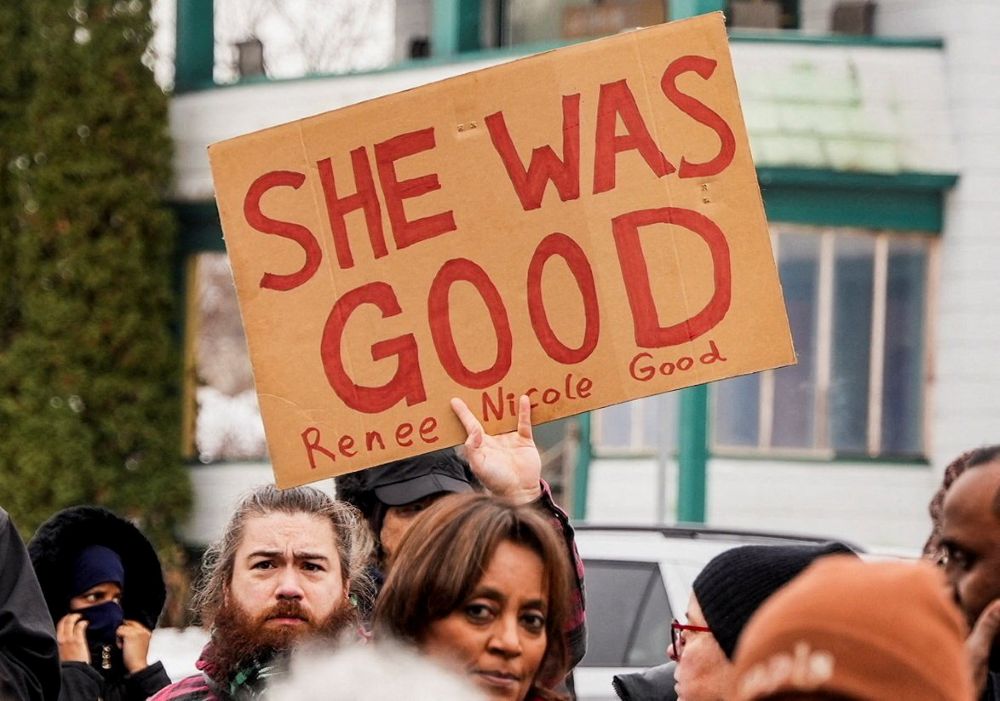
A man holds up a sign as protesters gather in Minneapolis Jan. 8, 2026, at the scene of the fatal shooting of Renee Nicole Good a day earlier by a U.S. Immigration and Customs Enforcement agent. (OSV News/Reuters/Tim Evans)

by Yunuen Trujillo
Join the Conversation
Send your thoughts to Letters to the Editor. Learn more
As Catholics around the world observe the solemnity of All Saints Nov. 1, some might be surprised to learn that All Saints' Day is not reserved for the famed and canonized, but celebrates all who have entered heaven, including laypeople who lived faithful lives of mercy, humility, peace, justice and love. These are our unknown saints.
As a Latina, an immigrant and an immigration attorney, I see these virtues reflected in the lives of countless undocumented immigrants who have in the past year been hunted down, subjected to cruel treatment and detained, often without due process. Some have been sexually assaulted, while others have been separated from their families indefinitely, confined in detention facilities without the right to government-funded legal representation.
I also think of those whose legal protections are being stripped away. Congress has not created a broad new pathway to permanent legalization since the passage of the Immigration Reform and Control Act in 1986, 40 years ago. Those who have obtained temporary lawful status are now seeing their protections revoked, leaving many vulnerable to violent immigration enforcement.
Yet despite all this suffering, many immigrants continue to demonstrate extraordinary mercy and humility. I am confident some of them are now in heaven.
If you ask me, Lorenzo Salgado Araujo is in heaven. Lorenzo was a 52-year-old Mexican immigrant who had spent more than three decades in the United States, raising a family with love and dedication. He was traveling to work when an ICE agent fatally shot him in Houston in July.
I think heaven now holds Renée Good, a queer woman, a Christian and a mother who stood with immigrants in her neighborhood. I believe Alex Pretti, an intensive care nurse who died trying to protect a woman, is there, too. Both were killed by federal immigration agents in Minneapolis in January.
Advertisement
All Saints' Day reminds us that we are all called to the kind of holiness that leads us to actually fulfill our duties toward God, our families, neighbors and society.
To show us the way to holiness, today's Gospel reading is Matthew's account of the Sermon on the Mount:
Jesus calls blessed those who mourn, for they will be comforted; the meek, for they will inherit the land; those who hunger and thirst for righteousness, for they will be satisfied; the merciful, for they will be shown mercy; the peacemakers, for they will be called children of God; and those who are persecuted for the sake of righteousness, for theirs is the Kingdom of heaven.
The Beatitudes remind us that those who use violence to amass power often do so by scapegoating vulnerable communities; and that while those communities may suffer injustice here on earth, they are promised the kingdom of heaven.
But make no mistake: The Beatitudes are not an invitation to passivity or resignation in the face of injustice. They are a wake-up call, reminding us that those who inflict violence, cause suffering and perpetuate injustice are furthest from the values of the kingdom of God. Those who hunger and thirst for justice, practice mercy and pursue peace are the ones who most closely embody the holiness to which we are all called.
The Beatitudes are a radical invitation to recognize holiness where the world often refuses to see it. The face of the immigrant is a good place to start. Are we willing to recognize the holiness and dignity of all those who continue to suffer, while they are still among us?
As the saints pray for us in heaven, may we pray with them by continuing the work of mercy, justice and peace.