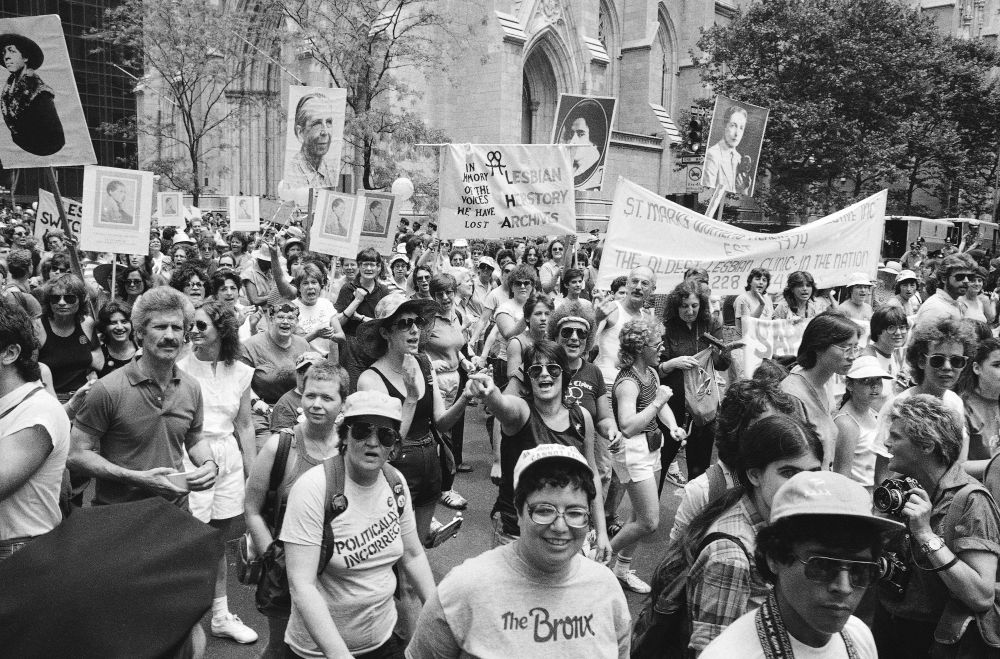
Participants in the 14th annual Lesbian and Gay Pride parade in New York City march in front of St. Patrick's Cathedral, June 26, 1983. (AP/Mario Cabrera)

by Emma Cieslik
Join the Conversation
Send your thoughts to Letters to the Editor. Learn more
Forty years ago, the Catholic Church's Congregation for the Doctrine of the Faith released a pastoral letter titled "On the Pastoral Care of Homosexual Persons." Known colloquially as the "Halloween Letter" because it was published Oct. 30, 1986, and opening with the words "Homosexualitatis problema" in Latin, the letter described gay sex as "intrinsically disordered" and "able in no case to be approved of." Not only was the letter profoundly devastating for LGBTQ+ Catholics and organizations, but it represented a crossroads for many LGBTQ+ Catholics about what they looked for and demanded in their faith.
Tthe Halloween Letter is well known among queer Catholic communities, especially members of the largest LGBTQ+ Catholic organizations, Outreach, DignityUSA and New Ways Ministry. It aimed to correct what its leading author, Cardinal Prefect Joseph Ratzinger (who would later become Pope Benedict XVI), considered misunderstandings surrounding a 1975 letter from the CDF.
Titled "Declaration on Certain Questions Concerning Sexual Ethics," the earlier letter acknowledged that there are some "homosexuals who are definitely such because of some kind of innate instinct or a pathological constitution judged to be incurable."
As a result, the letter continued, "these homosexuals must certainly be treated with understanding and sustained in the hope of overcoming their personal difficulties and their inability to fit into society."
While the 1975 letter continued to pathologize lesbian and gay people, it opened the door to recognize that lesbian and gay people were not coerced into nor voluntarily become lesbian and gay; instead, they were always this way.
"In our workshops, Bob and I would point that out and say there's some recognition here that the orientation is innate, is something within a person and God put it there," Loretto Sr. Jeannine Gramick explained to NCR. Gramick founded New Ways Ministry in 1977 alongside Salvadorian Fr. Robert Nugent.
This 1975 letter came out right after the Second Ordinary General Assembly of the Synod of Bishops released the document "Justice in the World," declaring that social justice is at the heart of Catholicism's mission. In 1976, Fr. John McNeill published his monumental theological text The Church and the Homosexual, disputing the church's long-held stance against gay sex and intimacy. In the 1970s, there were about 3,000 members of DignityUSA who were part of 60-70 chapters across the United States. These chapters largely met in local Catholic churches.
"The atmosphere at that time was just so exciting in the church because of the justice that was being promoted," Gramick explained.
"Ratzinger is seeing these theologians taking more progressive stances," she said. "He's seeing lesbian and gay people organizing and meeting publicly at churches, and he's seeing Catholic leaders speaking publicly in a favorable way about lesbian and gay people, and all of this generated that [Halloween] letter."
Gramick recalls the moment she and Nugent learned about it. "We were horrified when we read it, but I would say we were not surprised," she said.
New Ways Ministry Executive Director Francis DeBernardo, who was a graduate student at the time, recalled his first impressions. "I was really shocked. It just seemed so un-Catholic to me."
DignityUSA Executive Director Marianne Duddy-Burke remembered learning about it from the newspaper. "This can't really be what it says," she recalled thinking. "It was just so horrific to think that some of the language that was quoted in the early reports really came from the Vatican."
An active member of Dignity Boston and the national organization, Duddy-Burke said "when this document came out, it was crushing. It was probably one of the two worst crises of faith for me ever in my life. … I mean, it was clearly recognized that this was a direct attack on Dignity, and our leaders understood that."
By 1977, Dignity Boston had already been pushed out of the Catholic church where they first met. Following the publication of the Halloween Letter, dioceses suddenly refused to host LGBTQ+ Catholic groups including Dignity chapter meetings and New Ways Ministry workshops that had long taken place in their buildings.
"I knew people all across the country who were instantly anxious about what this meant for them, and that feeling of being unwelcome in your own home was something that, at the time, many gay, lesbian and bisexual people were used to feeling," Duddy-Burke said.
As a result, many gay and lesbian Catholics who had long found homes in Dignity chapters left the church for good, converting to or joining affirming Christian denominations. "I know people who immediately left the church," Duddy-Burke said. "They had put up with enough. This was kind of a last straw for them."
But for those who stayed and remained involved in LGBTQ+ Catholic ministry, something changed. In addition to hosting witnesses and protests against the letter in November and December 1986, delegates at the 1987 DignityUSA convention voted to change their statement of position and purpose to be very explicit about their support for the good of intimate same-sex relationships.
"We became honest about who we were," Duddy-Burke said. "I think it signaled a turning point for the Dignity community. It was clear that now we're not going to tolerate doctrine, practice, teachings that discriminate against the LGBTQ+ community … I think it gave a lot of people a sense that we weren't going to take second class."
Gramick said the letter also gave her and Nugent "energy to go on, that we absolutely were needed more than ever."
It also cemented New Ways Ministry's partnership with communities of women religious who took the risk of keeping their doors open to LGBTQ+ workshops and chapters, inviting Gramick, Nugent and others to meet at their motherhouses and retreat centers.
Advertisement
It took 40 years, but after Pope Francis cautiously cracked open the door to LGBTQ+ inclusion and Pope Leo has tentatively followed his model, Gramick said that "we were welcomed back into more official quarters."
"Nowadays," DeBernardo said, "I hear less people talk in the church about what the 1986 letter said, and more people talking about what Pope Francis has said or what Pope Francis has modeled."
But this doesn't mean that the fight for LGBTQ+ inclusion is over nor that the effects of Ratzinger's letter have dissipated. In Duddy-Burke's view, the letter signaled growing pushback to social justice movements inside the church, involving the suppression of theologians and investigations into social justice oriented ministries.
This fall, DignityUSA is hosting a four-part series reflecting on the long-term impacts of the Halloween Letter's release. While some members and allies were initially hesitant to revisit this history, Duddy-Burke said its impact persists to this day.
"You have queer kids going to schools that won't host LGBTQ+ groups," she said. "All of the stuff that is in that letter has shaped our church and our society for so long, and I think it is important we wrestle with it. … It's not history. It is unfortunately still a living document."