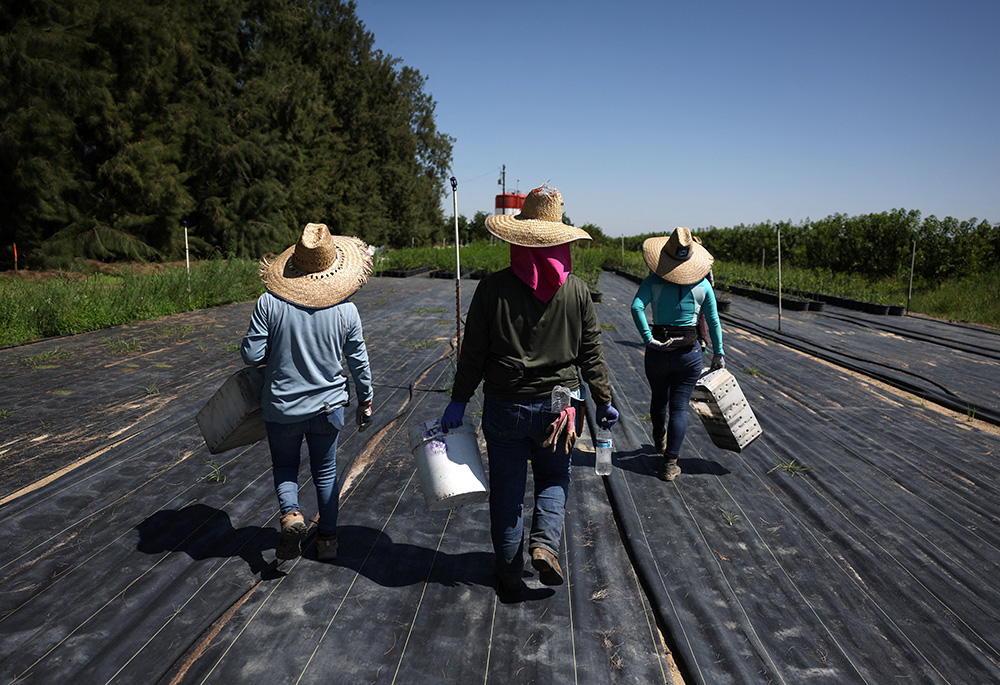
Guatemalan immigrants carry supplies into a field at a farm in Kern County, California, June 18, 2025. (OSV News/Reuters/Pilar Olivares)

by Mary Fontana
Join the Conversation
Send your thoughts to Letters to the Editor. Learn more
Rosario and María were born 20 years apart, but they had a few defining features in common. Both were foreign-born women who landed on the U.S.-Mexico border with young children. Both were undocumented. For a time, these women's lives in the U.S. followed a similar trajectory. They easily found work, but struggled to make ends meet.
But an act of Congress set Rosario and María on different paths. In 1986, the U.S. created a one-time route to legal status for undocumented people already living here. Through the new law, Rosario was able to earn citizenship.
María, arriving too late, was not.
This year marks the 40th anniversary of the Immigration Reform and Control Act, or IRCA. Since its passage, every major congressional attempt at comprehensive immigration reform has failed, even as the U.S. population of undocumented immigrants has more than tripled, to around 11 million. It is past time for the nation to create another opportunity for undocumented residents like María to come out of the shadows, earn citizenship and become full participants in the society to which they already belong. Such an opportunity would not constitute a reward for lawbreakers, but a recognition that our immigration law itself has been broken for a long time, unable to satisfy the needs of our globalized and multicultural nation.
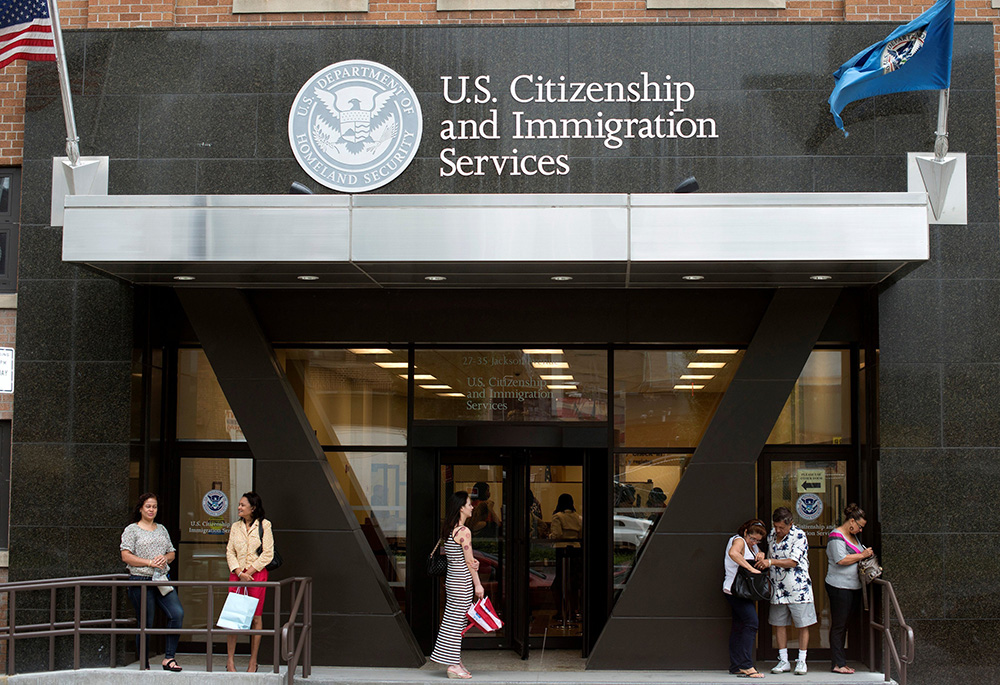
People are pictured in a file photo standing on the steps of the U.S. Citizenship and Immigration Services office in New York City. (OSV News/Reuters/Keith Bedford)
I interviewed Rosario and María for my book Strangers in the Province of Joy: Practicing Radical Hospitality on the US-Mexico Border. Their diverging stories illustrate the power of legalization to put a family on more stable footing. Consider: as a young woman, Rosario was undocumented, though one could hardly call her an immigrant. She lived her whole life in the conjoined cities of El Paso, Texas, and Ciudad Juárez, Chihuahua, Mexico. In the early 1960s, when she was born, Mexican nationals were still free to enter the country without restriction, and many in the region had close familial ties on both sides of the border.
But there were important differences between the two sides too, as Rosario learned. She married in her early 20s and gave birth to twins. When they were two months old, her husband abandoned the family. They moved into a shelter. Rosario realized that supporting a family would be much easier in El Paso than in Juárez: even though undocumented workers in the U.S. were often paid less than minimum wage, a low-wage worker in El Paso could still earn in one day what a factory employee in Juárez made in a week. Rosario got a job in a convenience store. She saved enough money to rent a small apartment with a friend, who helped with childcare. But she had little hope of further improving her family's circumstances: without citizenship or more schooling, she was only considered for low-paid, menial labor.
Advertisement
Then the Immigration Reform and Control Act changed her life. At age 26, along with around 2.7 million other undocumented immigrants, Rosario successfully applied for U.S. residency, then citizenship. Now she could secure better employment. She began to save money. When the twins started kindergarten, Rosario went back to school herself. She earned her GED, then a bachelor's degree, then a master's, working all the while to support her family. Finally, she embarked on a long career in management with a New Mexico school district.
Most satisfying to her, she saved enough money to buy a house. The woman who was once a homeless single mother could now invite her grown children to her home for family gatherings.
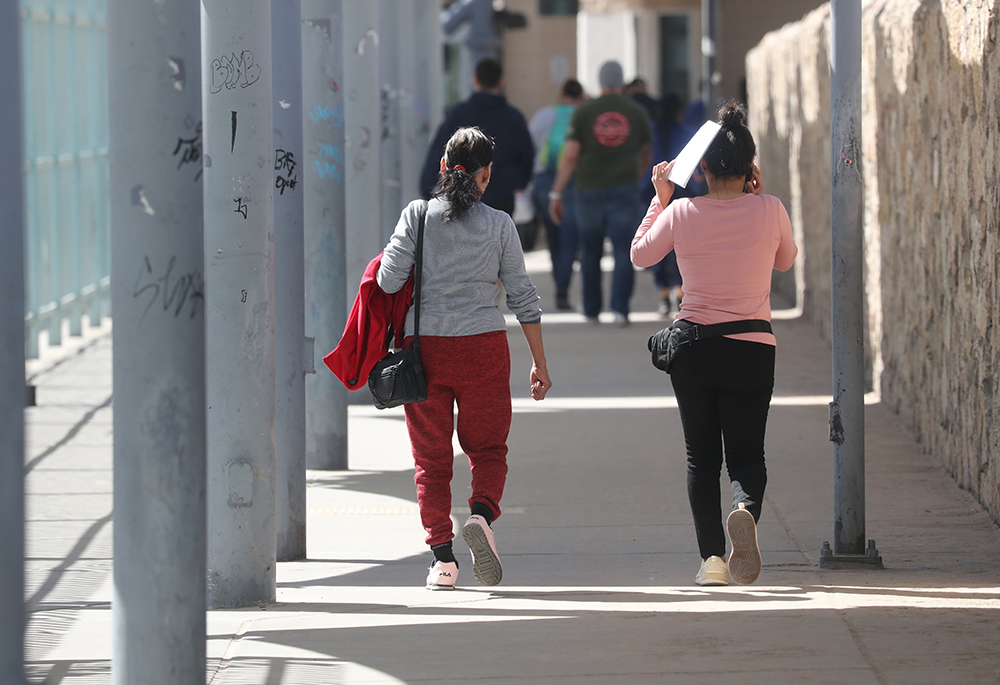
Women leave the port of entry in El Paso, Texas, to cross the bridge leading into Ciudad Juarez, Mexico, March 24, 2025, hours before Bishop Mark J. Seitz of El Paso led a protest and prayer vigil against mass deportations by the U.S. government. (OSV News/Bob Roller)
María's story ends differently. As a young woman in Honduras, she had worked full time in an American garment factory but didn't earn enough to support herself and her 1-year-old son. So she journeyed north. At the official port of entry in El Paso, María explained her plight to a sympathetic immigration official who allowed mother and child to cross. He told her she would soon be summoned before an immigration judge, but the summons never came. When she contacted the Immigration & Naturalization Service, she was told they could find no record of her.
Like Rosario, María soon figured out how to make a life in the U.S. She found employment quickly, but had to contend with low pay, poor working conditions and employers who exploited her vulnerability as an undocumented worker. She eventually married and had two more children. She went to trade school and opened her own business, something immigrants do at a higher rate than their US-born counterparts.
María has lived in the U.S. for decades now. She has never committed a crime. She has friends and family here. She contributes to the local economy as a small business owner; she pays taxes. But she cannot vote, obtain a driver's license, or visit her loved ones in Honduras. As she ages, she won't be eligible for Social Security or Medicare, no matter how much she has paid in. And she lives in constant fear of deportation, which would separate her from her U.S. citizen children.
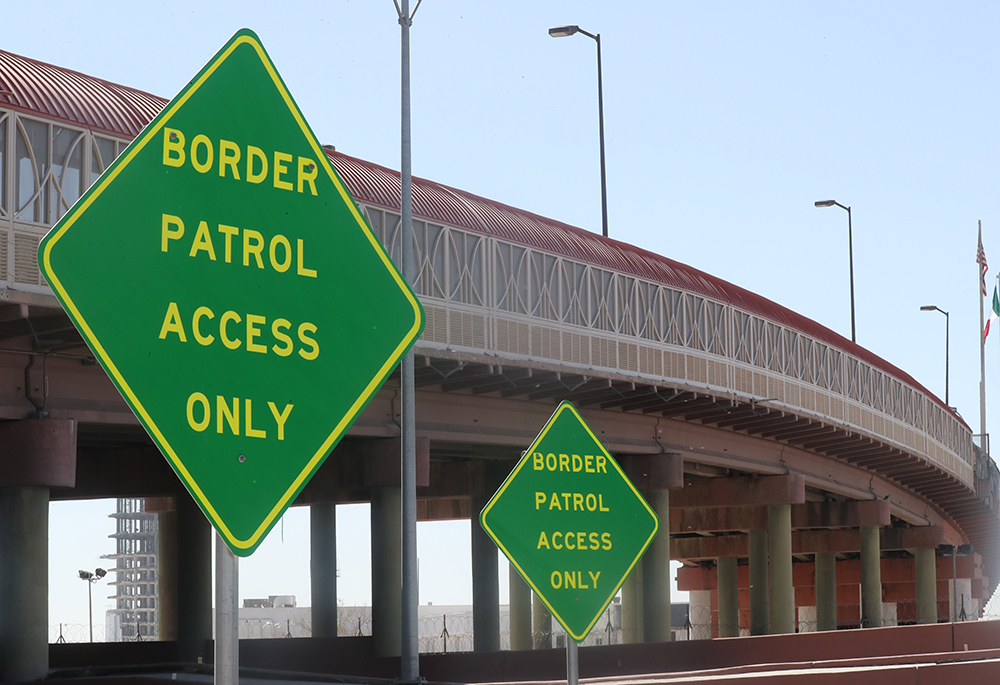
Signs are seen near the port of entry bridge in El Paso, Texas, to cross into Ciudad Juarez, Mexico, March 24, 2025. (OSV News/Bob Roller)
María's case is fairly typical. Over 90% of undocumented immigrants have no criminal history, and 80% have lived in the U.S. for at least five years. About one-third of undocumented immigrants have U.S.-citizen children who live with them, and collectively they pay upwards of $90 billion annually in taxes. Undocumented workers are overrepresented in sectors critical to our economy and infrastructure — like agriculture and farms, where they constitute over half the foreign-born work force, according to a 2020 report.
These are some of the factors motivating a bipartisan immigration reform bill called the Dignity Act (H.R. 4393), which was introduced into the U.S. House of Representatives last July. Among other provisions, the bill would provide temporary but renewable legal status, with work authorization, for undocumented immigrants who pay restitution and pass a background check. Regrettably, the bill falls short of creating a path to permanent legal status. Still, it represents a significant bipartisan compromise and a vast improvement over the status quo. But in this contentious election year, its fate remains uncertain.
Anyone who believes people enter the U.S. illegally because they don't want to jump through a few bureaucratic hoops has not seriously grappled with the risk, time, expense and sheer physical effort involved in much unauthorized migration. Most undocumented immigrants would leap at the chance to come legally — and happily turn in the required forms and fees. The problem is that for the vast majority, there is no legal path to entry. They generally do not qualify for U.S. visas, which prioritize highly educated workers and close family members of U.S. citizens. There is no line they can stand in that will realistically ever lead to long-term legal presence in the U.S.
It is time our nation once again provides a path to citizenship for people like Rosario and María, who have spent their lives helping to weave the rich fabric of this nation. It's in our best interests, and it's also the right thing to do.
The lack of legal pathways for poor workers should raise particular concerns for people of faith. Catholic social teaching has consistently affirmed that human beings have the right to migrate in order to provide for themselves and their families, a principle grounded in the belief that "the goods of the earth belong to all people." In a February statement, bishops from border states across the U.S. reaffirmed the position of the U.S. Conference of Catholic Bishops that "immigrants and their families who have built equities in our country and are otherwise law-abiding — the vast majority of the undocumented — should be given an opportunity to come out of the shadows and earn their citizenship over time." The bishops' conference has also written that "current immigration policy that criminalizes the mere attempt to immigrate and imprisons immigrants who have committed no crime or who have already served a just sentence for a crime is immoral."
The 1986 expansion of citizenship was a great gift, not only for people like Rosario but for our shared communities. But since then, our immigration system has failed to keep pace with changing national and global realities. Today, millions of undocumented immigrants are already an integral part of our society, living and working and deeply invested in this country. Limiting their full civic and economic participation serves no one. Rather, treating undocumented immigrants like criminals while relying on their labor undercuts the rule of law, leaves workers vulnerable to exploitation, suppresses wages and tax revenue, and destabilizes families. It is time our nation once again provides a path to citizenship for people like Rosario and María, who have spent their lives helping to weave the rich fabric of this nation. It's in our best interests, and it's also the right thing to do.