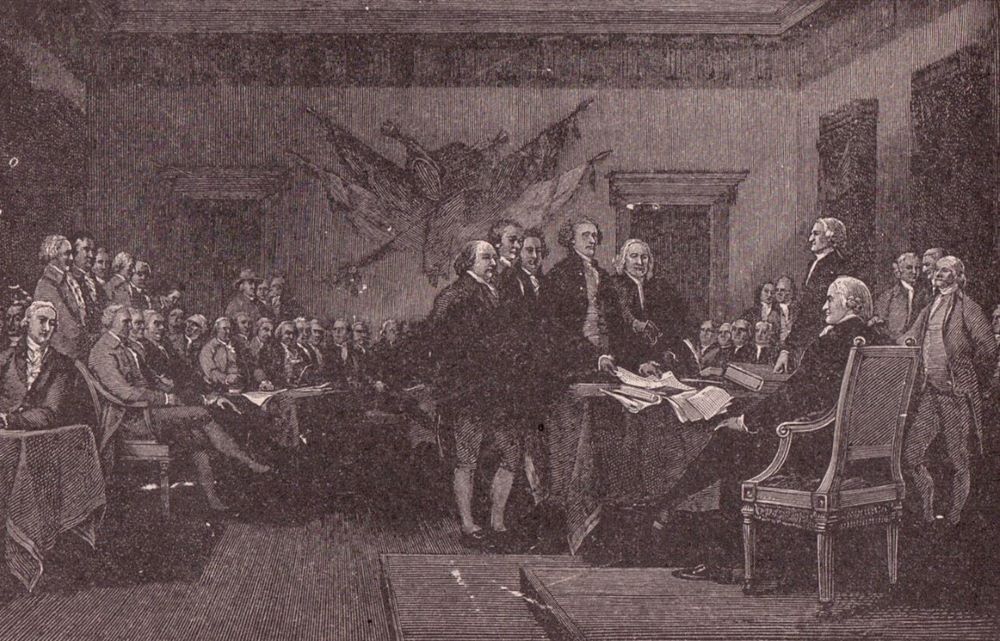
Illustration of the signing of the Declaration of Independence from "A History of the United States" by Wilbur F. Gordy, copyright 1920 by Charles Scribner's Sons of New York (Wikimedia Commons/CC BY 2.0)

Join the Conversation
Send your thoughts to Letters to the Editor. Learn more
The Heritage Foundation hosted an event on March 19 entitled "Catholicism and the American Founding." It is an important, interesting and complicated topic. Unfortunately, the principal speaker was Michael Knowles of The Daily Wire, and his interlocutor was Jay Richards, vice president of social and domestic policy at the Heritage Foundation. And their discussion was comic in its detachment from the actual American founding.
Speaking of the Founding Fathers, Knowles said, "the fact is the government they established is very closely, if not identical, it's very closely in accord with the ideal regime laid out by Thomas Aquinas in his Summa Theologiae and also in De Regno." Knowles rightly noted that Aquinas believed a sound government required a "kingly aspect," an "aristocratic aspect" and a "democratic aspect," which he compared to our presidency, the Senate and judiciary, and the House of Representatives.
Richards highlighted the references in the Declaration of Independence to the "Laws of Nature" and "Nature's God" and the "their Creator." Neither man brought up deism, which was the religion to which the Declaration's author subscribed.
Knowles suggested this line of intellectual influence ran from Aquinas, through the scholastic Jesuit thinkers Robert Bellarmine and Francisco Suarez, then to Algernon Sidney. Hmmm. Which one is not like the others? The first three were Catholic priests and thinkers. Sidney was a violent anti-Catholic. Considered a Whig martyr after his execution for treason, he did influence the American founding as one of the most frequently cited heroes of the "country Whig" political ideology. It was this ideology, which considered priestcraft one the greatest threats to freedom and thought that popery was akin to slavery, that historian Bernard Bailyn argued knitted together the various strands of political thought in the pre-revolutionary American colonies.
To be clear, there were many and varied ideas that informed those present in Philadelphia to draft the Declaration of Independence and, later, the Constitution. Most educated Englishmen of the late 17th and 18th centuries would be familiar with the writings of Algernon Sidney, and some even with Bellarmine, Suarez and Aquinas. But the most obvious source for the tripartite understanding of politics, its monarchical, aristocratic and democratic elements (and the corruption each posed), was Aristotle. Aquinas' reliance on Aristotle was unmentioned.
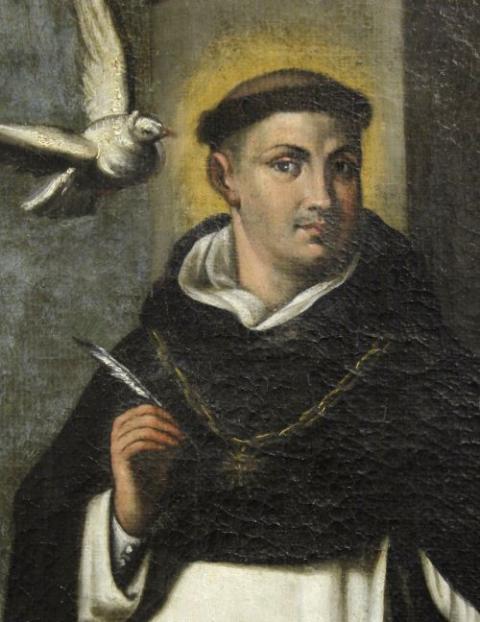
St. Thomas Aquinas is depicted in a painting at the Dominican House of Studies in Washington. (OSV News/Nancy Wiechec)
The larger problem here is the way Knowles disentangles ideas from their historical and cultural setting. History is the interplay of ideas, events and persons. Focusing exclusively on one to the exclusion of the others leads to misunderstanding, not clarity, and makes the manipulation of history much easier. Aquinas lived at a time when the Catholic Church had assumed responsibility for the whole of Western culture. Ideas about governance in later centuries inevitably were related to what occurred in the High Middle Ages, even if only by means of a rejection.
Later, Richards offered his theory of how we reached the intellectual and moral conundrum he perceives in our society today.
"Everyone who sort of knows recent American history, knows that, let's assume for argument's sake, that there was this natural right, natural law tradition that was sort of embedded in the founding and, you know, in the American mind," he said. "Progressivism, and I think this is a common trope, essentially sort of swept that away as our public philosophy, wanted to replace it with something else."
Progressivism? There are a variety of intellectual schools that tried to bury natural law thinking: libertarianism, scientific approaches, positivism. You can't hang it all on "progressivism." And, incidentally, natural right theory is at odds with natural law theory on many points, no matter how hard some conservative thinkers try to align them.
History is the interplay of ideas, events and persons. Focusing exclusively on one to the exclusion of the others leads to misunderstanding, not clarity, and makes the manipulation of history much easier.
The manipulation of American history continued. Turning to late colonial America, Richards noted "these were English colonies, many of them formed around religious covenants, you know, the Pilgrims fleeing the popish Henry VIII, or slightly too popish Henry VIII, they weren't classical liberals." He noted, correctly, that several states maintained established churches into the 19th century. Then he posed the question: "Is there some way to recover the basic idea, OK, no national establishment, but genuine free public exercise of religion in the public square?"
Let us set aside the fact that the Pilgrims arrived in 1620 and Henry VIII had gone to his maker in 1547. The bigger problem is the idea of a public square that has been scrubbed of religion, what the late Richard John Neuhaus claimed was a "naked public square." Today, as in the '80s when Neuhaus wrote his book on the subject, the American public square is filled with religious discourse. The Moral Majority and its progeny had become a key part of the Republican coalition in the '80s. Catholic bishops issued important pastoral letters on war and the economy. A Baptist minister, the Rev. Jesse Jackson, ran for president.
Today? Religion is even more prominent in the public square from Secretary of Defense Pete Hegseth to Democratic Senate candidate James Talarico, from the U.S. Catholic hierarchy defending migrants to resurgent antisemitism. Religion is everywhere in the public square. True, we do not permit the religion of the majority into public schools, and we are past the point when people can seriously consider secularism as a value-free answer to the problem of religious pluralism. This conundrum will not be solved by overturning the liberal inheritance of the Founding Fathers, nor by manipulating the history of the nation.
I suppose it is expecting too much for an organization with the word "heritage" in its title to actually evidence a deep understanding of our national heritage. Richards has been a purveyor of nonsense for years, as I learned when I was on a panel with him just before Pope Francis' 2015 visit to the U.S. If this is what passes for Catholic intellectual witness in the public square, our celebration of the nation's 250th anniversary is likely to be one long embarrassment.
You are reading a selection from Michael Sean Winters' weekly newsletter. To get the full edition — including the "In the News" link roundup — delivered 24 hours before it appears online, sign up here!
Advertisement