

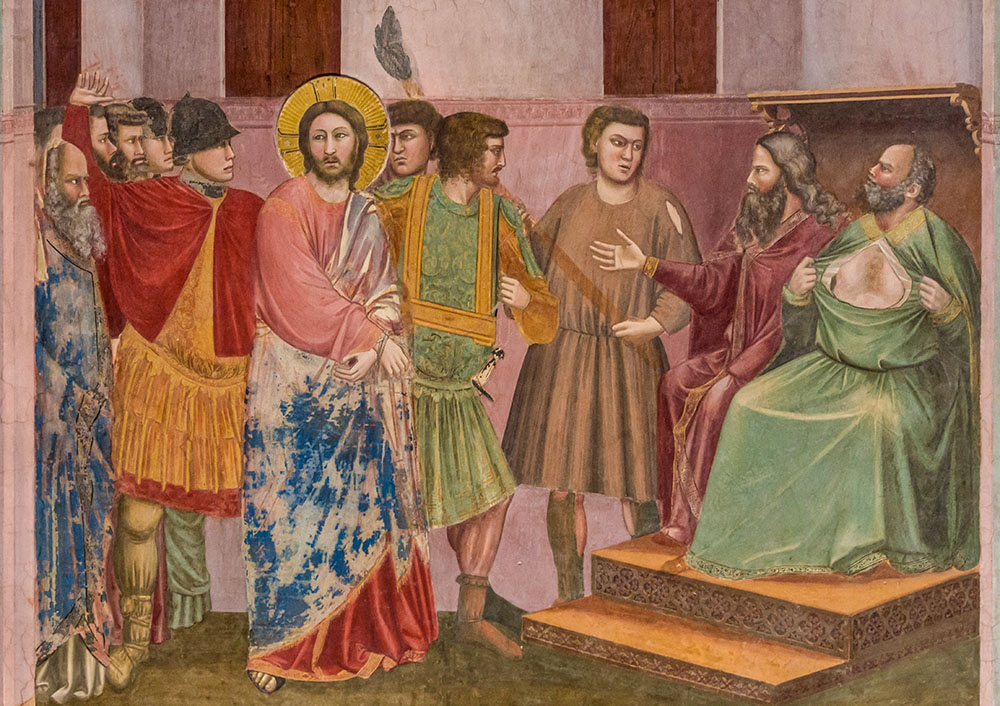
The high priest Caiaphas is depicted tearing his robe in grief at Jesus' blasphemy, in a detail from Giotto's 1305 fresco of the life of Christ, in the Scrovegni Chapel in Padua, Italy. (Wikimedia Commons/©Jörgens.mi, CC BY-SA 3.0)

Join the Conversation
Send your thoughts to Letters to the Editor. Learn more
This week, we enter into the mystery that is at the heart of our faith: the passion, death and resurrection of Jesus, the Nazorean. Everything else that we believe and do as Catholic Christians is rooted in this event.
"We have come to believe in God's love: in these words the Christian can express the fundamental decision of his life," wrote Pope Benedict XVI in his encyclical Deus Caritas Est. "Being Christian is not the result of an ethical choice or a lofty idea, but the encounter with an event, a person, which gives life a new horizon and a decisive direction."
Benedict's paraphrase from 1 John 4:16, with which he begins that passage, is rendered in the passive voice: "We have come to believe." Our belief is something that is received. 1 John 4:19 is explicit on this point: "We love because he first loved us." The priority of grace permeates the paschal triduum. It is a gift. We could never have fashioned such a story on our own. Who could have imagined that salvation would come through such an awesome series of events? Who, in Jesus' time or in our own, would dare God to pay such a price as expiation for our sins?
Advertisement
The religious authorities of the day could not imagine it. In St. Matthew's account of the Passion, which we heard last Sunday, the proximate reason for Jesus' death is recounted:
Then the high priest said to him,
"I order you to tell us under oath before the living God
whether you are the Christ, the Son of God."
Jesus said to him in reply,
"You have said so.
But I tell you:
From now on you will see 'the Son of Man
seated at the right hand of the Power'
and 'coming on the clouds of heaven.' "
Then the high priest tore his robes and said,
"He has blasphemed!
What further need have we of witnesses?
You have now heard the blasphemy."
The high priest was not wrong. For the people of that time, Jesus' claim to be one with the Father was blasphemous. He challenged the beliefs and practices of his time, and the religious leaders demanded he pay the price. On Good Friday, they believed they had defeated the blasphemer and exposed the false prophet. In the eyes of the world, in the eyes of the religious world, Jesus had it coming.
God's verdict on Jesus was different. God overturned the wisdom of the world and revealed to the apostles the central claim of the Christian faith: The Crucified lives. This is the decisive point, and distinguishing mark, of a Christian. We believe the Crucified lives.
Our agnostic and atheist friends can be kind. Jews and Muslims can have a finely tuned sense of justice. Buddhists can demonstrate great irenicism. What is different for us Christians is that our sense of what it means to be a human person, and what it means to be good, and what it means to be just, is revealed in the person of Jesus Christ and confirmed not because we find his teachings amenable or like our own, but because his teachings have been validated by God after being rejected by humankind. Because of these wondrous events we commemorate, it is not the message of Jesus that takes center stage. Jesus himself becomes the content of the kerygma. There is no other way that the Christian view of life makes sense.
We are lost until we recognize the priority of grace in our lives, but once found, our horizon expands beyond our wildest dreams.
The Second Vatican Council was perfectly clear on this point. "The truth is that only in the mystery of the incarnate Word does the mystery of man take on light," Gaudium et Spes states. "For Adam, the first man, was a figure of Him Who was to come, namely Christ the Lord. Christ, the final Adam, by the revelation of the mystery of the Father and His love, fully reveals man to man himself and makes his supreme calling clear."
And, a few paragraphs later in that same document, the council fathers state: "Indeed, the Lord Jesus, when He prayed to the Father, 'that all may be one. . . as we are one' (John 17:21-22) opened up vistas closed to human reason, for He implied a certain likeness between the union of the divine Persons, and the unity of God's sons in truth and charity. This likeness reveals that man, who is the only creature on earth which God willed for itself, cannot fully find himself except through a sincere gift of himself." We are lost until we recognize the priority of grace in our lives, but once found, our horizon expands beyond our wildest dreams.
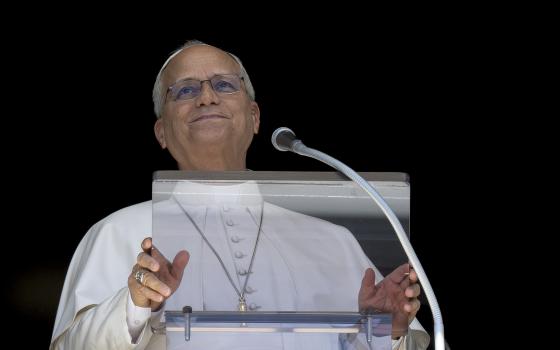
This will be the first triduum led by Pope Leo XIV. This son of Augustine, who is known as "the doctor of grace," can hopefully help our brutal and self-centered world to remember that all is grace and that "grace is everywhere," to quote Georges Bernanos in Diary of a Country Priest. Our wonderful pope can inspire us all to hear both the dreadful words "Crucify him!" and the amazing words "He is not here; he has been raised," to make those words our own and to share them with our hurting world. The conversion from sin and death to grace and life that is the heart of the triduum is the conversion to which we are all called. It is the most magnificent calling in human history.
You are reading a selection from Michael Sean Winters' weekly newsletter. To get the full edition — including the "In the News" link roundup — delivered 24 hours before it appears online, sign up here!


_jm56817_(cropped).jpg)