(Unsplash/Andrey K.)

by Melinda Henneberger
Join the Conversation
Send your thoughts to Letters to the Editor. Learn more
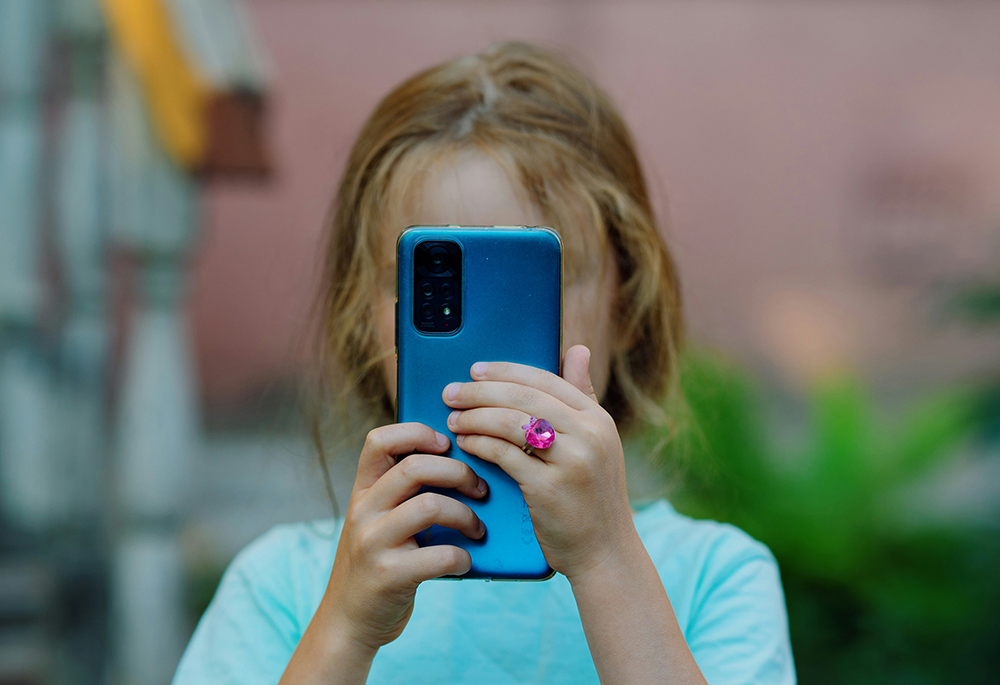
The digital wellness and safety class for third graders that I sat in on recently is part of a pilot program that every kid and plenty of adults, too, for that matter, desperately need, and I hope it gets picked up everywhere.
"When we use screens," the teacher, Sherri Berry, told her students at John Paul II Catholic School in Overland Park, Kansas, "believe it or not, we're always still dealing with real people. And real people have real feelings. Today we're going to learn how to be cyber savvy. Cyber means online. Savvy means smart. We've talked about our thinking brain and our feeling brain. So we have to remember, we always have to use our thinking brain to be smart online — to make kind, smart choices that are safe online, to handle even tough situations and to know what to do if something goes wrong."
The kids were as all-in as if she'd been handing out ice cream treats instead of info about cyber bullying and online citizenship.
It's been a minute since my Catholic school days, so I was amazed when she asked what they'd learned in this same class the previous week and they said, in unison, "Stop, think, then decide or click."
A boy raised his hand and added, "Take time, don't just send something mean."
"Stop, choose, and if you don't know what to choose, ask a grown-up," said a girl on the front row.
"I love it!" Berry told them, and she wasn't the only one. "You guys are so good at this!"
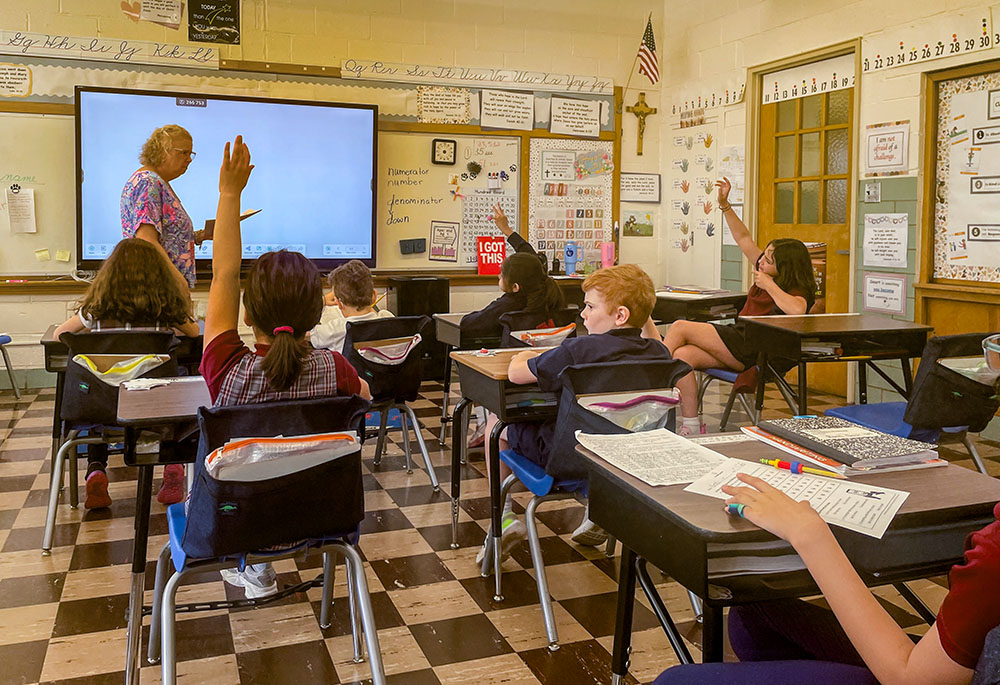
Sherri Berry teaches third graders a lesson in digital health and safety at John Paul II Catholic School in Overland Park, Kansas. (Melinda Henneberger)
Many hands flew up to answer every question, like, "What do you think I do before I send an email?"
"You try to remember not to make it too harsh," one student offered.
"If something online feels wrong, what do you do?"
"Tell a trusted adult," said another 9-year-old.
In this class, students learn about how online activity changes the brain, and maybe most importantly of all, to have a recovery plan already in place before something goes wrong.
For third graders, what Berry says about that is not at all frightening: "It's important to know, being in charge online doesn't mean being perfect. We all make mistakes. But it does mean being aware, thoughtful and ready with a plan."
The inspiration for this new program, called the Screen Guardians, was faith-based. The K-12 curriculum itself, however, is based on brain science. It was piloted in four Catholic and public schools in Kansas and Texas this first year, and brands itself as "Not anti-technology. Pro-child."
As a parent, its creator, Katie Longhauser, had for years been aware of and advocating against the toll of digital unwellness on her community. Then two years ago, a local high school student died by suicide after an inappropriate picture was posted online. "People think things like this don't happen in 'Perfect Village' "— aka upscale Prairie Village, Kansas, but nope, they happen everywhere.
It isn't only how screen time changes the brain, but how it robs us of crucial quiet time — the default mode network — that boosts creativity and imagination and guards against anxiety.
"I knew it needed to be done," said Longhauser, "and I had a moment where I asked God and said, 'If you want me in this space, I need a sign,' and nothing subtle, either. A couple of doors had closed, and I said I need doors thrown open."
That same day, she got a call from NPR inviting her to come on and talk, as she had been doing on her Screen Guardians podcast, about the decision not to allow her daughter, who was 11, on social media. Then just the right people, she said, appeared to help her develop the curriculum.
One was Susan Dunaway, a counselor with a specialty in neurofeedback, who has been trying for 10 years to tell Kansas boards of education about the impact of screentime on brains. Only recently, she was invited back to tell them again, now that it's obvious she was right all along.
It isn't only how screen time changes the brain, she told them, but how it robs us of crucial quiet time — the default mode network — that boosts creativity and imagination and guards against anxiety.
Another important contributor was the mother of a child who died by suicide after making a wrong comment online, which resulted in his arrest at age 13. That mother told me that unless we want what happened to her child to happen more frequently, recovery plans are a necessity. She worked with Longhauser to develop strategies for kids learning how to use technology the right way.
Advertisement
All of this dovetails with what Pope Leo XIV said in his encyclical about the appropriate use of and awareness of the risks of artificial intelligence, and Longhauser's team was already working on the addition of an AI component to its curriculum for next year.
"We just concluded the cyberbullying lesson, and it hit home that there's a person behind that screen, and that person has a mother and a father," said Michael Cook, who teaches the class to fourth through eighth graders at John Paul II. "They came in nervous about it, and they left with armor. They left knowing there's a process — and even I learned some things about the brain."
"I told them about Abraham Lincoln, and all of the letters he wrote that he never sent. That was huge for the fourth, fifth and sixth grades. The information being taught is relevant and real to everyone; it's here, and everyone needs it."
To me, here is the ultimate endorsement of how it went this first year, from Brad Grabs, the parent of a rising fifth grader at John Paul II: "The main thing," he says, is that his daughter is now "more understanding of the limits and restrictions — the guardrails — we put in place, because she's more informed. About how it affects your brain, your attention, your mood."
"We've been thrilled with the program — so many parents have reached out and thanked us," said Kathleen Mersman, who just finished her first year as principal at John Paul II.
This problem of living online and making mistakes there is enormous, and the solution is in no way easy. But a program like this seems like an important and overdue step in taking on the work ahead.