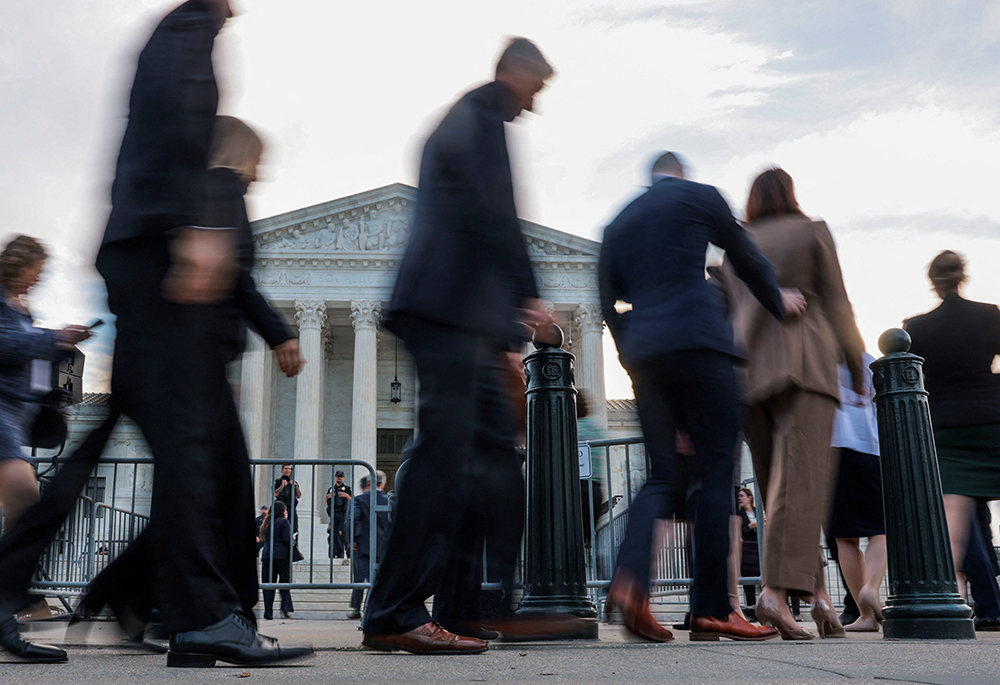
People walk in front of the U.S. Supreme Court building on the first day of the court's new term in Washington Oct. 5, 2026. (OSV News/Reuters/Jonathan Ernst)
The Catholic parishes and individuals in Colorado who seek exception to state nondiscrimination laws in order to receive state funding may soon get clarity from the U.S. Supreme Court. Whatever the high court decides, however, will do little to resolve the underlying tensions within the church over excluding children of same-sex parents from church classrooms.
The core dispute in St. Mary Catholic Parish v. Roy is over whether Catholic schools accepting funds from a state program designed to provide universal preschool education can stipulate that parents sign an agreement that they "support and uphold" church teaching. The obvious and immediate exclusion would be same-sex parents.
The two Colorado parishes and a Catholic couple, represented by the Becket Fund for Religious Liberty, argue that the refusal of Colorado to carve out an exception for Catholic schools violated the Constitution's guarantee of free exercise of religion. The argument depends on reasoning the court used in ruling for religious institutions in previous cases in which religious schools were excluded from public programs benefiting other schools.
The Supreme Court will hear the Colorado case this fall. Both the Federal District Court in Denver and the U.S. Court of Appeals disagreed with the church's brief, the latter noting that the Colorado program, far from excluding religious schools, "welcomed and actively solicited their participation." The only restraint in receiving funds was one that applied to all preschools, that they abide by state nondiscrimination laws. Those laws require all participating schools to accept children of same-sex couples.
The case seems to elevate — and balance on — a question that emerges, according to experts, from an unprecedented shift in the relationship between church and state resulting from decisions largely bearing the signature of Chief Justice John Roberts. The question: Is religion afforded equality or preference?
Whatever the decision, and however far-reaching its consequences in the wider culture, Catholics can be assured that the issues involved will remain far from settled within the church. Bishops themselves hold varying views on the matter. Further, the questions the case raises outside the courtroom about the Catholic community will resound at a far deeper level than any legal decision. What of the church's welcome of children? How qualified is that welcome in some dioceses? How many will the church exclude? Over what issues?
Advertisement
It is difficult to imagine that church officials can scrutinize the compliance with Catholic teaching of all the parents who show up to enroll a child at school. Can church and school officials screen for remarriage without annulments, fertility treatments, vasectomies and other matters that remain out of sight?
Demanding doctrinal purity may bring a certain sense of security and certainty to the community, but a great deal will also be lost in not extending a broader welcome to humanity — messy and unpredictable as that might be at times.
The tension between such approaches is likely to become more strained before there is resolution given not only the exploration of such topics at the Vatican level but also because of a decision fashioned by the late Justice Antonin Scalia. As reported earlier here, the court in this case "will consider narrowing a landmark 1990 decision" written by Scalia that "found religious practices don't create exemptions from broadly applicable laws." If that standard were to apply in the Colorado case, it is difficult to see how the church could claim such an exemption.
While the Becket lawyers wrote confidently in their brief of the kind of Catholic community that ought to be protected by an exception to state law, that certainty may be misplaced.
One need only note Pope Francis' embrace of LGBTQ ministries evidenced by his correspondence with and very positive meeting with Sr. Jeannine Gramick, co-founder of New Ways Ministry, as well as the blessing he gave Jesuit Fr. James Martin's work with Outreach, another ministry to the LGBTQ community. The approval by Francis and the ongoing encouragement of such activity by Pope Leo XIV do not represent a radical change in the church's teaching on homosexual activity. But those gestures certainly exemplify the kind of opening and welcoming that Catholic communities should extend.
Just this month, church leaders gathered in Rome to discuss "what is currently being done in the local churches" in light of Amoris Laetitia, the Francis document that ruffled some feathers by opening the door to sacramental access for divorced and remarried Catholics. His instruction suggesting "in vague terms and a single, strategically placed footnote — that bishops and priests could do so on a case-by-case basis after accompanying them on a spiritual journey of discernment" riled conservative corners of the institution.
It is increasingly obvious that attitudes at the highest levels of church governance are changing about some matters in ways once considered unthinkable.
Given the tenor of the Roberts court and the extent to which it has blurred the distinction between church and state, Colorado Catholics may win their case and thus the right to take the state's money while both keeping distance from and maintaining implicit judgment upon those it deems outside the range of God's tolerance.
That such permission exists doesn't mean it will be exploited by all bishops. There's a mixed record on how dioceses decide to either receive or reject the children of same-sex couples. For instance, Archbishop John Wester of Santa Fe, New Mexico, believes the church should baptize the children of same-sex couples, saying that refusing to do so "is not in keeping" with proper church outreach. If the church baptizes the children, one can presume it will certainly welcome them into its classrooms.
In 2010, a peculiar coincidence demonstrated how differently Catholic leaders could think about the issue. Within a two-month period, Archbishop Charles Chaput, then of the Archdiocese of Denver, and Cardinal Sean O'Malley, who headed the Archdiocese of Boston, both Capuchin Franciscans who were once classmates, faced the same question: Do we admit to our schools the children of same-sex parents?
In both archdioceses, the pastors who initially faced the question answered "no."
Chaput backed up the pastor, citing the need to uphold "the authentic faith of the church" and claiming that in this case "archdiocesan policy was followed faithfully."
O'Malley reversed the decision of the pastor in Boston and then, on his blog, told a story about a child he met while serving in the West Indies. At the funeral Mass for her mother, a notorious madam who ran a brothel, "I met the woman's daughter, a lovely little girl," O'Malley wrote. "I asked her what grade she was in. She replied that she didn't go to school. I sent a stern glance to her grandmother, who said: 'Her name is the same as that of the brothel. The other children were so cruel to her, she left the public school.' I told her grandmother, 'Take her to the Catholic school tomorrow.' "
He further said Catholic schools "exist for the good of the children. ... We have never had categories of people who were excluded."
The points of decision seem, from that example, rather clear. No Supreme Court decision can substitute for the choice that we have to make. In one instance, church rules and teaching are paramount. In the other, no child will be turned away.
It is always dangerous to mine Scripture for proof texts, but there seems little complexity or nuance in the words of Jesus to disciples attempting to ban children from approaching him. "Let the children come to me, and do not prevent them; for the kingdom of heaven belongs to such as these."