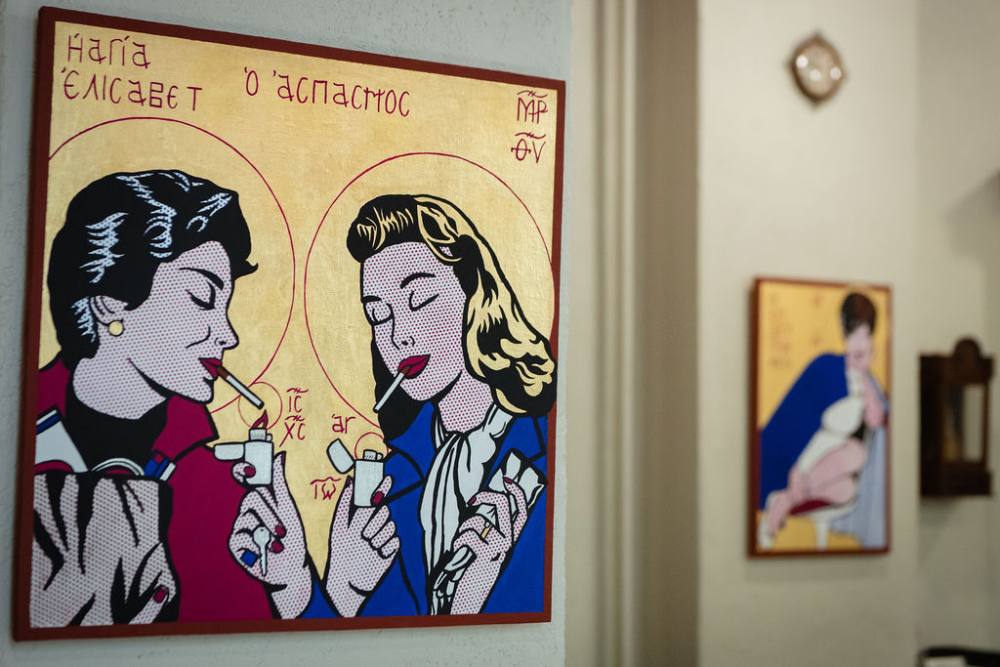
"The Visitation," 2025, by Nicholas Leeper, SJ on display at the Church of St. Francis Xavier in New York City. (Courtesy of Reena Rose Sibayan/Xavier High School)

by Nicholas Leeper
Join the Conversation
Send your thoughts to Letters to the Editor. Learn more
Catholic art is always contemporary. Yet some Catholic art groups are emphasizing the need to return to traditional art forms that belong more to 1526 than to 2026. For some, these forms have become the only acceptable visual style of Catholicism, prompting a subtle form of iconoclasm that betrays the ethos of our Catholic artistic heritage. From The "Salus Populi Romani" in St. Mary Major in Rome to Caravaggio's Madonnas, Catholic art has always found God working through and in the world. There is nothing sacred about such artistic styles; in fact, they can become idols if we worship the aesthetic instead of the Absolute.
My exhibition, "Twilight of the Idols", on display at The Church of St. Francis Xavier until May 29, is an invitation to consider the nature of idols, icons and iconoclasm. The show features 14 artworks that combine Byzantine iconography, pop art and advertisements using gold leaf and Benday dots. The artworks draw on what some consider modern-day idols: advertisements, the cult of celebrity and pop culture, and transfigure these into icons.
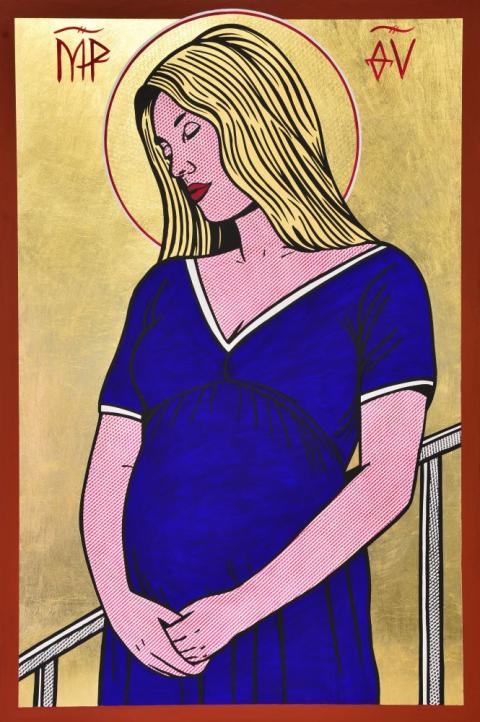
"Madonna del Parto (Once Upon a Time...In Bethlehem)," 2026. (Courtesy of Nicholas Leeper)
On idols
Today, we talk about idols casually. We idolize celebrities, brands and the rich, believing that becoming like them will bring us true happiness, but that doesn't mean that these things are inherently idols.
"Madonna del Parto (Once Upon a Time…In Bethlehem)" borrows such idol imagery but invites us to see it differently. Without any context, it looks like an innocent depiction of the pregnant Virgin Mary in a modern blue dress and with golden, blonde hair. However, the image's template is from a photo of Sharon Tate shortly before she was murdered in her Hollywood home. Her image, since her death, now carries a certain meaning it didn't have prior.
Tate presented as the Virgin Mary can help reveal something new about Our Lady. Isn't this a type of Sorrowful Mother? When they kill Christ on the Cross is that not also killing his Mother? The painting is not a canonization of the celebrity, but reinterprets her story to help us better understand Mary.
All art is a lie that tells the truth. Art becomes an idol when the lie is taken as the truth. In the desert in Numbers 21, God commands Moses to craft a serpent and raise it on a stick so those bitten by venomous snakes would not die of poison. At first, this object is venerated as a means by which God's grace and healing power are brought about. But later, King Hezekiah, a good king, destroyed the Bronze Serpent because the people had begun to worship it instead of God (cf. 2 Kings 18:4). A once-holy object becomes an idol. What mediated God's healing power is later mistaken for God himself. And perhaps we do the same with our own holy images.
Today, there isn't so much the call for a total erasure of pictures, but more a calcification of the aesthetic — that Catholic art can only appear a certain way.
On iconoclasm
There is an anxiety about what can count as sacred art. One painting in the exhibition, "The Visitation," is drawn from a Zippo lighter ad. Two women are taking a break and lighting each other's cigarettes. The ad is reimagined as the moment when Mary and Elizabeth meet in Luke 2, each bearing their miraculous children: Jesus and John the Baptist. However, here, the halos for each of those children are around the items: the lighter for John the Baptist and the flame or the cigarette for Jesus.
At first look, the image of this as the Visitation can be unsettling, but the discomfort raises the question: What kinds of things are we willing to imagine as capable of communicating holiness? Is John the Baptist like a lighter that prepares the way for Christ, who is the flame or the cigarette? To understand God through analogy means we need to parse out the true from the false. The danger is shunning art because we fail to look for the truth.
If idolatry treats images as absolutes, then iconoclasm is the opposite, which distrusts all images. It sees all art as a lie without the possibility of revealing any truth, and so it calls for their eradication. Today, there isn't so much the call for a total erasure of pictures, but more a calcification of the aesthetic — that Catholic art can only appear a certain way. But in our tradition, since the Second Council of Nicaea and the writings of St. John Damascene, iconoclasm has been rejected because we worship through images and not the image, or the style, itself.
"Madonna and Child (Tomatokos)," 2026. (Courtesy of Nicholas Leeper)
On icons
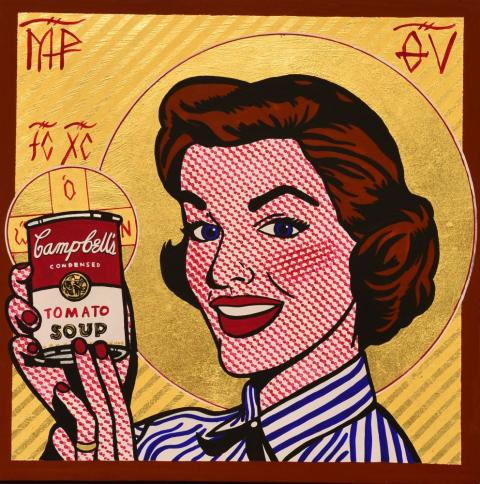
Icons and idols are not objects, but outlooks. In the exhibition, "Madonna and Child (Tomatokos)" shows a 1950s housewife advertising a can of Campbell's Tomato Soup. The woman has the halo of Mary, and the can of soup has Christ's halo.
The point is not to say that Christ is literally a mass-produced tin can. But like the can, the food Christ gives is ordinary and is made accessible for the whole world. The point is not to say that we need to start consecrating Campbell's. Instead, the idea is that God can work through something so banal as a can of soup we get from the store. And from this type of reading, we can see all things through a religious lens.
Icons are the space between the two extremes of idolatry and iconoclasm. In the Christian East, icons are not pictures to look at, but windows into heaven. Their purpose is to invite conversation with the saints depicted. They are placed in homes and churches to remind us that the saints are all around, blessing us. But ultimately, icons train our perception.
Advertisement
There are many details in icons, and our job is to read icons, not just look at them. Icons are traditionally understood as written and not painted because they contain a teaching. The idea is that all creation contains such a teaching as well. We can read the icon so that we can learn to legibly read the world for God's presence, too.
"Twilight of the Idols" is about the end of idolatry and iconoclasm and an invitation to see all things as icons — especially in our contemporary culture. The goal is not to escape our world, but instead to see it differently. Our job as Catholics is not to make the world look Catholic but to see the world as Catholics — with the universality that our church is all about.