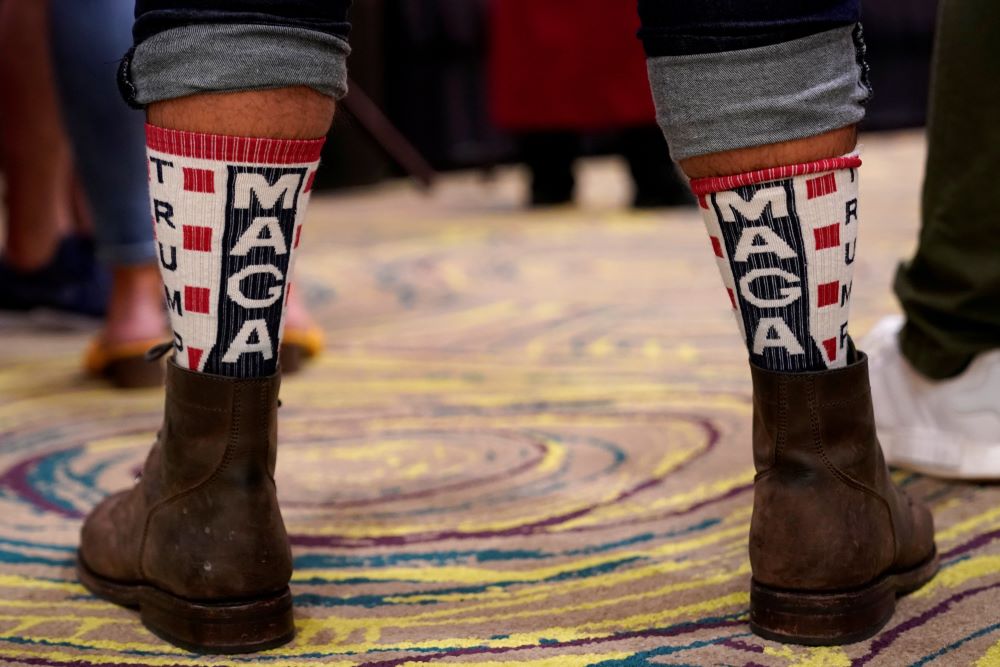
A supporter of President Donald Trump wears "MAGA" socks at the Oklahoma GOP watch party in Edmond, Okla., Nov. 3, 2020. (CNS/Reuters/Nick Oxford)

by Rebecca Bratten Weiss
Join the Conversation
Send your thoughts to Letters to the Editor. Learn more
Clashes between Pope Leo XIV and the Donald Trump administration over the latter's assaults on human dignity and bellicose foreign policy have been framed as a clash between church and state. And while Trump's attacks on Leo have elicited outrage from both Catholics and non-Catholics around the world, Leo himself insists he is not trying to debate the president, but is focused on promoting peace.
For many Catholics in the United States, this conflict is a reminder of the country's legacy of anti-Catholicism. The MAGA movement has deep roots in a culture of nativism and xenophobia that was long hostile to Catholics. The KKK often targeted Catholics as well as Black and Jewish people. For decades, immigrants from Catholic nations were viewed with suspicion. And the first Catholic president, John F. Kennedy, faced accusations that he'd be taking orders from Rome instead of working for the American people.
"Many are realizing that the soul of MAGA is viscerally anti-Catholic," Austen Ivereigh told NCR last month in a piece outlining a broader fracture in the Catholic-evangelical MAGA coalition over attitudes towards Israel. His sentiment is shared by others, who are positioning the Trump and Leo conflict as the latest entry in a "MAGA evangelical vs. Roman Catholic" saga.
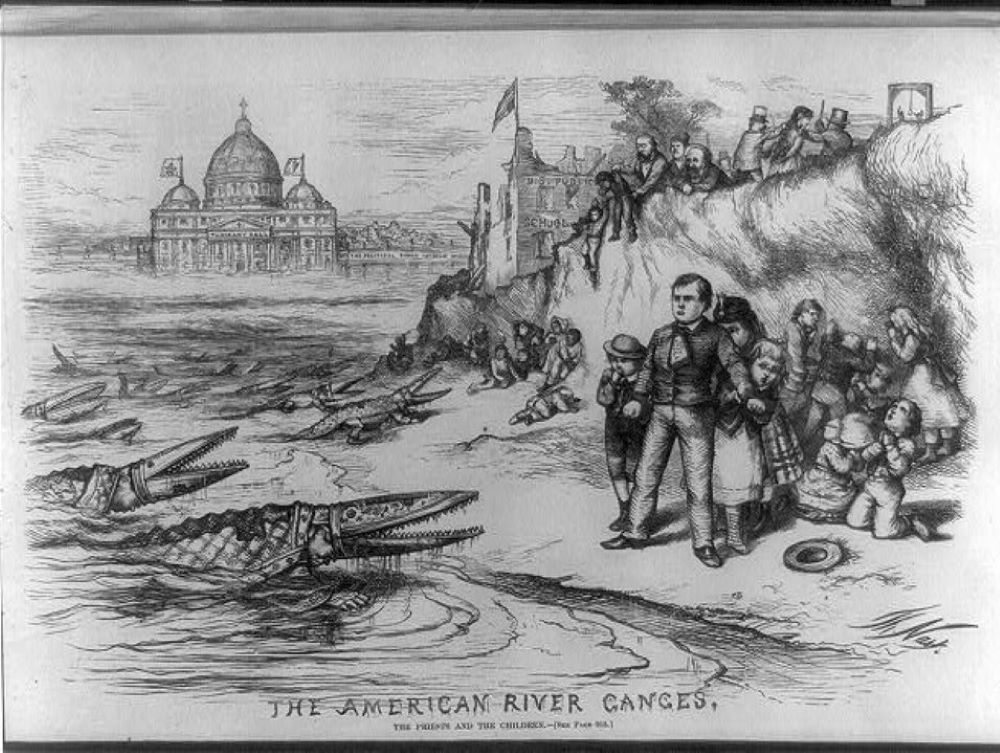
This anti-Catholic cartoon bv Thomas Nast was published in Harper's Weekly in 1871. (Library of Congress)
Those who see this conflict as a sign of an inevitable rift between Catholic and evangelical MAGAs are correct up to a point. Many conservative evangelicals — a key group in religious support for Trump who are represented in the administration itself — do not consider Catholics "real Christians." MAGA evangelicals are also irate at conservative Catholics for what they perceive as fracturing a culture war coalition. The rift is real, and will likely keep widening.
But if evangelicals and Catholics who have been instrumental in initiating this far-right regime turn on each other, there's no compelling reason to believe this would be a case of evangelicals oppressing Catholics. It might as easily be the other way around, since Catholics wield quite a bit of power in the MAGA regime, too.
Let's not forget that white Catholics helped get Trump elected, and that high-powered, well-funded Catholic groups are intimately involved in the MAGA movement, and have been orchestrating and manipulating it. Despite the MAGA movement's innate sexism, conservative Catholic women influencers have worked, both covertly and overtly, to promote Trump.
Catholic support for Trump has decreased, and a recent poll found that only 40% of Catholic respondents approve of Trump's handling of the conflict with Iran. During the Francis papacy, many conservative Catholics got comfortable with reviling the pope and defending Trump, and perhaps this prepped them to choose the president over Leo, too.
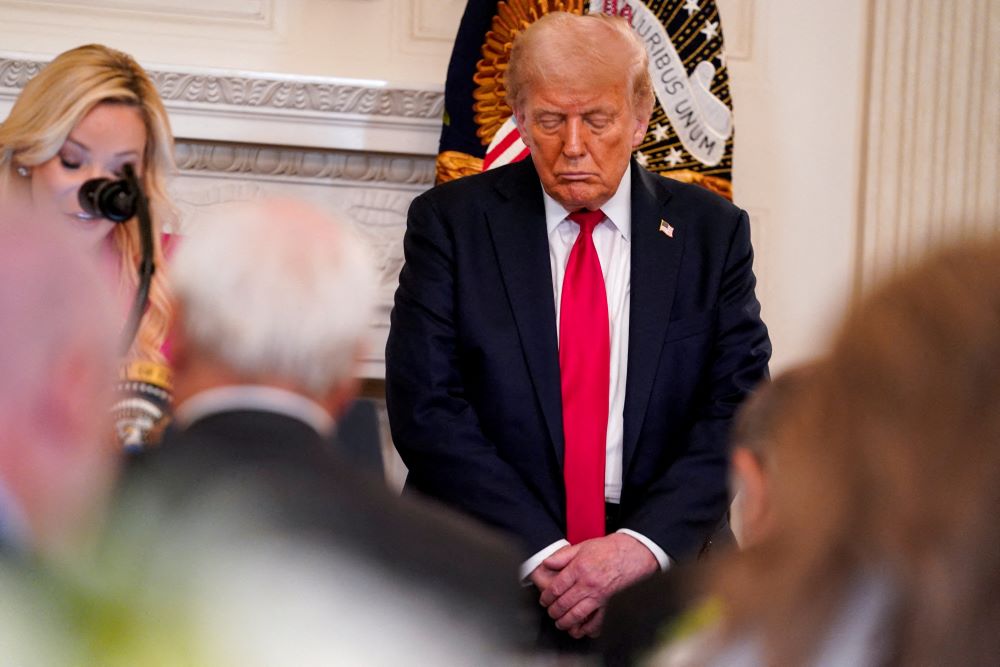
U.S. President Donald Trump takes part in a prayer, led by Paula White, senior adviser to the White House Faith Office, during the White House Faith Office Luncheon at the White House in Washington July 14, 2025. (OSV News/Reuters/Nathan Howard)
This is not a matter of anti-Catholic vs. Catholic. It is, rather, a struggle for the soul of the church, a clash between those who wish to weaponize religion for domination, and those who want it to be a source of healing and liberation. And while MAGA's goals are diametrically opposed to the church's core teachings, this is hardly the first time the Catholic Church has betrayed Gospel values of justice, charity and a preferential option for the poor.
Flirting with authoritarianism is, in a sense, part of the Catholic tradition — the part that far right radical traditionalists want to reclaim. Despite Jesus and his first followers being Jewish, the Catholic Church created and fostered antisemitism. Despite Jesus' radical teachings on nonviolence, the Catholic Church waged religious wars and murdered people simply for holding different beliefs. Despite the early church's Gospel-based egalitarianism, the Catholic Church relegated women to positions of subservience and continues to do so even when many other organizations at least nominally commit to gender equality. The church was complicit in genocide of Indigenous populations. And it enabled, and even defended and participated in, the kidnapping, trafficking and enslavement of Black Africans, for centuries.
This is our legacy. But ours is also the legacy of Jesus and the first apostles, of the martyrs who refused to capitulate to empire, the lay and religious reformers who served the poor and denounced corruption. Ours is the legacy of Teresa of Avila, Thea Bowman and Oscar Romero.
Advertisement
The problem is, we who aim to follow this life-giving legacy are sometimes tempted to use these Christian heroes to exonerate the church's other legacy — to pretend that the church has only ever been a force for justice in the world. When confronting xenophobic or bigoted Catholics, we may be tempted to say "oh those aren't real Catholics." This is a form of essentialism that neglects lived, historical reality in favor of an abstract ideal. Choosing a hate-filled authoritarian over the teachings of Jesus is something we've done before. Until we confront this reality, we will not be able to rise above that shameful past. No, it's not "of Christ." But it is who we have sometimes been in the world.
The right-wing Catholics finally detaching themselves from the MAGA movement are not waking up to justice. They were fine with the Trump administration's many assaults on the vulnerable. They just are upset that anyone, especially the leader they thought they had in their pocket, would dare to defy them.
It's not the 1960s anymore. Catholics are not a persecuted minority in the United States. We are a powerful political force. This force can be wielded for justice or for injustice, and Catholics need to come to grips with the fact that the tale of institutional Catholicism working against justice is woven through our 2,000-year history, globally and in the United States.
For the Christian church as a whole, this is one of those crucible moments, where we are tested to see whether we will be true to Jesus or succumb to the lure of amoral powers. Will we be the church of the papal princes like Alexander VI, the church of bigoted influencers like Fr. Charles Coughlin? Or, conversely, will we be the church of St. Francis of Assisi, St. Teresa of Avila, St. Oscar Romero and Servant of God Thea Bowman? That's the question we need to address. Leo is showing us the way. But let's not pretend it's the way the church has always taken.