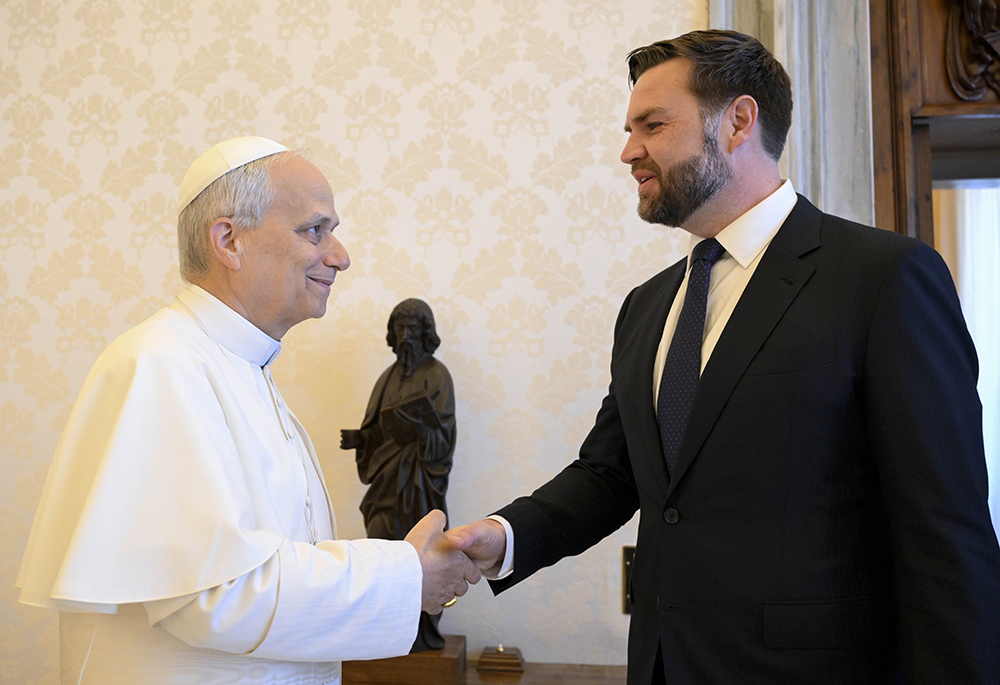
Pope Leo XIV shakes hands with U.S. Vice President JD Vance in the library of the Apostolic Palace at the Vatican May 19, 2025. (CNS/Vatican Media)

Join the Conversation
Send your thoughts to Letters to the Editor. Learn more
The estuary where politics and religion intermingle has rarely been a place of great clarity. Brackishness is a form of unpleasantness; you can't drink brackish water. Yet, religion and politics are two of the great engines of history and so collide they will.
The past week or so, a particular kind of clarity has emerged from the back-and-forth between the Trump administration and Pope Leo XIV on the subject of war. The president and his Catholic vice president have provided a master class in how not to understand the relationship between religion and politics.
The president's penchant for ranting on social media is one of his worst characteristics, but when those rants stand in contrast to Leo's measured, thoughtful preaching of the Gospel, the rants are worse than usual. The president's childish boastfulness — "I don't want a Pope who criticizes the President of the United States because I'm doing exactly what I was elected, IN A LANDSLIDE, to do, setting Record Low Numbers in Crime, and creating the Greatest Stock Market in History" — doesn't stand a chance against the Holy Father reminding the Christian faithful of the beatitude "Blessed are the peacemakers."
JD Vance, who was a Protestant five minutes ago, has rightly taken a shellacking for his pretension at theological engagement with the pope. First, Vance said the Vatican should "stick to matters of morality." Here he betrays his evangelical roots. For some of our evangelical brothers and sisters, morality is always personal, and mostly concerned with activities below the belt. The Catholic Church understands that the moral vocation of the Christian extends to public life, to the way we structure society and the way we conduct foreign affairs.
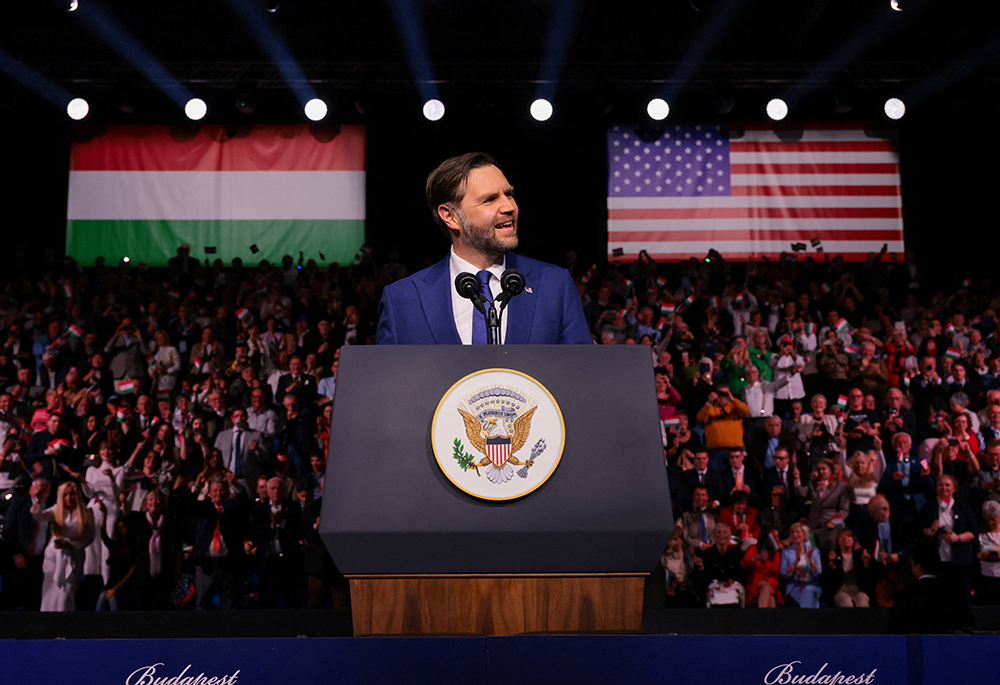
U.S. Vice President JD Vance smiles as he speaks to the crowd during a Day of Friendship event at MTK Sportpark in Budapest April 7, 2026. (OSV News/Jonathan Ernst, pool via Reuters)
The Christian God first revealed himself to a people, Israel, not to a person. For Christians, our understanding of the biblical claim that we are made in the image and likeness of God results in a dogmatic claim that we are made in the image of the Holy Trinity, which results, in turn, in the moral necessity of solidarity and charity in our relations with one another. Someone should hand the vice president a copy of theologian Meghan Clark's book The Vision of Catholic Social Thought: The Virtue of Solidarity and the Praxis of Human Rights, which I reviewed here.
A few days later, Vance changed his tune, telling a Talking Points USA gathering in Georgia, "You will sometimes hear people say, 'Well, ya know, the Vatican, the church, whether it's the Protestant church or the Catholic Church, like, ya know, they should preach the Gospel, they should ignore public policy.' I actually don't agree with that."
The vice president then did what he — and the president — should have done from the start: Run to the safe space carved out by then-Sen. John Kennedy in his speech to the Greater Houston Ministerial Association in 1960. Vance said, "I do think we have to remember that each of us has our own role." Kennedy said, "I am not the Catholic candidate for president. I am the Democratic Party's candidate for President who happens also to be a Catholic. I do not speak for my church on public matters — and the church does not speak for me."
Kennedy's speech was sophisticated and problematic. Given his immediate challenge — becoming the first Catholic president — he leaned a little too heavily into the separation of church and state, suggesting a complete separation of religion from politics. It is unsatisfying from a moral perspective but it is undeniably an effective political posture, one even more so today when our society is more secularized than it was in 1960.
Vance did not stop with his comment about the pope and the politicians operating in different lanes. He actually tried to address the difficulty with Kennedy's strict separationist stance. "I'm the vice president of the United States," Vance said. "The fundamental way I understand my role is that I'm trying to take the lessons, the moral truths that are rooted in Christianity and I'm trying to apply them to a whole host of complicated, real world scenarios."
I would have added that he needs to also consider the lessons and moral truths of liberal democracy, which has a distinct moral and intellectual authority from that of Christianity, but we should not deplore Vance's framing. It is or could be, an attempt to distinguish between church-state separation and a strict separation of religion and politics.
Unfortunately, Vance needs to better understand the moral truths of Christianity before he tries to apply them, especially the truths of just war theory. The cause of replacing the theocratic and murderous regime in Iran is a just cause, but just war theory requires more than that. In this case, it is far from clear that replacing the regime is one of the intentions of the war, and even more doubtful that a war is the best way to weaken and replace the regime. I fear greatly that President Donald Trump's war on Iran will actually strengthen the hold the Iranian regime has on its long-suffering people.
Advertisement
One criticism of Vance was especially egregious. The misnamed substack "Letters from Leo" (they aren't letters and they are not from Leo) chided the vice president for acknowledging that he told the president he opposed going to war in Iran but then, when the president decided to attack anyway, Vance replied, "I'll support you." The substack author thinks this violates the church's teaching on the demands of conscience. In fact, the Catholic teaching on cooperation with evil recognizes that in a democracy, we often are called to support decisions with which we disagree. As a taxpayer, we pay our taxes which support a variety of morally objectionable things. Members of a presidential administration, any administration, will be called upon to support decisions with which they disagree.
The problem for Vance is that on both immigration and the Iran war, he cannot claim to be applying church teaching in any meaningful way. Return to his speech at Turning Point USA. On immigration, he complained that church leaders had "attacked mercilessly" the administration's policies as "inhumane." Vance argued, "How is it humane to allow drug traffickers and sex traffickers to bring little kids across the southern border? How is that humane?" This is a shell game. How do indiscriminate deportations of people who have lived in the U.S. for years help stop drug and sex trafficking? Remember Liam Conejo Ramos, the 5-year-old shipped off to a detention center with his undocumented father? How did that help stop trafficking?
Similarly, on the Iran war, just because the Iranian regime is terrible doesn't mean that bombing Iran, still less threatening to destroy their entire civilization, is the moral path to ending the terribleness. The requirements of just war theory are there to point out that war is never a great answer and even when it is a necessary answer, it is an answer of last resort.
The vice president has thought, heretofore, that his religious conversion to Catholicism was a political plus, that the base of today's Republican Party would appreciate the seriousness with which he approaches the relationship of faith to politics. The problem is that he just doesn't know enough about the tradition, and utterly fails to see the way Catholic moral and intellectual tradition challenges all politics to be more compassionate, more irenic, more just. Or he sees the tradition and can't reconcile it with the fact that he has tied his political fortunes to the cart of the least compassionate, least irenic, and least just president in the history of the Republic.