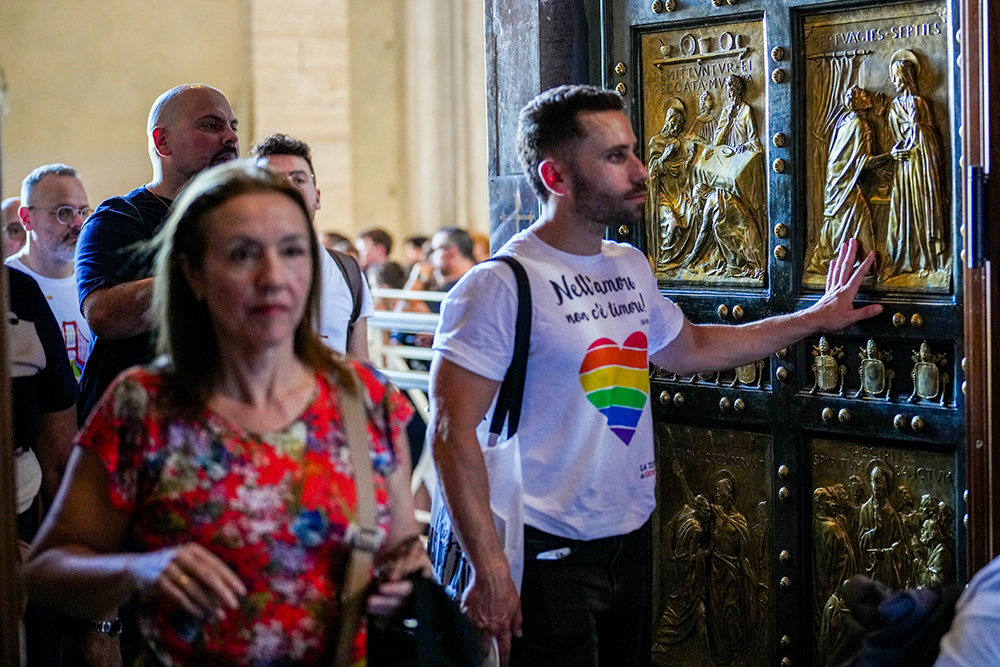
Some of the hundreds of LGBTQ+ Catholics and their families who joined a Holy Year pilgrimage to Rome walk through the Holy Door of St. Peter's Basilica at the Vatican Sept. 6, 2025. (AP/Andrew Medichini)

by Emma Cieslik
Join the Conversation
Send your thoughts to Letters to the Editor. Learn more
In February, I attended "Being Seen, Being Heard, Being Accepted: An Ignatian Retreat for Our LGBTQIA+ Community" held by Holy Trinity Catholic Church in Washington, D.C. The retreat, led by Jesuit Fr. Jack Dennis, was a beautiful moment of community solidarity with fellow LGBTQIA+ people claiming their Catholic faiths. This year's six-hour retreat, featuring testimonials from LGBTQ+ Catholics, personal reflection and small group discussions, had the highest attendance of any of the past annual retreats.
As the organizer shared with me afterward, the fact that they didn't have enough room was a sign of how many queer and trans people were hungering for Catholic community.
It was a timely moment, as last September Crux published an interview between Pope Leo XIV and journalist Elise Ann Allen for her biography Leo XIV: Citizen of the World, Missionary of the XXI Century. In the excerpt, Leo told Allen that the church's doctrinal stances on sex and gender would not change anytime soon, while still opening the door to pastoral acceptance.
"I do understand that this is a very hot-button topic and that some people will make demands to say, 'we want the recognition of gay marriage,' for example, or 'we want recognition of people who are trans,' to say this is officially recognized and approved by the church. The individuals will be accepted and received. ... I think that the Church's teaching will continue as it is, and that's what I have to say about that for right now. I think it's very important," Leo said.
While Leo participated in this interview last year — and his views may have radically changed or at least softened in the time since — many LGBTQ+ Catholics were discouraged to hear his words. Many of us have waited our whole lives, have died, waiting to see the day that the church would welcome our full selves, sacralize our relationships and recognize our bodies made in the image of Jesus Christ.
Advertisement
Leo's words, while well-intentioned, reinforce a long-standing argument that recognizing LGBTQ+ people will in some way shake the foundations of the church itself. Let me be clear: Our bodies, our identities and our relationships are not political or polarizing — they are politicized by people who believe we do not and should not exist.
For the pope to say that our welcome into the church is a form of polarizing tension only reinforces the idea that the liberation of our bodies and identities is expendable for the sake of church unity. And it stands in direct contrast to his determination and fortitude in defense of migrants and other vulnerable groups.
As I saw at the retreat, LGBTQ+ Catholics will not stop pushing for inclusion and recognition in the church. We will not accept being tolerated by the institution we invest in, one that welcomes only one- or two-dimensional images of ourselves. We demand full communion and recognition of our bodies, our love and our joy.
No one models this mission better than Marianne Duddy-Burke, executive director of Dignity USA. I direct the Queer and Catholic Oral History Project, based out of the Pacific School of Religion in Berkeley, California, and I recently had the honor of interviewing Duddy-Burke about her life as a Catholic lesbian and her leadership in LGBTQ+ Catholic ministry. In our conversation, she shared the impact of LGBTQ+ Catholic organizations like DignityUSA — and its many wonderful chapters — not only on their queer and trans members but the whole church.
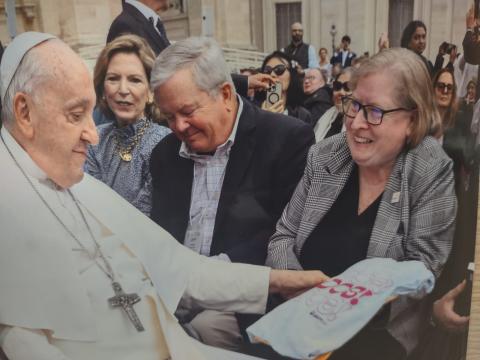
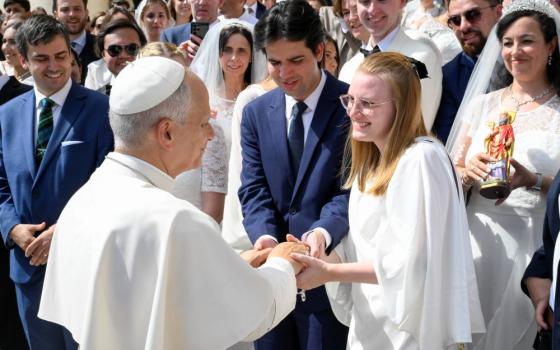
Pope Francis greets Marianne Duddy-Burke in St. Peter's Square Oct. 25, 2023, at the Vatican. (Courtesy of Marianne Daddy-Burke)
"For the church, Dignity has been incredibly significant," Duddy-Burke said. "We were formed in the excitement and the energy of the post-Vatican II world, when there was all kind of hope that the doors of the church had been thrown open and there were fresh breezes coming through the windows and so much was possible."
As the church solicited documents during the synodal process, Dignity submitted a reflection on its 50 years in Catholic synodal community — making it the oldest LGBTQ+ faith organization in the United States.
"Although we were started by a priest, we quickly became a lay-led organization, which has given us so much space to do things that were within the purview of the institutional church or academic institutions in the past, but we've taken it on," Duddy-Burke shared with me.
"We no longer seek permission or approval or who we are. We bring the gifts of who we are to the church," Duddy-Burke said.
Nowhere was that clearer than this past September when as part of the LGBTQ+ pilgrimage held during the Jubilee Year, Duddy-Burke passed through the doors of St. Peter's with other queer and trans Catholics. In her hands, she held photos from her wedding to her wife, Becky, back in 1998.
Before same-sex marriage was legalized on the federal level, Marianne and Becky got married at a Dignity Boston meeting. In attendance were 200 Dignity members, friends, and family who stood as witnesses for the celebration of their wedding.
As she walked through the doors of St. Peter's, she clutched that small collection of photos carrying with her everyone who had celebrated her marriage. As she shared with me in the interview, carrying these people with her as she passed through the doors was "an unimaginable moment to most of us."
As Duddy-Burke's story represents, LGBTQ+ Catholics have fought for institutional recognition for decades, for centuries, and we have not existed in silence. Gender and sexual diversity is a fundamental part of the Catholic Church's history, but despite our fight for visibility, our contributions to the wellspring of Catholic liturgy, art and tradition, LGBTQ+ people remain "highly polarizing," in the words of the current pope.
But even if the church is not ready to make our inclusion and welcome institutional, LGBTQ+ Catholics are proceeding ahead with it — forming their own faith organizations to serve our spiritual needs where the church cannot, and creating spaces whose structure and governance revolutionize not just our own communities but the church as a whole.
The church is welcome to be a part of that spiritual journey — LGBTQ+ Catholics have long invited the church to stand with them and recognize their personhood, their love, but it has to stop viewing our welcome, our liberation, as too polarizing, too political of a choice. LGBTQ+ Catholic existence and inclusion is not a choice or an institutional stance — it is an inevitability.
As Duddy-Burke shared, "We can't go back. We're not going to be invisible anymore."