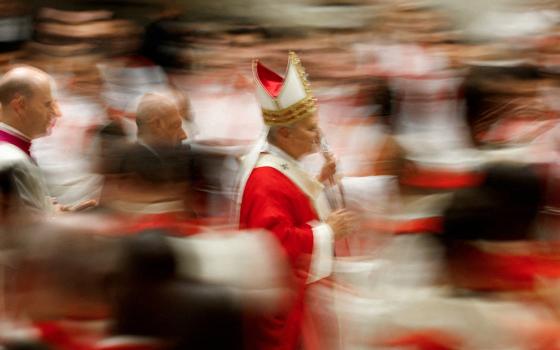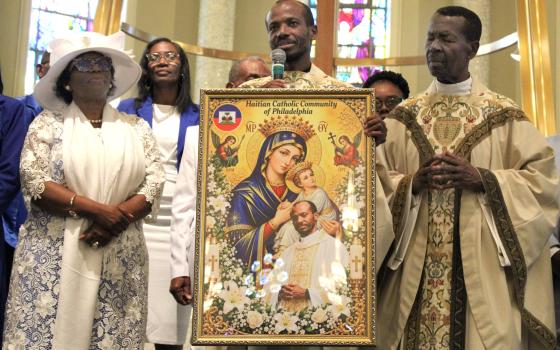
Nuns take a selfie ahead of a June 14, 2025, celebration in honor of Pope Leo XIV at Rate Field in Chicago, home of the Chicago White Sox baseball team. (OSV News/Reuters/Carlos Osorio)

by Billy Critchley-Menor
Join the Conversation
Send your thoughts to Letters to the Editor. Learn more
People love nuns. And they love to love nuns. Consider the recent TikTok and podcast sensation of Dominican Sisters of Mary, Mother of the Eucharist talking about their hobbies and playing ultimate frisbee. Or a recent Birkenstocks ad campaign slogan: "From hippies and punks to nuns and monks — some wear a habit, others make it one."
Just in the last couple of weeks, The New York Times and NPR both ran feature stories on nuns — one about the influx of nuns to an assisted living facility, the other about young women finding an affordable place to live while building community with aging Catholic sisters. ABC released a 30-minute in-depth video on the Sisters of Charity and their opposition to President Donald Trump.
Just last month, my old friend and former teacher Dominican Sr. Mary Jo Sobieck threw the first pitch at a papal-themed White Sox game. The last time she did that, her perfect pitch went viral and she was nominated for an ESPY Award.
The fascination with nuns in popular media and in the American social imagination is not new. Think about the "Nuns Having Fun" trend — calendars featuring images of nuns doing pretty normal things: playing baseball, going ice-skating or smoking a cigarette. For years, #SuperBowlintheConvent went viral on Twitter each year when nuns started live tweeting their Super Bowl watch parties. Last year, Rosalía donned the veil herself on the cover of her "Lux" album and the year before that, Rihanna did the same for a cover shoot for Interview Magazine.
The trend goes still farther back, and runs much deeper. Nuns have been a staple in Hollywood for decades. There is an entire subgenre called nunsploitation that runs the gamut of comic books, horror films and even video games. People seem to be obsessed with nuns, and for good reason!
Perhaps this fascination, which might first seem to be about novelty or even mockery, actually reveals something deeper about the theology of religious life itself. While many lament the declining numbers of religious sisters in the United States, just perusing the news might leave us wondering if their witness is as strong as ever.
So why is it that nuns playing ultimate frisbee, or holding protest signs, or simply the imagery of a woman in a veil is so captivating to media consumers, even those who aren't religious?
The Second Vatican Council's Dogmatic Constitution on the Church, Lumen Gentium, might offer part of an answer. Lumen Gentium says that religious life "appears as a sign which can and ought to attract all the members of the Church to an effective and prompt fulfillment of the duties of their Christian vocation."
The 1964 document places an emphasis on words like "appears," "sign" and "manifest." It appeals to the reality of public consecration, not ministry or apostolic work, that distinguishes women and men religious and their role in the church.
In Lumen Gentium, the chapter on "Religious" comes right after the chapter on "The Universal Call to Holiness," which follows the chapter on "The Laity." This order is instructive. It suggests both the laity and religious are part of this call to holiness, but in different ways. Prior to the council, nuns, priests and brothers were thought to be called to holiness and ministry while the laity, generally, were expected to be passive recipients.
Following Vatican II, a deeper emphasis on and understanding of baptism — not religious vows or ordination — emerged as the primary induction into a call to both holiness and ministry.
Now, with all members of the baptized honored and invited to pursue both holiness and ministry, what was it that set religious apart? What was their unique contribution in the church and the world if not their heroic work?
"The essential contribution that the Church expects from consecrated persons is much more in the order of being than of doing," Pope Benedict XVI wrote in his 2007 exhortation Sacramentum Caritatis.
In her 1995 article "Come Follow Me: Reflections on Some Current Theories of Religious Life," scholar of religious life Dominican Sr. Elizabeth McDonough explains that the theology of religious life following Vatican II highlighted "consecration as more fundamental than mission, being as more fundamental than having, and witness as more fundamental than service." So, while mission and service are still essential elements of religious life, they are not distinct to it.
Advertisement
However, the reality of their witness, their ability to "appear" in the world as a sign or symbol, is what the church suggests is the unique contribution of religious to the world and the church. This is perhaps some of what we may be seeing with the public's fascination with nuns.
Is it just superficial novelty that people are so taken with some young nuns smiling and laughing about playing frisbee? Is it mockery when Rosalía or Rihanna put on a veil? And why, for instance, is it noteworthy that an old nun likes a glass of wine at the end of the day at her assisted living facility — a tidbit highlighted several times in the recent Times profile?
When people see these joyful sisters talk with each other about their life, they see not only the quotidian elements, but the sacred. It opens permission in all of us to believe that the mundane parts of our lives really might be integrated with those deep longings and questions that pull us toward the transcendent. Without having to say much, their witness allows people to give voice or just some attention to those stirrings inside of them.
When people hear about the nuns engaged in heroic activism work on behalf of the marginalized, there is more than just a political statement being made. By the very fact of their public consecration and identity as nuns, people take up with their stories on another level, one that proposes — not verbally or doctrinally, but symbolically — an association between the Gospel and standing with the poor.
In a 2019 speech to a gathering of international sisters, Sister of Charity of the Incarnate Word Teresa Maya told her fellow women religious:
We need a new way of witnessing that will manifest our values, that will be more intelligible and accessible for our time. Gospel news needs to be told in art, symbol and gesture. These are times to share the kind of deep meaning that cannot be found in words. ... We have a new apostolic call to offer meaning to a suffering world, with the nonverbal language that our consecrated life can speak with such beauty.
And that nonverbal language is potent. Perhaps in a world where there is indeed so much suffering, violence and despair, the lives of sisters cue up questions and possibilities for people that otherwise might lie dormant inside of them.
An encounter with a religious, either directly or mediated through an image, a podcast or video necessitates an additional encounter with at least the idea, the question of God. Their lives symbolically manifest a reminder of our vertical suspension, or at the very least provoke a question about it.
While questions of transcendence, religion and spirituality were once thought to be on their way out with the supposed rise of secularism, people seem to be more and more open to those questions. So, even if sisters aren't teaching in the same number of schools as they once did, or running the hospitals, perhaps what they are offering today goes beyond their work, accomplishments or ministries.
As McDonough continues, "The public vows of chastity, poverty, and obedience are supposed to render each religious both more able and more willing to manifest, in a personal way, the primacy of consecration over production, of being over possession, and of witness over power in a world dominated by forces of production, possession, and power."
It might just be that what captivates people about the lives of sisters, whether it is verbalized or not, is a way of living in the world that is open to and reliant upon a great hope — that of a real and loving God.