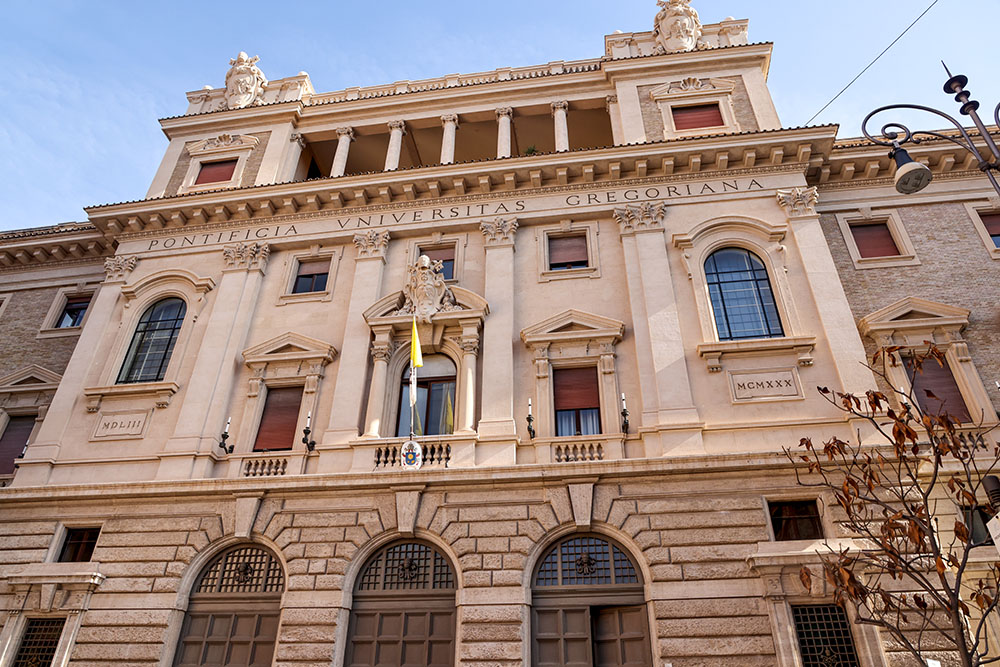
The main entrance to the Pontifical Gregorian University in Rome is seen in a 2024 file photo. (CNS/Pablo Esparza)

by Abby Strelow
Join the Conversation
Send your thoughts to Letters to the Editor. Learn more
In the same weekend that Pope Leo XIV spoke to Argentines about the "challenges posed by artificial intelligence and unregulated automation," a group of church leaders, technology developers, venture capitalists and policymakers from around the world gathered in Rome to discuss how best to develop artificial intelligence products that "serve the church's mission."
The Nov. 5-6 Builders AI Forum (BAIF), an interdisciplinary conference hosted by the Pontifical Gregorian University, held a two-day program of workshops aimed at identifying problems facing Catholic AI development.
The forum was formed two years ago and holds annual gatherings in Rome.
With this year's theme, "Uniting to Shape AI Before It Shapes Us," the conference examined issues such as the lack of human accountability within AI models, potential system biases against particular languages and cultures, and the dangers of treating machines as human persons. Participants then worked together to develop possible solutions for their communities and dioceses.
Matthew Harvey Sanders, founder of the forum and the CEO of Longbeard, the company behind AI tools such as Magisterium AI and Vulgate, framed responsible human development of AI as a duty for the church in his opening address. He quoted Leo and called Catholic developers to fill the gaps of agency — instances where AI lacks human oversight and accountability — that are often created by AI developers.
"A machine that can be blamed is a convenient place for everyone above it to leave the blame. So before any parish, school or hospital lets an agent act for a person, someone must be able to stop it, and someone must answer for it," Sanders said.
In addition to insisting on human accountability and involvement at all levels of an AI system, Sanders presented a more hopeful vision for the way in which Catholics will be able to leverage artificial intelligence tools, a vision for "digitizing the church's patrimony and universalizing access to it" that he has worked to implement through Longbeard's AI products.
Sanders' vision of AI as a tool for good echoes Leo's encyclical, Magnifica Humanitas, which called AI "a valuable tool ... [that] calls for a measured and vigilant approach." But, while advocating a vision of AI that goes beyond "merely regulating it" toward making it "disarmed, welcoming, and accessible," Leo warned tech developers to "embed values in their projects with due seriousness: with transparency, responsibility toward affected communities and careful attention to ensuring that what is being cultivated is a genuine good."
Leo has often spoken about the importance of safeguarding the dignity of labor and the human person in the age of AI. His Nov. 6-17 Latin America trip included a stop in Argentina, where he spoke to representatives of the country's work community about the dignity of labor and the dangers of encroaching technology.
On Nov. 8, the pope addressed workers, business and trade union leaders, and teachers and students at the Catholic University of Argentina in Buenos Aires, telling them: "All work, and every aspect of the work community, must always bear this distinctive mark: It must be carried out by people, who bring all their potential to bear, and it must likewise be directed toward the full development of those who perform it."
Advertisement
Leo reminded the crowd of the "first and most fundamental of the principles of the church's social doctrine: the dignity of the human person ... [who] is the author, the center and the goal of all economic and social life."
He went on to warn, "The challenges posed by artificial intelligence and unregulated automation can put countless jobs at risk and become a real threat to proper integral human development."
The pope's address came as Argentina's Congress considers legislation submitted by the Javier Milei administration that would grant legal recognition to companies operated solely by AI. Milei's proposed legislation comes after an announcement last October that a massive AI data center project, Stargate Argentina, will be constructed in Patagonia.
At the Builders AI Forum gathering, Cardinal Michael Czerny, who heads a Vatican commission on artificial intelligence, used an image from Magnifica Humanitas contrasting two biblical construction sites, Babel and Jerusalem, as examples of different ways that technology can be developed.
"Both are collective efforts, yet the manner of constructing and the outcome are very different in the two sites," he said.
"The difference between Babel and Jerusalem lies in the desire that guides the act of building," he said. "The contrast between the two cities presents us with today's primary question: Out of what desire shall we build, deploy and employ artificial intelligence?"
The conference focused on the need for positive action in addition to technology regulations, emphasizing that forming thriving Catholic communities, building responsible and properly sourced AI tools, and calling governments and tech developers to protect human labor are essential tasks for the church today.
Sanders told the National Catholic Reporter that he sees AI as an "unfortunate means" to evangelize the world, emphasizing that building authentic Christian community is the ultimate goal.
"I don't think Catholic AI should need to exist. If we're living in a world where everyone's well formed, and we're living in good, vibrant Catholic communities, we're learning the faith from a young age, and it's modeled for us. So those pressing fundamental existential questions, I just think those will just get answered by osmosis," he said.
"The only reason why we decided we needed to [develop Catholic AI] was because we could see there was this wave of interest in the Catholic faith, and we weren't prepared for the scale. ... Our thinking was AI could be a really good instrument in the short term to help ensure people get answers to fundamental questions ... but [then] we need to get this person into community."
In his closing speech at the conference, Sanders encouraged participants not to stand idle in the face of AI's challenges, but to take action in building communities and technologies that uphold and promote human dignity.
"A year ago, Pope Leo prayed that this forum's work would bear fruit. Fruit is something you can see and hold, and it feeds someone. This forum convenes; you build," he said.