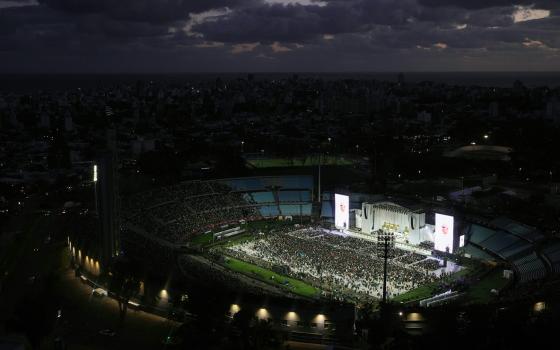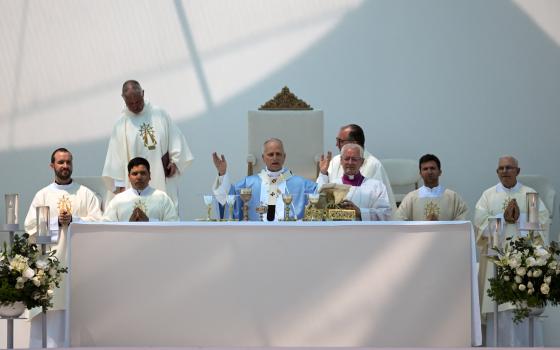
Pope Leo XIV leads a prayer vigil at Centenario Stadium in Montevideo, Uruguay, Saturday, Nov. 7, 2026. (AP/Matilde Campodonico)


Religion News Service
Join the Conversation
Send your thoughts to Letters to the Editor. Learn more
When the pope visited Uruguay, the media noted it is the most secular country in Latin America, with the lowest percentage of Catholics. What was not noted is that Uruguay is powered almost entirely by renewable energy: wind, solar and hydro.
The United States and the rest of the world can learn a lot from Uruguay, which gets 98% of its electrical energy from renewables. It did this not because of concerns about global warming; it did it because it was the cheapest way to go.
In 2008, Uruguay, like much of the world, was faced with rising oil prices and the need for more energy to power its growing economy. Imported oil was $150 a barrel. Blackouts were common. Uruguay traditionally got a lot of electricity from hydro power, but droughts made this source unpredictable, especially during El Niños. (For more on this story, listen to "Volts," the podcast by David Roberts on which this column is based.)
Without domestic fossil fuels, nuclear power was seen by many as the best solution to Uruguay's energy problems. But nuclear power plants take years to build and are very expensive. The government, which owned the power company, did not have the money to invest in nuclear.
All the experts, including the IMF and World Bank, told Uruguay to privatize its power company and let foreign investors solve the problem. However, this would have led to higher electric bills and left Uruguay and its businesses at the mercy of the power company.
Ramón Méndez Galain, a particle physicist teaching at the Universidad de la República in Montevideo, came to a different conclusion after examining the proposals. Galain concluded that renewables were the better and cheaper way to go.
Galain's plan was to go full speed on wind and solar and use hydro only as a backup. Reservoirs behind dams would act like huge batteries for when the sun does not shine and the wind is calm. This reduces the amount of water needed.
Uruguay's president liked the plan and put Galain in charge of implementing it. Galain convinced the Uruguayan political establishment and business community to support it, as well.
Advertisement
He got consensus by asking everyone to dream about what the country should look like in 30 years, a less threatening concept than talking about what to do immediately. If we want to get there, he asked, what do we have to do in 25, 20, 15, 10, five years in the future. He referred to this as reverse engineering.
Ultimately, everyone saw the advantage of cheap, reliable energy based on resources readily available in their country: wind, sun, water. Renewable energy ensured their sovereignty and independence and protected them from global events over which they had no control.
He still faced the challenge of paying for the initial investment. But he was able to raise money from capital markets by showing investors that the public utility would have a steady and reliable income from long-term contracts and commitments that guaranteed the loans would be paid back. Because there was little risk, the bonds sold quickly at a lower interest rate than Galain expected. He built the system without any government subsidies.
Today, with a super El Niño and oil prices skyrocketing because of the Iran War, everyone in Uruguay is happy with stable energy prices.
The new system creates electricity at half the cost of the old system. EVs outsell gas-powered cars, and they can be fully charged for $4.
These EVs can also act like a huge battery for the system. With smart electric meters, an EV can be charged at night, when winds are high and demand is low. Owners can then sell electricity from their EV batteries back to the utility in the early evening, when demand is high.
The new system also created 50,000 new jobs, which for a country with only 3 million people is huge.
Galain, through his nonprofit Asociación Ivy, is now advising governments in the Global South on how to redesign their electricity systems, but the United States could learn from Uruguay's experience.
Texas and California have shown that solar and wind energy are now cheaper than other sources of energy. Green energy has become a new source of revenue for ranchers, farmers and Native American reservations.
Renewable energy should be a bipartisan issue, but opposition from the fossil fuel industry is fierce. It uses campaign contributions, lobbyists and lies to slow the transition to renewable energy.
Another roadblock to expanding renewable energy is America's outdated electrical grid. We need a grid that can easily share electricity between states and regions. It should be easier to transmit and sell electricity from wind and solar created in rural areas to urban and industrial areas. Investments in renewables are being held back because, even if they were built, they could not get on the grid to sell their electricity.
Upgrading the grid is opposed by utility companies that don't want cheaper energy coming into their areas. Utilities are financially rewarded by how much they invest in power plants, not for providing cheaper energy to their consumers. State utility commissions that are supposed to regulate them have been captured by industry insiders who prefer the status quo.
If Congress wants to do something about "affordability," it needs to mandate an upgrade to the electrical grid so that cheaper electricity can reach businesses and consumers. The permitting process needs to be simplified so that special interests cannot stop the grid from being upgraded.
And if renewable energy created 50,000 jobs in Uruguay, imagine how many it would create in the United States.
Ethics and religion often ask people to sacrifice for the common good. Uruguay has shown that you can do good and do well if you embrace renewable energy. In his encyclical "Laudato Si," Pope Francis urged us to fight global warming and protect the planet. Uruguay has shown us that this does not require sacrifice. It is in our financial self-interest.