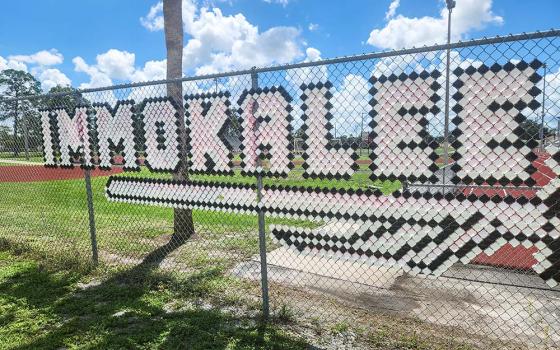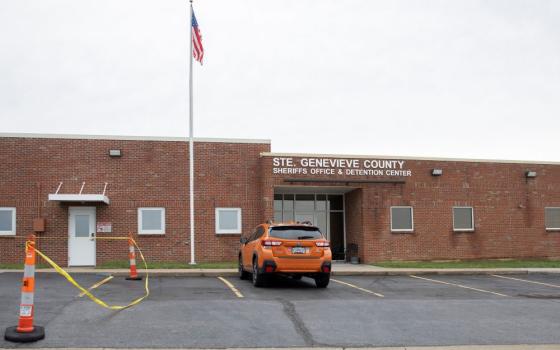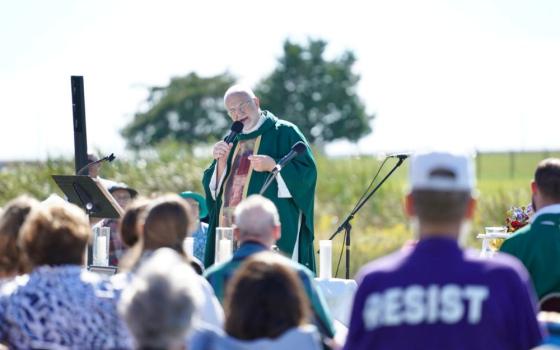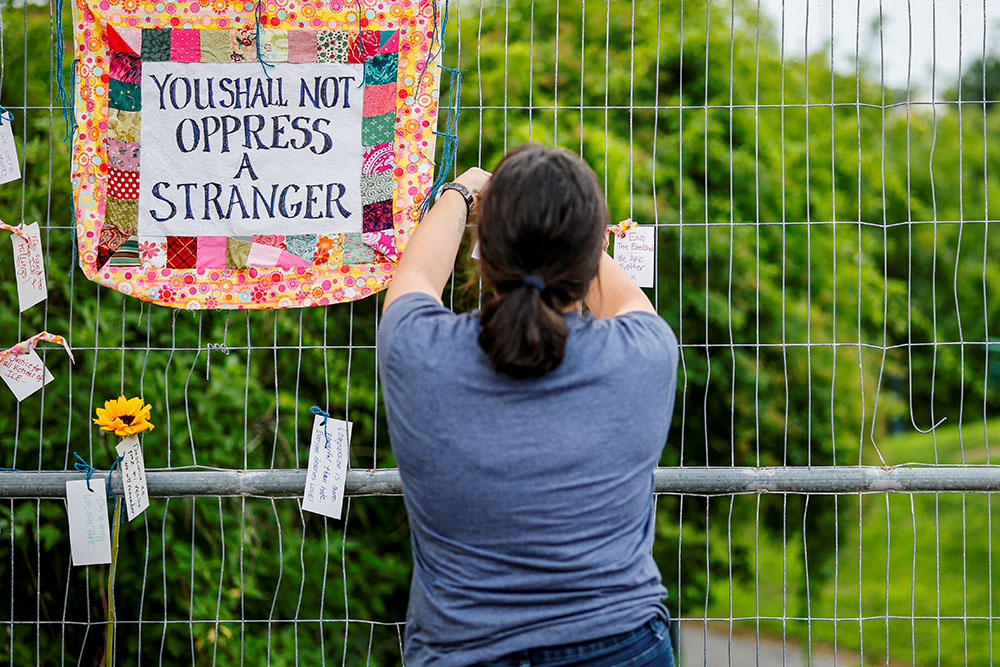
A woman places a message on a fence during a candlelight memorial service at Mechanics Park in Biddeford, Maine, July 13, 2026, after a U.S. Immigration and Customs Enforcement agent fatally shot a motorist. (OSV News/Reuters/CJ Gunther)
Join the Conversation
Send your thoughts to Letters to the Editor. Learn more
All four of my grandparents were immigrants from Italy.
For decades, I've tossed out that line as an interesting bit, a fact that often elicits a raised eyebrow and a "What about the name?" For the record, Roberts is the anglicized version of Rabottini, a change made in the early 1900s.
All four of my grandparents came from two small towns along the Adriatic in the region of Abruzzo.
I can't say those words in the same tone any longer. There's no lightness to the remark these days, said against the backdrop of what I know is happening to contemporary immigrants. A record is accumulating that will demonstrate for generations into the future that at this point in our history the United States has become an agent of deliberate cruelty.
I heard over the years stories about some of the obstacles my grandparents faced as newcomers escaping endless military enlistments and poverty — the crude and condescending remarks, the one neighbor who wouldn't permit members of my mother's family to put foot on the sidewalk in front of his house.
But there were also stories of kindness, of help from strangers, of the public schools that taught the nine Roberts kids (the first to show up spoke little English) and the eight Palladino kids.
I think today of how fortunate they were not to have encountered the savage cruelty of armored vehicles and masked unidentified thugs accountable to no one. They didn't face the threats unleashed today by the dangerously foolish man in the Oval Office and his subservient minions.
I know details of the story of the Roberts and Palladino clans because, in addition to the oral history handed down, one of my father's brothers, Alfred, wrote the histories of both. He was near the younger end of the nine Roberts kids, and was the first to go to college, initially as a music major. That path was interrupted when he volunteered for the Army during World War II and served for a stint in France.
When he returned home, he changed his major to French, graduated top of his class at Ursinus College in Collegeville, Pennsylvania, not far from the farm where he grew up. He went on to a master's and doctorate in romance languages from the University of Pennsylvania.
He was hired by what was then West Chester State Teacher's College, where he founded the foreign languages department.
Another brother, Thomas, an accomplished musician who also served in the Army during World War II, became head of music for a school district in Pennsylvania. Facilities where each of them taught now bear their names.
Among my mother's siblings were six brothers who established a heating, plumbing, sheet metal and roofing company that supported their families and enhanced the wider community for decades.
Those 17 kids in both families produced a small village of aunts, uncles and around four dozen first cousins. Among them and their offspring are businesspeople, lawyers, nurses, artists, musicians and a virtual battalion of educators at all levels.
Advertisement
The Roberts and Palladino clans were not a one-off. They were an example of what immigrants have always done. They came here and worked hard, prayed a lot, were longtime active members of Catholic parishes. In all of it, they benefitted from a pluralist democracy, of, for, and by the people. The country eventually, at times grudgingly, welcomed and embraced them. And the country, in turn, benefited enormously.
I'm glad none of that first generation is around today to see the destruction underway at the hands of the, again, dangerously foolish man who now inhabits the Oval Office.
Welcoming Vietnamese
In the early 1980s, my wife, Sally, and I helped resettle a number of Vietnamese refugees. The last were two brothers who lived with us for a time and have remained friends and part of the family for life.
We watched the younger one graduate from high school and college and go on to a long public service career in the Department of Defense. The older brother completed his undergraduate studies and earned two master's degrees — one in mechanical engineering, another in electrical engineering — and spent a long and productive career in the Federal Aviation Administration.
I am glad they arrived before our national leaders began making up horrible fictions about immigrants and summarily removing even those going through immigration and naturalization processes. We didn't have to worry back then about being out and about with people who may have looked different from the majority and who were struggling with a new language.
Not long ago, during the occasional lunch we have together, the Vietnamese brothers and other members of their families told us that for the first time, they're carrying their passports with them wherever they go.
Another friend, Hispanic and a member of the parish I attend, told me at one point last year that if he was missing from a scheduled meeting it might be because he had been picked up by Immigration and Customs Enforcement agents. I looked surprised. He is a citizen and works a successful job.
He shook his head and said, "It's just the way I look and the way I speak." Driving is no longer a neutral activity for him or for other members of his community.
President Donald Trump, vain, amoral and devoid of conscience, understands the immediate political benefits of some of the more fevered suggestions from the likes of his Deputy Chief of Staff Stephen Miller and those who assembled Project 2025. Trump read the dark side of the national character and realized, after that first ride down his golden escalator, that hate, constructed on a foundation of lies and racism, pays political dividends.
Vice President JD Vance, who once described the president he now serves as "cultural heroin," has turned 180 and gone all in. He, who falsely accused Haitians of eating neighbors' pets, has taken to advocating a type of citizen that some describe as "heritage Americans."
It was a step too far even for Republican strategist Karl Rove, who called out the vice president in a blistering commentary in the Wall Street Journal. "The notion of 'heritage Americans' is at odds with the Declaration. America's birth didn't include a new aristocracy based on inherited valor," he wrote.
"One in seven American residents is an immigrant. For the other six," he wrote, the Fourth of July "should be a day for special gratitude. Through no action of our own, we were born here, and — alongside all who made their difficult way to America — enjoy the blessings of what happened in Philadelphia in the summer of 1776."
Cruelty, not policy
All four of my grandparents were immigrants. I have a personal understanding of the record of what this country, in all its imperfections, can mean to people willing to risk pulling up stakes to make their "difficult way" here.
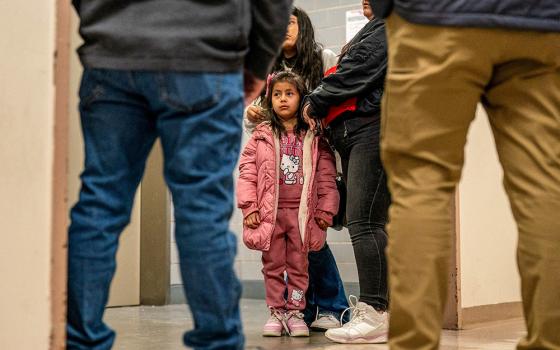
The record that is accruing today is far different. It is the record of an era of intentional government brutality in which we send people to torture prisons in El Salvador, subject them to endless incarceration in prison camps in our own country, deport people to countries our own State Department warns should not be traveled to under any circumstance. Federal agents are shooting and killing suspects in our streets. The record will also include the horror stories of separated families and traumatized children.
What we are witnessing is not a change in immigration policy — a policy that certainly needs fixing and that saw a measure of extreme actions during Democratic administrations. Until Trump, after all, Barack Obama had deported more people than any other president. But this isn't about policy. What we are witnessing today is government-directed human rights abuses that are, by any measure, immoral and gratuitously heartless.
At some point beyond the current chaos, our children and grandchildren will be able to read the accumulated record and they will have to contend with the fact that we not only witnessed but were complicit in a national era of cruelty.
I wish there were an easy, upbeat way to tie this up. There isn't. What's left to us is the call to resist the cruelty however we can. What's left is whatever compassion and solidarity we can muster for those who live in terror. What we have, too, is the hope, evidenced in our past, that our better angels somehow manage to survive and carry us beyond such dark national moments.