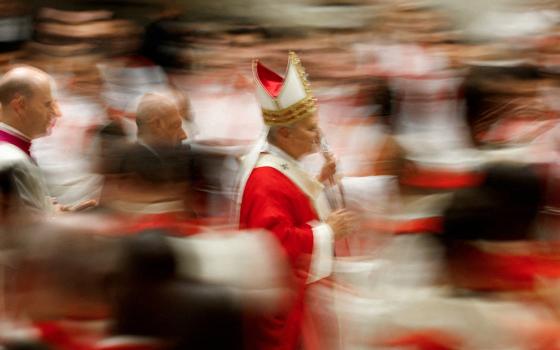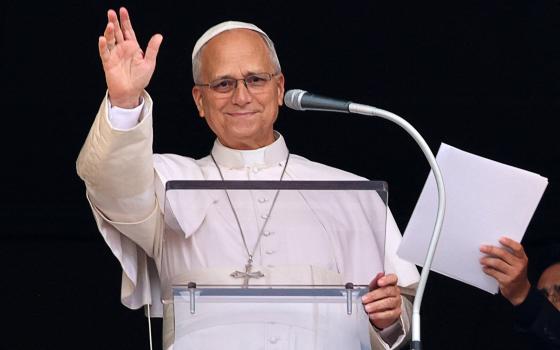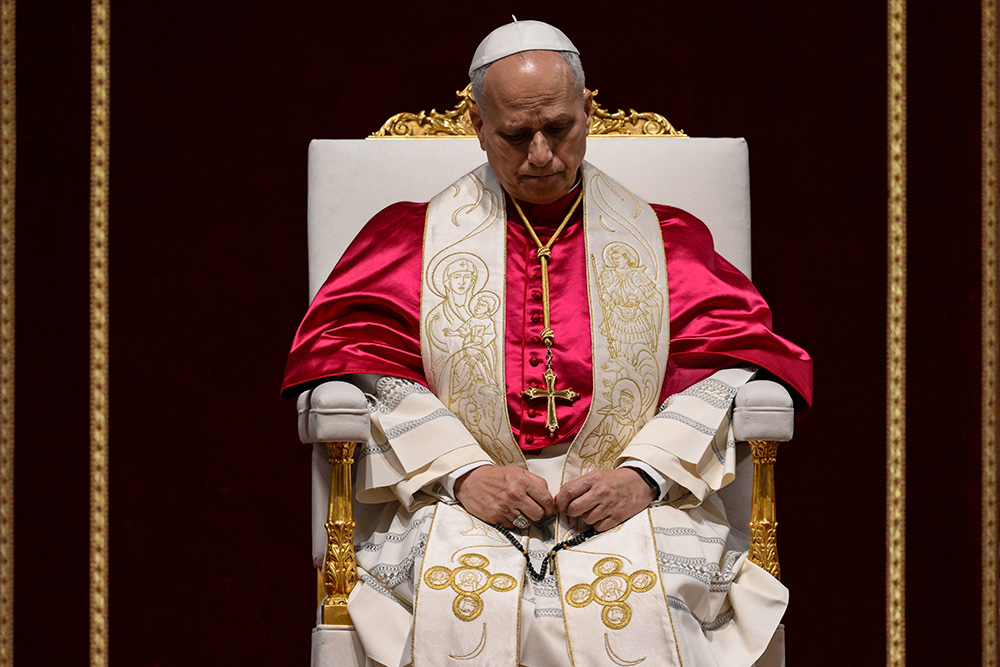
Pope Leo XIV prays the rosary for peace during an evening prayer vigil in St. Peter's Basilica at the Vatican April 11, 2026. (CNS/Vatican Media)

by Jim McDermott
Join the Conversation
Send your thoughts to Letters to the Editor. Learn more
If you simply scanned the headlines of late, you could be forgiven for thinking that Pope Leo XIV had launched a kind of counterattack to Donald Trump's weird social media rant on Divine Mercy Sunday. "Pope Leo says he has 'no fear' of Trump Administration," The New York Times wrote immediately after the Pope's press conference the next day on the plane from Rome to Algeria, as did many, many others, including NCR and OSV News. The pope and the president, said the Chicago Tribune's editorial board, are in a "war of words." The Guardian took the sense of a battle of personalities further, posting headshots of the president and pope side by side with the headline "I do not fear Trump, says Pope Leo after US president calls him 'weak.' "
In reality, onboard the plane, which did not in fact see Leo engaging in a Pope Francis-type press conference, but rather had him walking around saying hello to various groups, he repeatedly said that he's not interested in some sort of back and forth with the Trump administration.
"The message of the church, my message, the message of the Gospel," he said, is " 'Blessed are the peacemakers.' "
As he spoke to various news outlets, that's what he kept coming back to. "Too many people are suffering in the world today, too many innocent people are being killed, and I think someone has to stand up and say, 'There's a better way.' "
Even when he talked about having no fear of the Trump administration — and also, notably, as OSV News pointed out in its headline, "preaching the Gospel," he immediately explained what he meant: "We're not politicians, we're not looking to make 'foreign policy,' as he calls it, with the same perspective that he might understand it, but I do believe the message of the Gospel, 'Blessed are the peacemakers,' is a message the world needs to hear today."
Something similar happened on Easter Sunday. Many outlets focused on Leo's comment, "Let those who have weapons lay them down!", as though he had used his homily on the most important day of the Christian year to subtweet the Trump administration and Israel. But in fact the point of his homily was that we can get so lost in our conflicts and fears, we forget that there is anything but them.
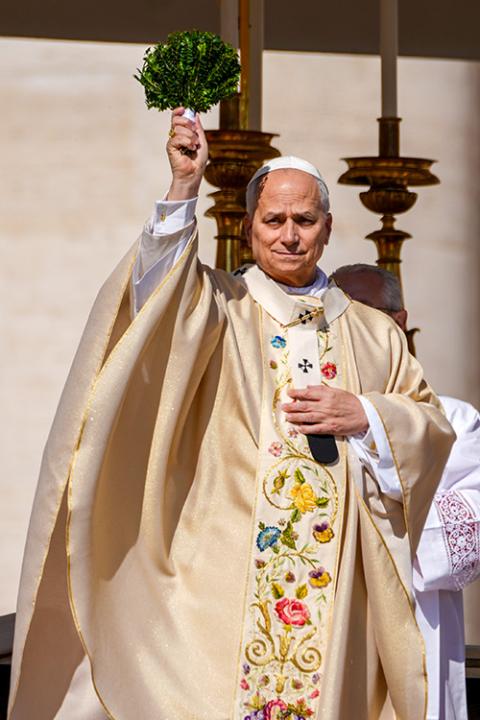
Pope Leo XIV blesses the faithful in St. Peter's Square with holy water during Easter morning Mass at the Vatican April 5, 2026. (CNS/Lola Gomez)
On Easter, the resurrected Jesus invites us to fight that sense of resigned hopelessness and cast our eyes upward from ourselves to him. The pope's line about laying one's weapons down was presented in the context of that invited encounter. "In the light of Easter, let us allow ourselves to be amazed by Christ! Let us allow our hearts to be transformed by his immense love for us! Let those who have weapons lay them down! Let those who have the power to unleash wars choose peace! Not a peace imposed by force, but through dialogue! Not with the desire to dominate others, but to encounter them!"
This is what Leo is about: not the world leader equivalent of a rap battle, with point scoring and a side that wins, but the loving transformation of people's hearts. He believes, as the Catholic Church does, that not only are we all meant to be reconcilers and friends to one another, family, but that within us that seed is already there, that we yearn to be that and live in that kind of a world. Christ came to unlock what is already within us, to help us see that we have the courage that it requires, and that the costs that it will entail are not in vain.
In his news analysis column after the Pope's comments, NCR editor-in-chief Michael O'Loughlin notes similar ideas coming from U.S. Catholic leaders as well, an invitation for U.S. Catholics to see themselves as apostles of peace and to act.
"Leo does not want church leaders and Catholics to be partisans," O'Loughlin writes. "Rather, he is inviting Catholics to apply teachings about peace and human dignity in novel and meaningful ways."
Admittedly, we live in an eyeball economy, where attention equals profit and, for many today, the possibility of survival. Headlines that emphasize conflict, that play upon familiar tropes or can find compelling sound bites are more likely to get clicks, are more likely to keep publishing. But such headlines or reporting tend to flatten the world into the seemingly inescapable landscape of antagonism and provocation of the president and his administration.
And so the pope's repeated calls for peace in Iran are described as "escalating" by the Los Angeles Times, as though he is heightening a conflict, not trying to end it. Or The New York Times depicts his recent comments as the pope finally "clapping back" at the president, rather than as him trying to save lives and end a war.
In truth, Leo's words in recent weeks do not represent some sort of dramatic turn in response to the ongoing violence of the Trump administration. In his very first public words as the leader of the Catholic Church, Leo began by wishing all "the peace of the risen Christ, a disarmed peace and a disarming peace, humble and persevering."
"God loves us, God loves you all, and evil will not prevail!" he said immediately after. "We are all in God's hands. Therefore, without fear, united hand in hand with God and with each other, let us move forward."
Whether as members of the press or as concerned Catholics, we'll have more luck interpreting the pope — and learning from him — if we keep in mind that insistent belief in a better way and quest for a disarmed, disarming peace at the heart of his message.
Advertisement