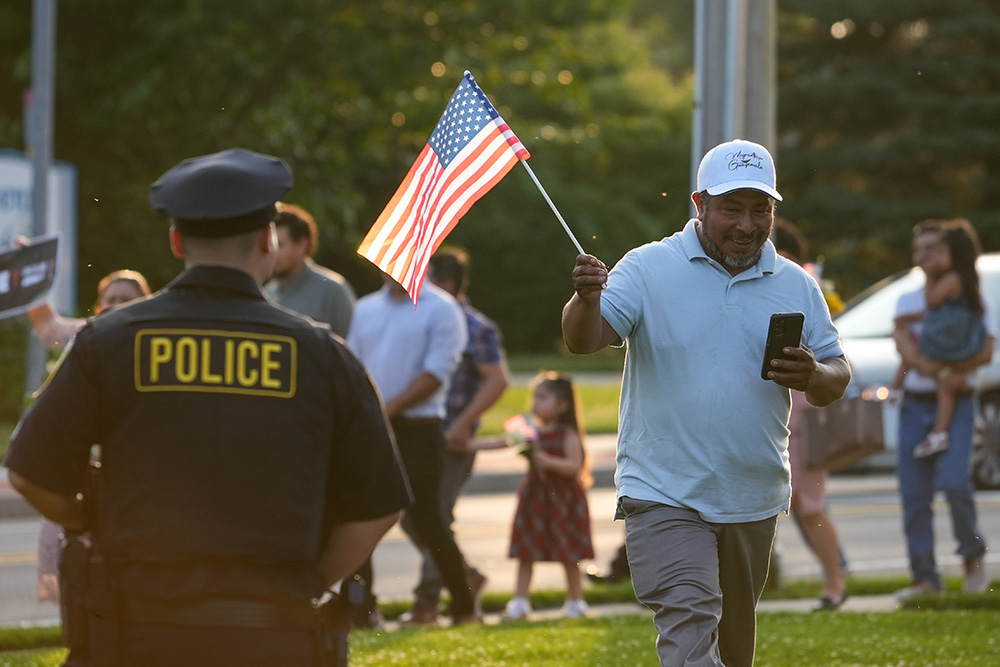
A man holds a U.S. flag as he attends a pro-immigrant march and rally following a Spanish-language Mass at St. John the Evangelist Church in Riverhead, N.Y., June 22, 2025, the feast of the Body and Blood of Christ. St. John's parish social ministry organized the event, which drew about 300 participants. (OSV News/Gregory A. Shemitz)

by Michael J. O'Loughlin
NCR executive editor
Join the Conversation
Send your thoughts to Letters to the Editor. Learn more
Reducing President Donald Trump's provocative attack on Pope Leo XIV to a political sideshow would obscure the larger story, which is that church leaders today are calling Catholics in the United States to reimagine their responsibilities in the public square.
For the last couple of decades, U.S. Catholics engaged in civic life tended to live out their faith through identification with a particular tribe in the church. Catholics for whom issues like abortion and marriage were paramount could gravitate toward certain bishops, parishes and organizations that informed their consciences and helped them make political choices during elections. Other Catholics, perhaps drawn more strongly to challenges like poverty and health care access, also had their own structures for engaging with their faith and navigating public life.
Church leaders today appear to be leading Catholics toward a different posture, one based not on explicit political issues, but on Catholic principles about what it means to be a human being and about our role in civic society. In a way that perhaps Pope Francis was unable to achieve, the arrival of Leo's papacy presented something of an opportunity for a reset for the church in the United States, an invitation to move beyond the ecclesial and political battles of the past. Leo does not want church leaders and Catholics to be partisans; rather, he is inviting Catholics to apply teachings about peace and human dignity in novel and meaningful ways.
Speaking to reporters on Monday during his flight to Algeria, the first stop in an 11-day tour of Africa, Leo said plainly, "I do not look at my role as being political, a politician."
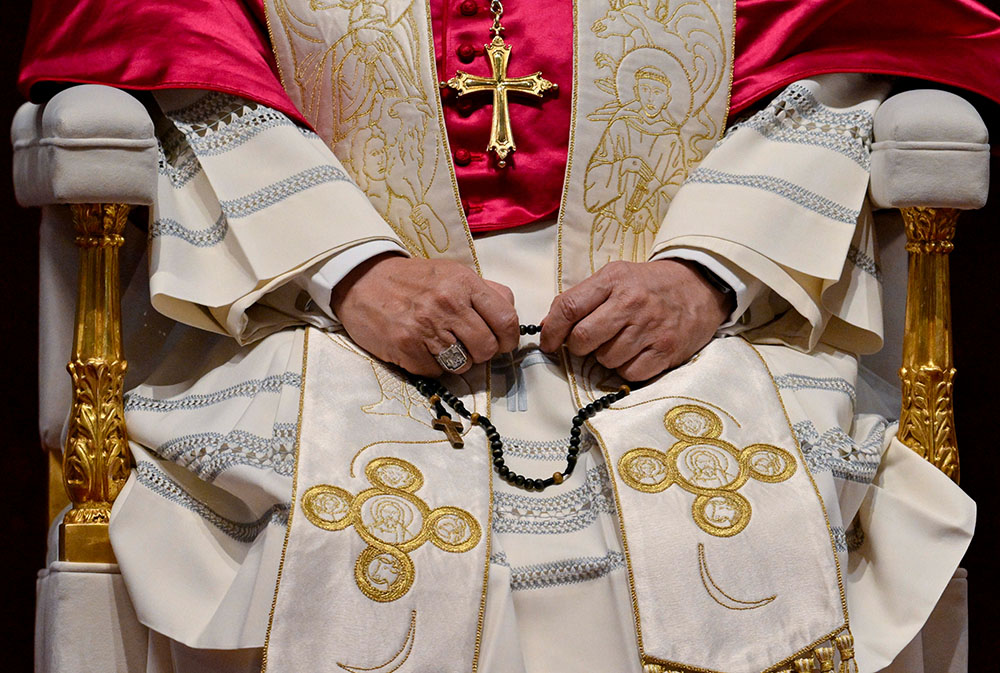
Pope Leo XIV prays the rosary for peace during an evening prayer vigil in St. Peter's Basilica at the Vatican April 11, 2026. (CNS/Vatican Media)
If Leo does not see himself as a political actor — a viewpoint shared by the three U.S. cardinals featured on "60 Minutes" on Sunday discussing the Trump administration's immigration policies — then why does he weigh in, with increasing frequency in the last few weeks, on hot-button political questions?
"Too many people are suffering in the world today, too many innocent people are being killed," Leo said on the plane, "and someone has to stand up and say there's a better way."
If that sounds familiar, it's because the Gospels feature many examples of Jesus speaking out on behalf of the poor and marginalized, views that weren't inherently political in nature but nonetheless provoked backlash from the authorities.
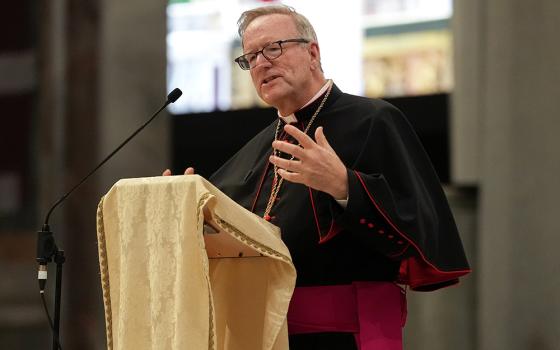
A similar sentiment to Leo's, that Catholics in this moment must "stand up and say there's a better way," is one shared by Cardinal Robert McElroy, the archbishop of Washington, who laid out a similar challenge in a homily he delivered on April 11 at the Cathedral of St. Matthew the Apostle in Washington.
The Mass was held in conjunction with a prayer vigil for peace that Leo hosted in Rome the same day, and McElroy noted that Catholics throughout the world "pray that the ceasefire holds and that it leads to a substantive foundation for the emergence of peace in the Middle East."
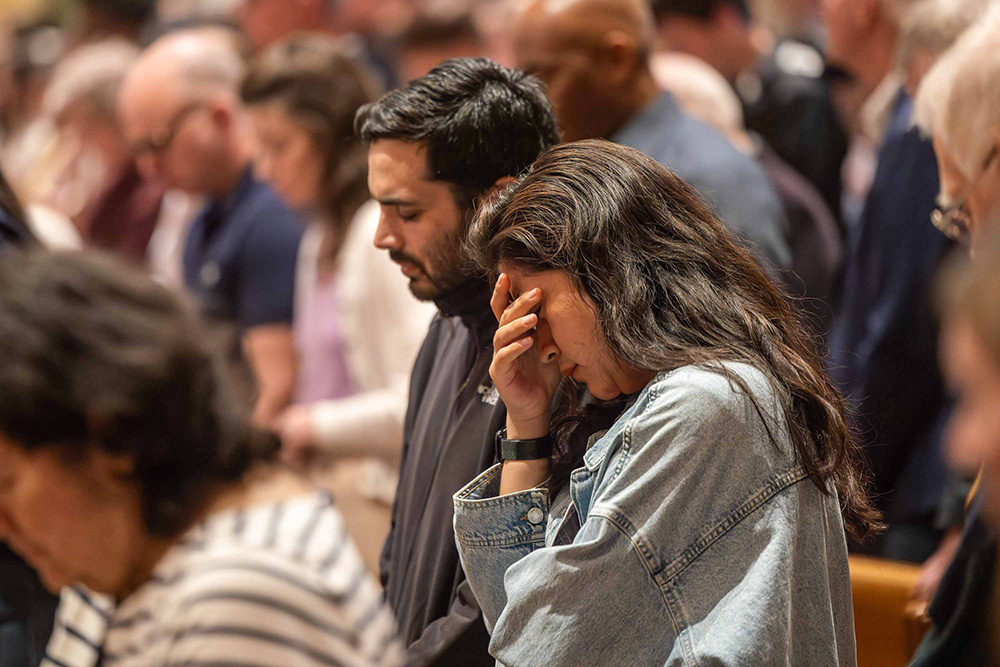
People mark a moment of silence to pray for peace during a vigil Mass for peace celebrated by Washington Cardinal Robert McElroy at the Cathedral of St. Matthew the Apostle in Washington April 11, 2026. Pope Leo XIV had encouraged Catholics around the world to participate in a vigil for peace on that day. (OSV News/Catholic Standard/Mihoko Owada)
In addition to prayer, McElroy urged Catholics to take action in this new political moment.
"It is not enough to say we have prayed," he preached. "We must also act."
Last week, an NCR editorial highlighted some of the recent examples of church leaders calling Catholics to a new understanding of how to live out their faith in the public square, including:
- The bipartisan condemnation of Trump's online threats to annihilate an entire civilization.
- Archbishop Timothy Broglio, who heads the Archdiocese for Military Services, joining Leo and other bishops in suggesting that the war in Iran is morally unjust, echoing sentiments he had made weeks earlier about service members having the right not to follow unjust orders.
- Bishops around the country calling out abuses prevalent in the Trump administration's immigration efforts and for Catholics to take action. Take a new pastoral letter by Bishop Steven Biegler of Cheyenne, Wyoming, who wrote, "When our guts ache with compassion for others, we advocate, intervene and take sides."
Advertisement
What are Catholics to make of this moment?
For one, it's bigger than a particular political issue, even perennial challenges like immigration reform or foreign wars. Rather, church leaders are extending an invitation to U.S. Catholics to move on from the dichotomy of the past and instead take seriously the existential threats facing U.S. democracy and to human dignity, both here and abroad.
Back in D.C., McElroy imagined what might happen should the fragile ceasefire between Iran and the United States and Israel break. While his statement is specific to that particular challenge, it could easily be applied to the broader conversation taking place among church leaders and ordinary Catholics.
"At that critical juncture, as disciples of Jesus Christ called to be peacemakers in the world, we must answer vocally and in unison: 'No,' " he preached. "Not in our name. Not at this moment. Not with our country."