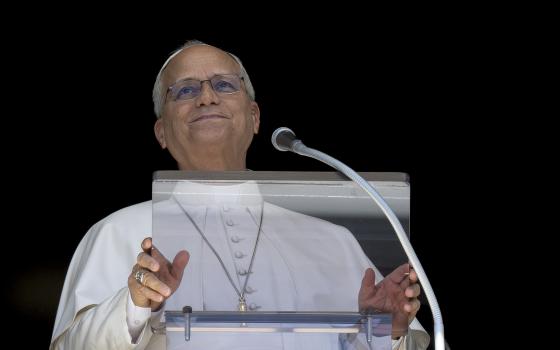
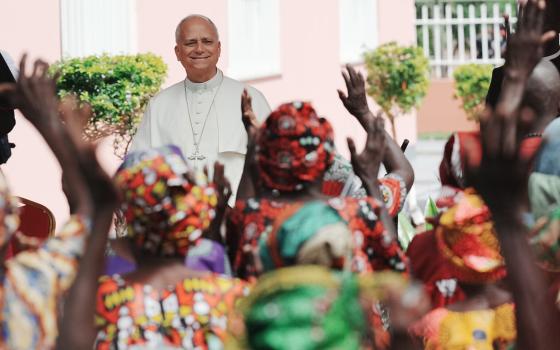
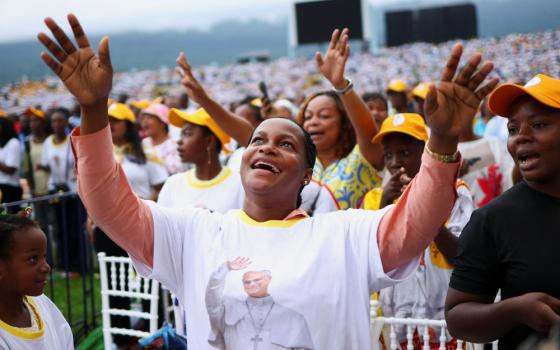
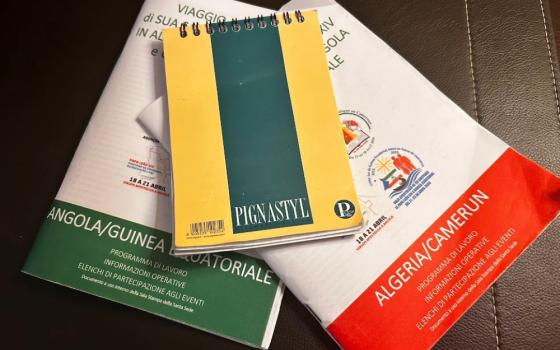
Pope Leo XIV addresses journalists during the flight heading to Algiers on April 13, 2026. Pope Leo XIV embarks on April 13 on an 11-day visit to Algeria, Cameroon, Angola and Equatorial Guinea for his first major international trip since becoming pontiff in May 2025. (OSV News/Alberto Pizzoli, Reuters)

Join the Conversation
Send your thoughts to Letters to the Editor. Learn more
Pope Leo XIV told reporters en route to Algeria that he has "no fear of the Trump administration," hours after President Donald Trump lodged a vicious attack on the pontiff via social media.
"I don't want to get into a debate with him [Trump]," the U.S.-born pope told Reuters on the two-hour flight from Rome to Algiers April 13. "I don't think that the message of the Gospel is meant to be abused in the way that some people are doing."
In a post on Truth Social the evening before the pope was set to depart on his 11-day, four-nation tour of Africa, Trump wrote that Leo "should get his act together as pope and use common sense," calling him "weak on crime and terrible on foreign policy."
The president's post came shortly after "60 Minutes" aired an interview of three American cardinals who were critical of the Trump administration's pursuit of the war in Iran and its domestic mass deportation of migrants; the segment framed Leo as a counterweight to Trump on the world stage.

Pope Leo XIV disembarks the papal plane upon his arrival at Houari Boumediene International Airport to begin his apostolic journey to Algeria, Angola, Cameroon and Equatorial Guinea, in Dar El Beida, Algiers, Algeria, April 13, 2026. (OSV News photo/Guglielmo Mangiapane, Reuters)
Asked about the post on his two-hour flight from Rome to Algiers, Leo told NBC News, "we are not politicians, we don't deal with foreign policy with the same perspective he [Trump] might understand it."
And in response to a question from the Associated Press, the pope said that "to put my message on the same plane as what the president has attempted to do here, I think is not understanding what the message of the Gospel is."
"I am sorry to hear that, but I will continue on with what I believe is the mission of the church in the world today," he said.
A reporter for the New York Times also asked the pope for a comment on the Truth Social post, to which he replied: "It's ironic the name of the site itself, say no more."
The direct responses on hot-button topics are rare from a pope at the start of his travels, who tend to avoid commenting on controversial topics so as to not divert attention away from the trip itself. Yet Leo did not shy away from questions around Trump's post, in which he said Leo should not strive to be a politician and that he was only elected to the papacy in response to Trump's election.
The pope instead insisted on his responsibility to speak out against war in his capacity as a peacemaker.
"I do not look at my role as being political, a politician," he said. "Too many people are suffering in the world today, too many innocent people are being killed, and someone has to stand up and say there's a better way."
Leo stressed that his calls for peace, which have recently intensified, "are not meant as attacks on anyone."
In the last week, the pope directly called Trump's threat to kill the entire civilization of Iran "truly unacceptable" in comments to reporters, and during a prayer vigil for peace he decried the "delusion of omnipotence" that has taken hold among world leaders that wage war.
"The message of the Gospel is very clear, 'blessed are the peacemakers.' I will not shy away from announcing the message of the Gospel," he told reporters on the papal plane. "I am inviting all people to look for ways of building bridges of peace and reconciliation, of looking for ways to avoid war any time that's possible."
The pope's first day in Africa was dedicated to addressing Algerian civil authorities before heading the next day to the site of ancient Hippo to pay homage to his spiritual father, St. Augustine.
After departing Muslim-majority Algeria, Leo is set to continue his tour of Africa in Cameroon, Angola and Equatorial Guinea – nations where Christians constitute a majority of the population and with significant Catholic communities.
The National Catholic Reporter's Rome Bureau is made possible in part by the generosity of Joan and Bob McGrath.
Advertisement