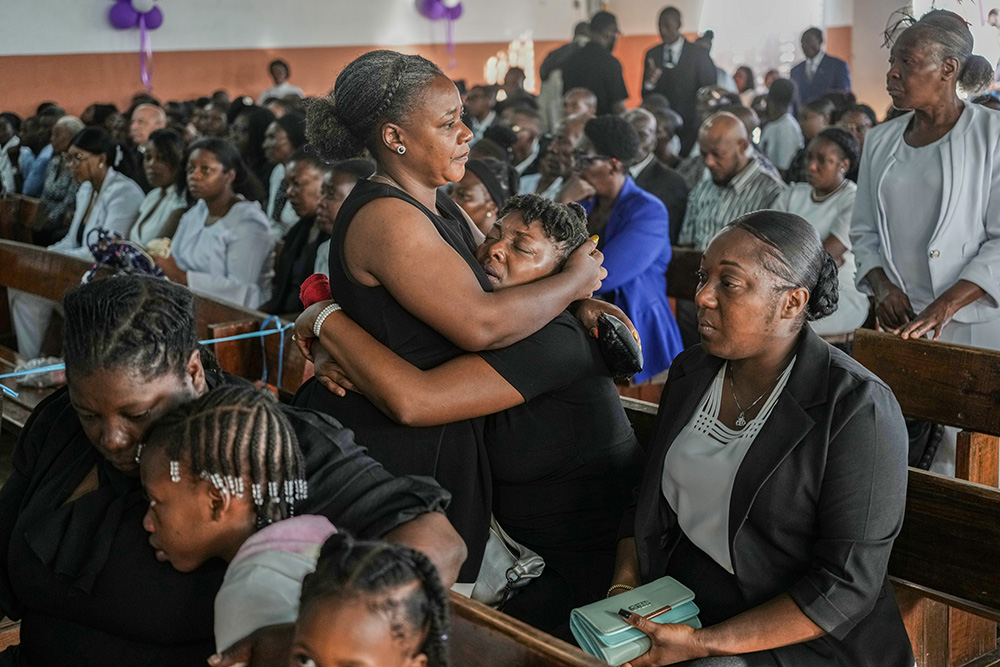
On Aug. 30, 2026, relatives attend the funeral ceremony for four victims of a gang attack in the Kenscoff neighborhood of Port-au-Prince, Haiti. (AP/Odelyn Joseph)
by Enzo Del Brocco
Join the Conversation
Send your thoughts to Letters to the Editor. Learn more
As I write these words, Haiti is mourning again.
In Kenscoff, in the mountains above Port-au-Prince, at least 47 people were killed in a brutal gang attack between Sunday night and Monday morning, Aug. 23-24. Another 22 were wounded and, according to the United Nations, more than 50 people were kidnapped.
There have been condemnations and promises. But what if, this time, someone who is not part of a U.N. mission or another government promising financial or military assistance went to Haiti?
For six years, I lived and worked in Haiti in Cité Soleil, one of the poorest neighborhoods of Port-au-Prince, accompanying its young people, serving as a hospital chaplain at St. Damien Pediatric Hospital and St. Luke Hospital, and reaching remote communities in the Jérémie Diocese devastated by Hurricane Matthew in 2016.
The news of the massacre in Kenscoff particularly tormented me. I know those mountains, as I often climbed them to visit the children and staff of the Nuestros Pequeños Hermanos programs there. To see a place I once knew as a refuge for orphaned and disabled children become the scene of such horror is a grief I can hardly put into words.
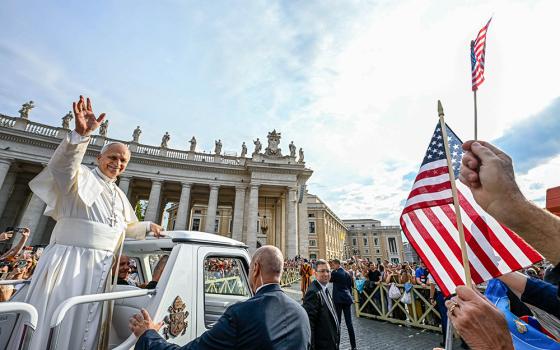
That is why I was so moved when Pope Leo XIV mentioned it after the Angelus Aug. 30. I know I may now sound like a dreamer, but allow me to dream. What if Leo visited Haiti?
The first and last pope to visit Haiti was John Paul II, on March 9, 1983. His visit was brief, and yet his words in Creole — "Mwen vini wè nou" ("I have come to see you") — entered the hearts and souls of the Haitian people during another difficult moment in their history. It was the time of the dictatorship of Jean-Claude Duvalier.
Advertisement
I believe that, more than 40 years later, those words deserve to be heard again: I have come to see you.
One of the most important things in the life of a human being is to be seen, to be recognized, to know that someone else knows we exist. And perhaps the same is true of a nation. Despite the fact that we live in an age of digital monitoring, facial recognition, and the watchful eye of "Big Brother," some people — and indeed entire nations — remain unseen, ignored by what Pope Francis so powerfully called the "globalization of indifference."
Haiti, since declaring its independence in 1804, has spent much of its history struggling to be seen and recognized. Haitians defeated a colonial system that had treated them as property rather than as persons, and yet international recognition was slow to come. The Holy See had contacts with Haiti from the early years of its independence, particularly concerning the pastoral life of the church, but formal relations were established through the Concordat of 1860. The United States waited even longer, until 1862, to recognize Haiti as a nation.
Today this question of recognition takes on an even more urgent meaning. Some 350,000 Haitians who had been in the United States under temporary protected status have now lost that protection. These are people who, until recently, had legal authorization to live and work in this country. And their return to Haiti is no longer simply a possibility. It is happening.
Last week, more than 160 people were deported from the United States to Haiti. The plane landed in Cap-Haïtien rather than Port-au-Prince because of the dangerous security situation in the capital. This fact alone should make us cringe. If a plane cannot safely land in the capital, why are we deporting people back into such a dangerous situation? Particularly when many of them had been living and working legally in the United States, raising families and sending their children to school — all legally.
Those 160 deportees have names, faces, families, histories, fears and hopes. As Leo reminded the church in an Aug. 11 message: Before someone is a "migrant," he or she is a human person. We must resist the temptation to reduce a person to a statistic and recognize the inalienable dignity of each individual.
What happens when people or an entire nation like Haiti begins to feel that the world no longer sees them?
For more than five years now, Haiti has lived without an elected president. Since the assassination of President Jovenel Moïse on July 7, 2021, armed gangs have taken control of much of Port-au-Prince and beyond. The international community has attempted timid efforts. Haiti has been seen enough to be discussed, studied and subjected to new international missions — but not enough to be rescued from a crisis that seems to intensify everyday.
Haiti is like the paralyzed man at the pool of Bethesda. For 38 years he waited for healing, watching others reach the water before him. When Jesus approached him, his answer was: "Sir, I have no one to put me into the pool."
Haiti, too, has been waiting. It is not invisible. Like the paralyzed man, Haiti is there, but too often overlooked and left waiting behind others who are able to reach the pool for healing. Then Jesus stopped and saw the paralyzed man.
And so I find myself asking a question that may seem unrealistic: What if Leo visited Haiti? I do not know how such a visit would unfold and how security could be guaranteed, especially while celebrating Mass for thousands of people.
While I don't have those answers, I know that the Gospel begins where our answers fall short. The disciples had to face a crowd of more than 5,000 people who had followed Jesus into a deserted place. With so many people and without enough food, their solution was: send them away. But Jesus did not. He saw the crowd and had compassion because they were like sheep without a shepherd. Jesus asked what they had. Five loaves and two fish. Definitely not enough and yet Jesus began there.
For decades, the international community has looked at Haiti as a problem too large to solve: political instability, poverty, natural disasters, corruption, kidnapping, gang violence and hunger.
In front of this, the conclusion is often like the disciple's one: send them away. Or better: look away.
In my opinion, the first miracle Haiti needs from us is to be seen with compassion and this is why I hope for a visit from Leo.
The first American-born pope also has a personal connection to the country. His maternal grandfather, Joseph Martinez, was born in Port-au-Prince in 1864, according to his birth certificate.
Imagine the visit of the successor of Peter coming as the apostle did from the beginning of the Acts of the Apostles: close to the suffering, allowing even his shadow to fall upon those who hoped to be healed.
I want to close my eyes for a moment and imagine Leo sitting among children with disabilities or visiting one of Haiti's struggling hospitals; meeting Haitian doctors and nurses who continue to work for their people with resilience. I see him listening to mothers who do not know where their children's next meal will come from. I can see him listening to young people who are struggling to see a future that is not trapped in the grip of gangs and political corruption.
And yes, I see him with tears in my eyes celebrating the Eucharist with thousands of Haitians!
I don't know how a papal visit to Haiti could happen. But I remember when Queen Rania of Jordan asked Leo if it was safe to travel to Lebanon and he brushed off the safety concerns, firmly stating: "Well, we're going."
The disciples had no idea how five loaves and two fish could feed a multitude. They only knew that the people were hungry.
Jesus knew something more. He knew they were there.
A papal visit could be a beacon of hope for Haiti. His presence could assure the Haitian people that they have not disappeared behind the statistics of violence, poverty, migration and political failure. The pope's presence could say, without needing many words: "Mwen vini wè nou." And maybe his presence could help open the eyes, ears and hearts of the rest of the world to Haiti once again.