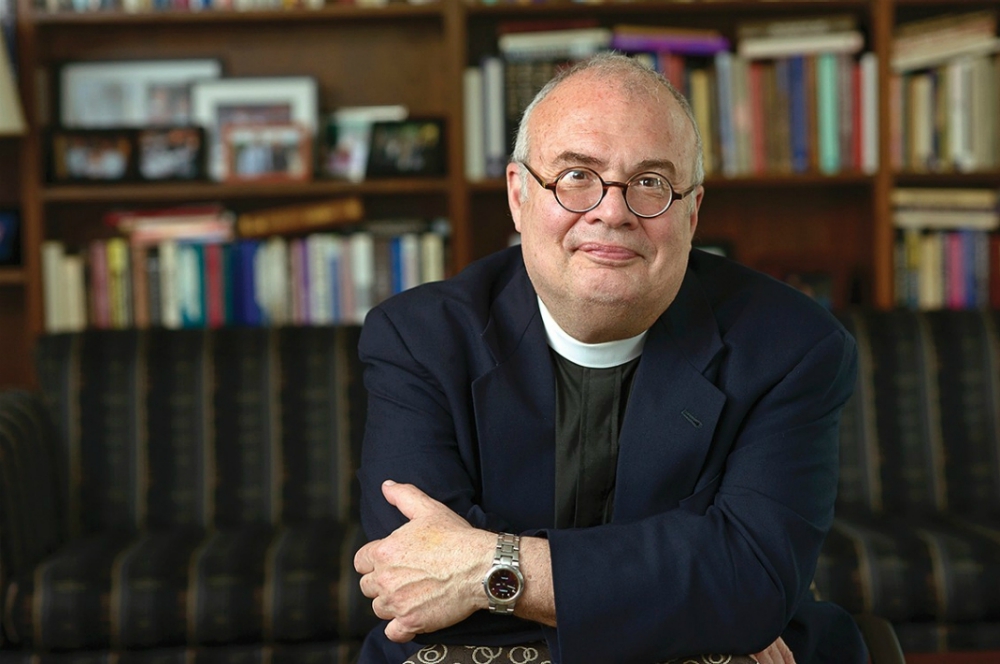
Jesuit Fr. Mark Massa (Boston College/John Gillooly)
Join the Conversation
Send your thoughts to Letters to the Editor. Learn more
The death of Jesuit Fr. Mark Massa leaves a gaping hole in the intellectual landscape of American Catholicism. In the past few decades, while academics were drawn increasingly into highly specialized studies, and interdisciplinary studies were harder and harder to find, Massa's inquisitive mind could not help but leap across the boundaries.
Massa was the first holder of the Karl Rahner Chair in Theology at Fordham University, where he also founded the Curran Center for American Catholic Studies in 2004. Later, he would go on to direct the Boise Center for Religion and Public Life at Boston College.
His last book, Catholic Fundamentalism in America, examined trends in American Catholicism through a distinctly Protestant lens. I reviewed that book here and here. At our 2025 Way Forward conference, we gave copies of this book to all the participants and Massa was so delighted when a bishop would write to him saying how much he enjoyed reading it.
Before that, he wrote The Structure of Theological Revolutions, in which he examined the development of Catholic natural law theories after the 1968 encyclical on the regulation of births, Humanae Vitae, through the lens of Thomas Kuhn's famous The Structure of Scientific Revolutions. I reviewed that book here and my conclusion holds:
Intellectual breadth, empathy and precision, so rarely found together, and so illustrative of the best of humankind, are here combined into a tour de force. Anyone who wishes to be serious about the Catholic intellectual life must henceforth have a well-dog-eared copy of this book on their shelves.
This capacity for intellectual cross-pollination yielded insights that were at once fresh and profound. These two books revealed a mind that could not be contained within the confines of a single discipline. And he did not suffer fools and could throw a sharp elbow when needed. It was rare that Massa described someone as "really smart," but when he did, that person was really smart.
In the hours after he died the afternoon of Sunday, Nov. 15, however, most of the texts and emails I received did not focus on his scholarship. Instead, they focused on the fact that he was such a mensch. St. John's University moral theologian Meghan Clark remembered Massa from her undergraduate days at Fordham University. "In Belgium, they refer to their academic advisor as their 'promoter,' and that was Mark," she told me. "He promoted his students and loved seeing them blossom."
Clark also related an incident at Mass that captures something of Massa's naughty sense of humor. "It was one of those epic Rose Hill Masses when I was an undergrad, on a feast day or Ash Wednesday," she told me. "The university church was packed, people standing in the back, all the way back, but the first five rows of pews were empty. Before beginning the liturgy, Fr. Massa noted there are empty rows at the front and said, 'Don't worry — celibacy isn't catching.' "
Advertisement
"During my doctoral studies, he did a directed readings course with me on the thought of David Tracy. There were texts he knew almost by heart — The Analogical Imagination — and texts he was eager to have me read and report back to him with my thoughts," Jesuit Fr. Ryan Duns, chair of the Theology Department at Marquette University, told me in an email interview. "We met bi-weekly over lunch, and we'd chat for 90-minutes. When he seized on an idea that he wanted to hear more about, or to have me develop further, he was (as the kids say) 'locked in.' Whereas some would associate this with a laser-like gaze, Mark's version of being 'locked in' was for him to begin to gesture frenetically, his eyes moving every which way, as he pushed and pulled and probed the ideas. I could feel myself learning, growing, and making unimagined connections as he wove my fragmented ideas into a larger tapestry of thought. He was an adventurous thinker, a scholar who empowers you to venture out of the tried-and-true lanes of the academy and to beat about the bush in search of new avenues of thought."
Stephen Schneck shared an anecdote that captured Massa's priestly side. Schneck was serving as chair of the United States Commission on International Freedom at the time. "He invited me to Boston after my first wife had died, ostensibly to talk about Adrian Vermeule and the integralists," Schneck told me. "But our time together ended up being about my own grief and confusion. I saw his pastoral side, consoling and kind. It was so very different from his gruff, almost pugilistic, intellectual persona."
Villanova University's Massimo Faggioli reflected on Massa's mentorship when Faggioli first arrived in the United States. "He was my first American friend, and made me understand what it means to do Church history in the USA," Faggioli recalled. "At Boston College, during the 2008-2009 academic year, Mark Massa, who was the visiting Gasson Chair at the time, helped me, a fellow at the Jesuit Institute, my first semester ever in America, to understand the history of the Church in the United States, its importance — and what it was that I was looking for in that history."
"He is the godfather of our daughter," Faggioli added, "and he came to her baptism in St Paul, Minnesota in a parish where there is, or there was, a small shrine dedicated to pope Clement XIV who abolished the Jesuits in 1773!"
Clement XIV may have suppressed the Society of Jesus, but in Massa, the restored society found someone who could not be suppressed. Michael Murphy, director of Loyola Chicago's Hank Center, said of Massa: "A mirthful garden gnome of a Jesuit with a big intellect and an even bigger heart." Murphy, Massa, Fordham's David Gibson and I collaborated on the Way Forward project, which entailed countless Zoom calls at the beginning. Massa could be pathologically discursive on those calls — his storytelling ability was notorious — but he was also the one most likely to find a creative solution to a conundrum, or know precisely the right person to speak about a given topic, or the person who could make us all laugh when we needed it.
Fr. Mark Massa was a great scholar, teacher, priest and mentor. Most of all, he was a great friend to many of us. His untimely death is still raw, still difficult to process. I am not alone when I say that his death makes me unspeakably sad and that I shall miss him very, very much.