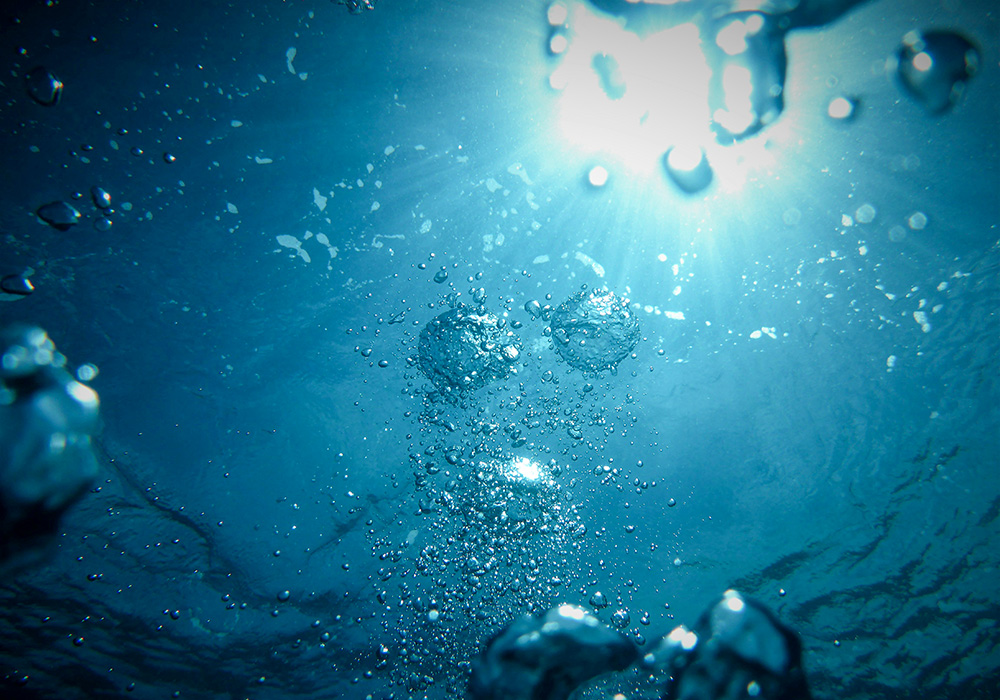
(Unsplash/Jong Marshes)

by Daniel P. Horan
Join the Conversation
Send your thoughts to Letters to the Editor. Learn more
The second account of creation in Genesis 2 declares that God makes human beings and all other living creatures ha-adamah in Hebrew, or from "the dust of the earth." Each Ash Wednesday we are reminded of this earthen origin and ultimate destination when we hear the minister proclaim: "Remember you are dust and to dust you shall return!"
But science tells a different story about our physical composition. Our elemental foundation is more accurately water, not earth (or wind or fire for that matter).
According to scientists, the human adult body is composed of nearly 60% water! Some of our bodily organs contain an even higher percentage of water, with our brain and heart exceeding 70% and our lungs topping 80%.
I admit that it can be strange to make sense of this fact, to imagine our bodies, which usually feel quite solid, as a liquid landscape. And yet, water is the source of life. It provides the conditions for cellular functioning at the microscopic level, and it is the originating incubator of all life that has evolved on our planet over billions of years. While it is well-known that a human being can survive for a few weeks without food in an emergency, the human body cannot last more than a few days without water.
For these reasons, among others, it seems especially fitting that this year's theme for the Season of Creation — that annual ecumenical commemoration of care for creation that runs from Sept. 1 through Oct. 4, the feast of St. Francis of Assisi — is "living water."
According to the steering committee for the Season of Creation, "This year's theme, 'Living Water,' explores Ezekiel 47:9 and 12 as a powerful biblical vision of hope and ecological healing. Set amid exile and loss, the image of living water flowing from God's sanctuary reveals divine healing that renews land, water, biodiversity, and human responsibility towards the whole creation."
The Season of Creation organizers remind us that the historical context of this passage from the Book of Ezekiel is "one of political, social, theological and national catastrophe. Jerusalem has been destroyed by the armies of Babylon." The great Temple of Solomon has been destroyed and many of the Israelites are now experiencing exile in Babylon.
The passage in Ezekiel is one that foretells God's restoration of the destroyed lands and dissipated communities with the metaphor of healing water flowing from God's sanctuary.
That water is the primary symbol of healing and renewal makes a lot of literal and figurative sense. As already noted, the majority of our human bodies are made up of water, and it is an element that all other creatures also require for survival. Therefore, any attempt to restore a broken people or land would require clean, accessible, healing water necessary for sustaining life.
So intimate is our bodily dependence on water that St. Francis of Assisi bestowed the title of "sister" on this aspect of creation that is, in his words, "so very useful and humble, precious and chaste."
In his 2015 encyclical letter, "Laudato Si', on Care for Our Common Home," Pope Francis discussed how water was of central importance when thinking about our responsibility in becoming better members of God's community of creation. He wrote: "Fresh drinking water is an issue of primary importance, since it is indispensable for human life and for supporting terrestrial and aquatic ecosystems. Sources of fresh water are necessary for health care, agriculture and industry."
Advertisement
Highlighting the interconnection between "the cry of the earth and the cry of the poor," Pope Francis observed how the poorest members of the human family are those most immediately and drastically harmed by lack of access to clean water due to drought and pollution.
Water supplies used to be relatively constant, but now in many places demand exceeds the sustainable supply, with dramatic consequences in the short and long term. Large cities dependent on significant supplies of water have experienced periods of shortage, and at critical moments these have not always been administered with sufficient oversight and impartiality. Water poverty especially affects Africa where large sectors of the population have no access to safe drinking water or experience droughts which impede agricultural production. Some countries have areas rich in water while others endure drastic scarcity.
So important is access to clean drinking water that Francis declared it a "fundamental right which conditions the exercise of other human rights."
As the source and symbol of life, water has long held a privileged place in our sacramental imagination, especially in celebrating baptism. But as we recount this sacrament of initiation, we should recall that the presider reminds the assembled that water can also be a source of death and destruction. We are told that the catechumen "dies with Christ" only to "rise with Christ" through the waters of baptism, a theological proclamation we reaffirm each Easter season as we renew our baptismal promises.
But the death that water can bring is more than symbolic.
We see this in recent tragedies like the devastating floods in Nepal, which have resulted in more than 1,000 people confirmed dead and more than 4,000 unaccounted for in the wreckage.
We will see how current and predicted weather patterns caused by an El Niño weather system over the next year will affect huge swathes of the globe in terms of water — both too much with anticipated flooding and droughts in other parts of the world.
We are witnessing the melting of polar ice caps and glaciers that disrupts normal ecological systems, threatens clean water supplies, and affects ocean temperatures and weather. Relatedly, we are seeing the rising of sea levels that threaten the lives of human and nonhuman creatures, especially those on islands or along ocean shores. Scientists have said that the melting of glaciers in the region contributed to the Nepal floods.
And despite environmental, governmental and even ecclesiastical calls to protect waterways, we still see new instances of pollution that threaten human and nonhuman animal life in rivers, lakes and oceans. One only has to recall the devastating situation in Flint, Michigan, a decade ago to see an illustration of the havoc such pollution can cause to a community.
For something so essential to every creature on this planet, we humans can take water for granted too easily. And this is why this is an excellent time to pause and reflect on the significance and importance of water during this Season of Creation. When millions of people face drought or polluted waterways as a result of climate change or industrial impact, when fish and coral reefs face death and extinction, and when weather systems continue to grow unpredictable and destructive, it is vital that we turn our attention to water, the source of life.
May this year's Season of Creation be an opportunity for people of faith to reflect on what is ours to do as members of God's community of creation who not only depend on Sister Water for life but are also called to protect and preserve this essential part of creation.