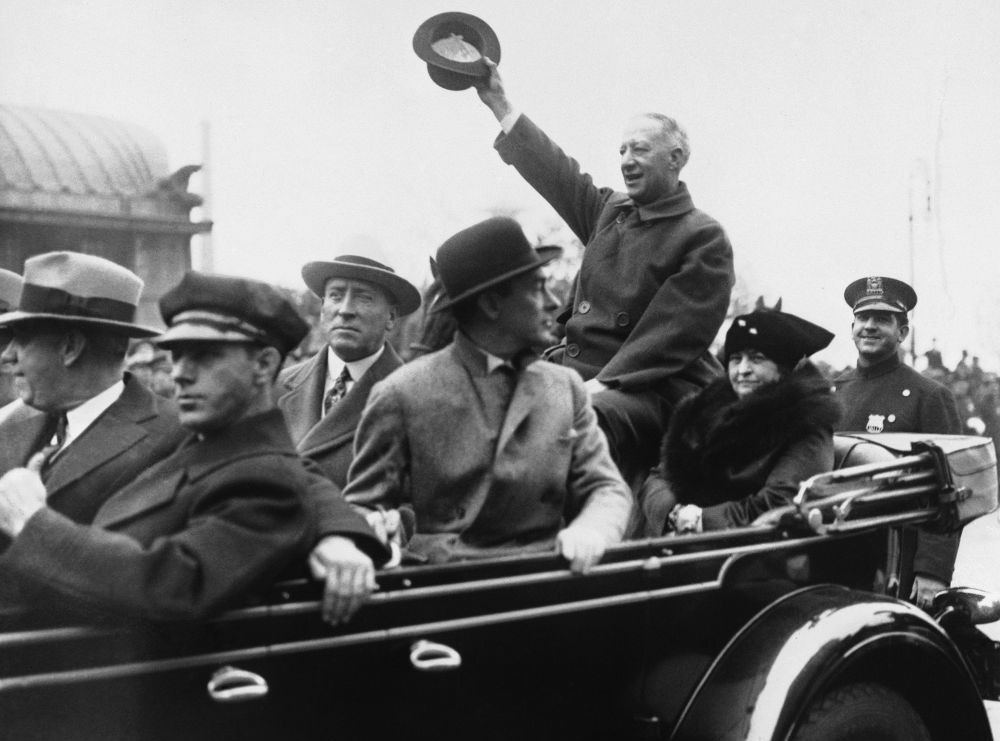
Al Smith, New York governor and Democratic candidate for president, waves during a parade in New York, Nov. 2, 1928. Smith was the first Catholic presidential candidate in a major U.S. political party. (AP)

Join the Conversation
Send your thoughts to Letters to the Editor. Learn more
Last week, I asked if the protests against building AI data centers marked the beginnings of a populism of the left. In the course of the editing process, an interesting question arose: Is there a specifically Catholic form of populism?
Let's start by explaining what we mean by populism. It is a political category with no particular content. Liberalism has come to mean many things, but each of those things derives from a desire to build a society that protects certain visions of human freedom. Conservatism usually refers to a political platform that stipulates certain human goods should be immune from tinkering by free individuals or by democratic societies. Catholic social doctrine does not fit neatly into either ideology. Its approach was rooted in pre-modern ideas about society drawn from natural law and biblical witness, whereas both liberalism and conservatism are products of modernity.
Populism only means anti-elite. And elites change over time and place.
In colonial American history, populism and indeed democracy itself were viewed with suspicion by some. It is no coincidence that the Founding Father who worried most about the dangers of democratic mobs and populist uprisings was John Adams, whose conversion to deism was complete by the time of the revolution but who retained for all his years a dark, Calvinistic view of human nature.
As Catholics became politically involved in the 19th century, they turned to the Democratic Party because it was the party most in opposition to the moneyed interest and Catholics were poor. The Democrats also were keen to enlist Catholic immigrants in building up local political machines. Local influence did not yet translate into national influence. Al Smith could win elections first in New York City and then in New York state, even though his Catholicism proved an insuperable hurdle when he ran for president in 1928.
Catholics were a significant part of the New Deal coalition assembled by Franklin Delano Roosevelt, which had a strong populist quality, and that coalition saved capitalism from the capitalists. FDR understood that the economy had to serve the best interests of the people, not just the rich, and that government oversight and regulation were necessary to assert the sovereignty of the people in the economic sphere. He did not aim to eliminate the market economy, only to regulate it. He was not an ideologue; FDR's pragmatism was one of his strongest political traits. But he was an idealist who thought big when the political class was thinking small.
As Catholics became affluent in the postwar era, they remained churchgoing and Democrat-voting until the late '60s when they moved to the suburbs and the rise of the cultural left alienated them. Catholics had long been placed in two categories: practicing or lapsed. Their assimilation into U.S. culture was complete with the emergence of liberal and conservative Catholics, upper middle-class Catholics and working-class Catholics, Democrat, and Republican Catholics. Catholics found themselves on both sides of the diploma divide. How this was affected by internal ecclesial issues is a topic for another day.
Advertisement
In the U.S., as throughout the Western, industrialized world, the deregulation of capital, the financialization of the economy, the liberalization of global trade and the deindustrialization of many local economies in the 1980s resulted in increased income inequality. Instead of an economy in which all people were doing better, especially those at the bottom of the economic pay scale, millions of working-class people now found themselves surrounded by decay: The factory closed, the shops and restaurants that catered to the workers closed, many people emigrated, all creating a downward spiral for many communities. In once largely Catholic, blue-collar cities like Fall River, Massachusetts or Wilkes-Barre, Pennsylvania, or Detroit, Michigan, the only growth industry was narcotics. Identity politics, driven by academics, began to eclipse class-based politics. The Clinton years replaced the moral rigor of Catholic social doctrine and New Deal solidarity with a meritocratic creed that implied the elites' success was the result of their own hard work. Thus, those on the downside of the economy must be to blame for their predicament. Remember "deplorables"? Hopelessness led to anger. Donald Trump figured out how to harness that anger, as did Nigel Farage in the U.K., Viktor Orban in Hungary and Marine Le Pen in France.
The Catholic Church roots its social doctrine in the dignity of the human person. While it favors no particular political or economic systems qua systems, it has a strong affinity with liberal democracy's embrace of rights that defend that dignity and an equally strong affinity for conservatism's organic understanding of human society which also defends that dignity. So, Catholics agree with liberals on the need to restrain the power of the business class, the rights of workers, and the need to fight racism, while Catholics agree with conservatives that abortion and euthanasia are wrong because they deny the dignity of the unborn and the elderly and inform. The Catholic measuring stick is not liberal vs. conservative, but what advances human dignity and what threatens that dignity.
The Catholic measuring stick does not necessarily favor populist objectives over elite ones. Populism usually has an angry edge to it, and Catholicism always favors a more irenic approach. Still, insofar as Catholic social doctrine focuses on the dignity of the person, and populism seeks to give voice to the people whose dignity is threatened by elite power, there is a natural sympathy between the two. Elites can sometimes be right, and Catholicism does not insist on rejecting any opinion on account of who supports it. But there is no natural affinity with elites, quite the opposite. The preferential option for the poor is almost always a preferential option against a country's elites.
You are reading a selection from Michael Sean Winters' weekly newsletter. To get the full edition — including the "In the News" link roundup—delivered 24 hours before it appears online, sign up here!