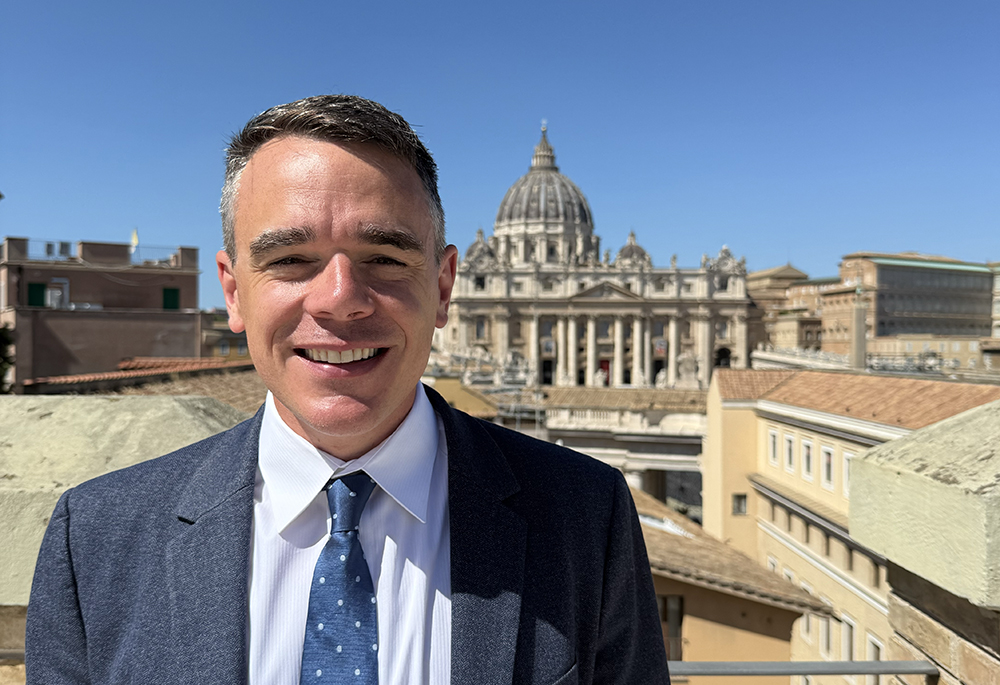
Michael J. O'Loughlin is pictured on the rooftop of the Jesuit Curia, with St. Peter's Basilica in the background, at the Vatican in September 2025. "Capturing the full range of experiences and individuals that make up the church is my goal as editor of NCR," writes O'Loughlin. (Courtesy of Michael J. O'Loughlin)

by Michael J. O'Loughlin
NCR executive editor
Join the Conversation
Send your thoughts to Letters to the Editor. Learn more
Pope Leo XIV announced earlier this year that he would devote a number of his weekly audiences to exploring themes from the Second Vatican Council — engagement of the laity, an openness to the world, a commitment to the Gospels — that were foundational in the creation of the National Catholic Reporter in 1964.
"In the face of today's challenges, we are called to continue to be vigilant interpreters of the signs of the times, joyful proclaimers of the Gospel, courageous witnesses of justice and peace," Leo said in January.
I remember learning about Vatican II for the first time about 20 years ago, as a theology student at St. Anselm College in New Hampshire. Dominican Sr. Maureen Sullivan, an energetic scholar of the council, taught a class about its legacy with an animated sense of possibility. She highlighted concrete changes, like the use of the vernacular in the liturgy, and the more ethereal spirit that led to creative, novel and meaningful avenues for laypeople to live out their faith and serve the church. Sister Maureen's enthusiasm would stick with me as a young journalist covering the church and I would come to hold the council's spirit of aggiornamento, or the throwing open of the windows of the church, close to my heart.
Leo delivering his remarks during my first week as executive editor of NCR felt serendipitous, almost like a challenge to remember my introduction to Vatican II at the start of this millennium. And in a way, his words provided a surprising prompt in helping answer one of the most common questions I've been asked over the past three months: "What's your vision for NCR?"
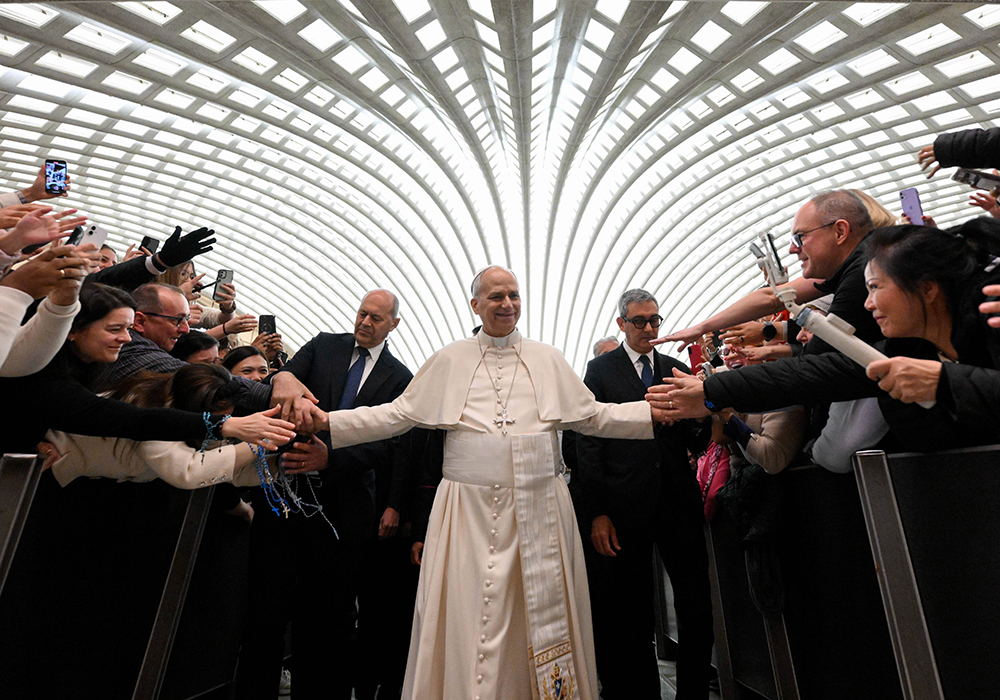
Pope Leo XIV greets people at the conclusion of his weekly general audience in the Paul VI Audience Hall at the Vatican Jan. 7, 2026. (CNS/Vatican Media)
My first task in developing an editorial vision was synodal in nature: hosting listening sessions with NCR's reporters, opinion writers and editors, as well as board members, donors, readers and even critics to understand what makes NCR so important to so many. Those conversations, along with Leo's insightful words on the council and a deep dive into NCR's earliest editions, have informed my consideration into how I will lead NCR and build on its legacy.
In an 1968 editorial, NCR positioned itself as "a Catholic paper, concerned with Catholic activities, values and ideas, trying also to be present to the world."
That's still true today.
Editors back then regularly cited and celebrated a 1963 talk to Catholic journalists from the Jesuit Fr. John Courtney Murray.
"The Catholic press can be nothing but the vehicle of truth and of fact," Murray said, adding, "the rule of the journalist [is] to say nothing that is false and to conceal nothing that is true."
To say nothing that is false and conceal nothing that is true.
Throughout its history, NCR has upheld this exhortation with courage. I think especially of the publication's pioneering reporting that exposed sexual abuse by priests and cover-up by bishops, as well its commitment to covering Catholic communities whose stories were often overlooked.
Advertisement
We are still guided by Murray's exhortation to report the truth and now by Leo's call to be "courageous witnesses of justice and peace." We also draw inspiration from our mission statement, which reads, "NCR connects Catholics to church, faith and the common good with independent news, analysis and spiritual reflection."
Many readers have asked what kinds of stories we'll focus on. We'll remain flexible given how quickly the news cycle moves, but coverage plans can be broken down into three categories: news articles exploring "the signs of the times," as Leo put it recently; stories offering hope even in the midst of the many challenges facing the church and the world; and occasional lighthearted fare exploring the fun side of faith, such as the recent creation of an ice chapel at Notre Dame or Leo's inaugural appearance on Vogue's "Best Dressed" list.
There are also several broad themes that have come up repeatedly in conversations with readers, reporters and newsmakers that we will explore:
- Rise of authoritarianism: How are Catholics fighting, or aiding, the rise of authoritarian politics in the United States? What about Catholic political leaders? How is political polarization shaping our church?
- Dramatic demographic shifts: As the United States becomes less religious, and by some measures, more politically conservative, what does this mean for the Catholic Church here and around the world? What drives the young people who anecdotally are leading a resurgence of interest in the church?
- A U.S.-born pope: How will Leo interact with political leaders in his native land? Will he shape the hierarchy in his image? How might he promote peace and protection of creation? What will synodality look like for him? Will he find ways to include women in decision making structures and make the church more welcoming to LGBT people?
- Tech challenges and opportunities: Is there a role for Catholics to play in the rapid expansion of artificial intelligence? How will AI affect the faith lives of believers? Are Catholics part of the effort in finding solutions to what will undoubtedly be a massive disruption in employment, inequality, environmental degradation and even human relationships?
- Spirituality in a modern age: How do Catholics find God in their day to day lives? Where do they encounter the transcendent? How is faith confronting the epidemic of loneliness? What resources is the church providing for Catholics seeking a refuge from the onslaught of distractions and diversions?
Editorial planning aside, in my experience, the most meaningful stories have sometimes been the ones that have flown under the radar.
I was in Rome in 2014 covering Pope Francis and the synod on the family. Thoughtful questions that once seemed off limits were being discussed at the highest levels of the church: Could divorced and remarried Catholics receive Communion? How should the church welcome LGBT people? Were the views of young adults being taken seriously? As a journalist covering the synod, and as a young Catholic myself, I had a lot of questions about the synod and the future of the church, particularly for young people who maybe didn't quite feel at home.
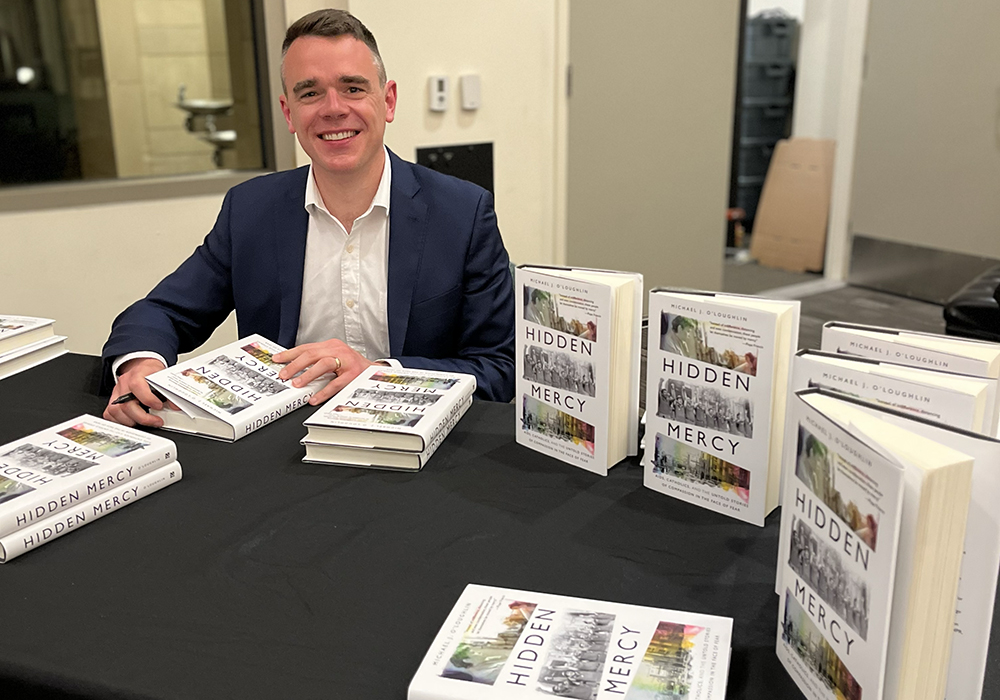
Michael J. O'Loughlin is pictured during a 2022 book-signing event for his book Hidden Mercy: AIDS, Catholics, and the Untold Stories of Compassion in the Face of Fear. (Courtesy of Michael J. O'Loughlin)
One night at dinner, over crisp Roman pizza and glasses of red wine, a priest friend listened to my questions and suggested that I explore how the church responded to HIV and AIDS in the 1980s and '90s. He said I would likely find some helpful historical examples of how marginalized communities found a home in the church. I couldn't have imagined at the time that his idea would lead to hundreds of interviews with Catholic sisters, priests, politicians and activists and result in my book, Hidden Mercy. Or that the stories in that book, as I learned later in messages from readers, would provide a lifeline for many Catholics struggling to find their place in the church today. That experience reminded me that stories chronicling the struggle to help the church live up to its own ideals are timeless.
In my early conversations with NCR stakeholders, I heard how much they value our independence, which gives our team the responsibility to report, analyze and comment on the news with freedom. I also heard a desire to engage with the institutional church in creative and novel ways.
The church today is radically different from the 1960s, when NCR was founded. It is in some ways a diminished institution, culturally and politically, the result of a number of factors, including rapid secularization and its own mishandling of clergy sex abuse cases. At the same time, the church continues to provide an outsized role in U.S. health care, higher education and charitable work and it's the spiritual home of millions of Americans. Many of those practicing Catholicism today, including many NCR readers, have shifted their posture toward the institution over the past several decades. Engaging with the church today means taking seriously the role of lay leaders at every level of the church — especially women — as well as seeking to understand and report on the hierarchy.
On a recent work trip to California, I attended Masses at two different parishes, experiences that illustrated for me the breadth and opportunity of the work ahead.
At one, an established congregation gathered in a beautifully restored church situated in a lovely, upscale neighborhood. Professional musicians lent their talents to a soaring and inspiring liturgy and Mass ended with several announcements about the parish's many social justice ministries. I marveled at how the community uses its resources to worship and to serve.
The other Mass took place in a church located in a less manicured area, but the liturgy was no less packed, with people spilling outside onto the steps. What the Mass lacked in polish was made up for in enthusiasm. The crowd was more ethnically diverse, intergenerational and led by a millennial priest wearing a black biretta preaching about the value of popular devotions.
It can be tempting to view these two parish experiences as representative of two ends of a polarized church: different spiritual emphases, different styles of worship and different ways of living out a common faith. But I didn't experience them in that way. Instead, it felt like stepping into the vibrant complexity of the church. Each offered moments that were inspiring and challenging. The individuals gathered in those spaces shared a commitment to Jesus, a relationship to the church and a quest for understanding the truth. Capturing the full range of experiences and individuals that make up the church is my goal as editor of NCR.
Back in 1968, NCR's editors pledged, "As long as people are interested and the U.S. post office stays in business, we'll be around." As we plan for the future of NCR, we'll eventually rely less on the post office as we invest in new ways to deliver the news to our readers. Our website will be refreshed in the months ahead, our newsletters will be revamped and we'll explore how we can best utilize audio and short-form video to connect with readers. We will also invest more time in explainers and analysis.
The future of media remains uncertain and NCR is not immune to industry challenges. But here's how you can help. I hope that you'll hold us to account when it comes to meeting the standards you've come to expect. When our stories inspire, challenge or inform, let us know and share them with your friends and colleagues. When we come up short, when we miss the mark or contribute to the polarization plaguing the church and the world, be in touch. We strive to hold leaders accountable, at every level, and to cover the rapidly changing demographics of the U.S. church, and we need your help to do this effectively. The trust that NCR readers place in this publication makes this endeavor possible, and we strive to honor that in all that we publish.