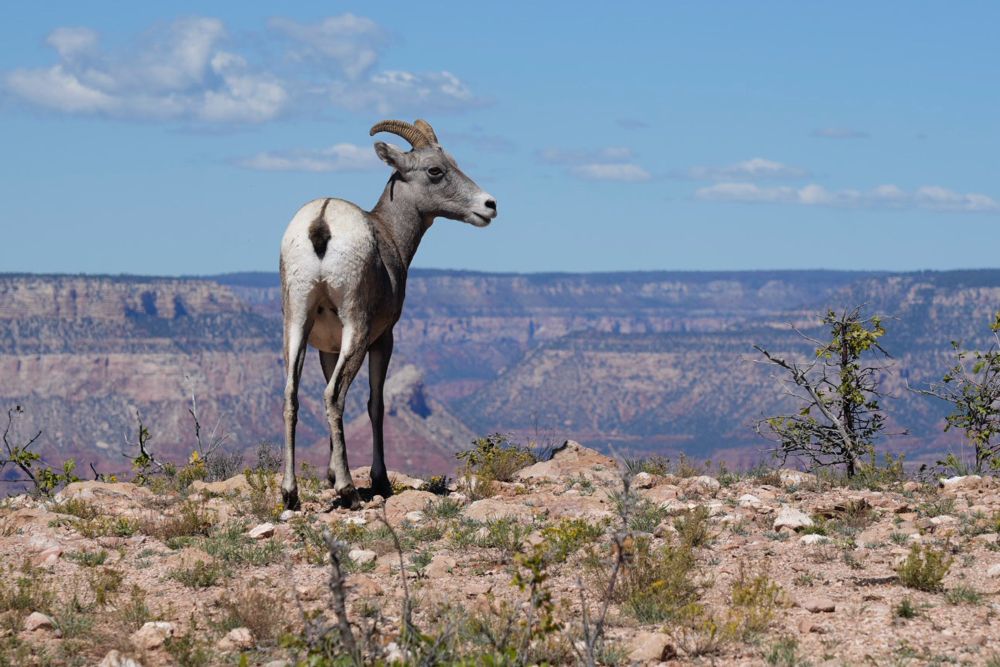
A desert bighorn sheep stands at the South Rim of the Grand Canyon in Grand Canyon National Park in Arizona Oct. 2, 2026. (OSV News/Gregory A. Shemitz)

by Daniel P. Horan
Join the Conversation
Send your thoughts to Letters to the Editor. Learn more
For those who may have forgotten, we are still very much in the midst of a global climate catastrophe with things expected to get significantly worse in the coming years and decades. Despite the fact that this reality has ceased to garner the headlines and front-page stories it deserves, we would do well to remember that we must change our ways and revise how we understand our role as humans within God's cosmic community of creation.
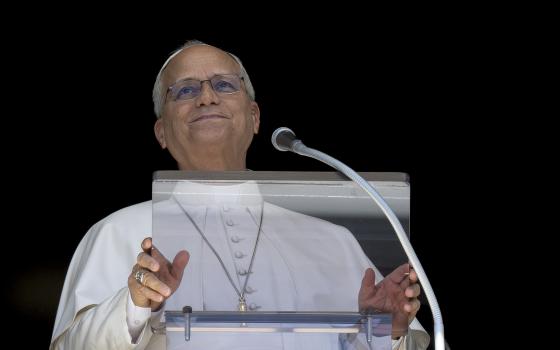
In 2023, Pope Francis published Laudate Deum, his apostolic exhortation and follow up to the 2015 encyclical letter "Laudato Si', On Care for Our Common Home." As he explained early in the text, "Eight years have passed since I published the Encyclical Letter Laudato Si', when I wanted to share with all of you, my brothers and sisters of our suffering planet, my heartfelt concerns about the care of our common home. Yet, with the passage of time, I have realized that our responses have not been adequate, while the world in which we live is collapsing and may be nearing the breaking point."
Indeed, as the late Holy Father plainly stated, "our responses have not been adequate" and we now find ourselves faced with a choice: We can embrace "ecological conversion," turn away from ecological sin and strive to live in right relationship with the rest of creation, or we can keep on the same path of environmental destruction.
If we choose change, one thing that is long overdue for renewal is our understanding of our place within the community of creation. Dating to at least the classic 1967 article by the historian Lynn White Jr., in the prestigious journal Science, researchers and advocates alike have noted that a misguided Christian reading of the Book of Genesis and its mention of "dominion" (1:26) and "subduing" (1:28) understood to give humanity sovereignty over all of creation has contributed to distorted attitudes and destructive practices. Fortunately, Francis formally rejected that interpretation of Genesis in Paragraph 67 of Laudato Si'.
Other attempts to make sense of our relationship to the more-than-human world have focused on a call to stewardship, recognizing that it is better to affirm a divine calling or vocation to tend to the rest of creation than to assume our own lordship over it. Laudato Si' strongly encourages this transition in thinking.
However, there is another way to conceptualize our place within and relationship to the rest of creation that comes from the life and example of St. Francis of Assisi. Recalling that Francis recognized the inherent kinship or familial bond shared among all creatures, which I wrote about here last year, we might ask ourselves how we can translate the need to care for creation in light of our cosmic sisterhood and brotherhood with all creation.
In the early 1260s, the Franciscan theologian, cardinal and doctor of the church Bonaventure of Bagnoregio (1221-1274) offered an insightful reflection on how Francis understood himself and the whole human family in relation to nonhuman creatures. Bonaventure believed that Francis exhibited a profound embodiment of the virtue piety, and he dedicated Chapter 8 of his The Major Legend of Saint Francis to unpacking this dimension of Francis's life and legacy.
To many contemporary audiences, the word "piety" evokes images of devout, religious, saintly people. We may think of those people in our churches who attend daily Mass, recite the rosary and volunteer regularly at parish events.
However, Bonaventure uses the word piety differently, drawing on its ancient Roman origins. The Latin word pietas was used to describe a key virtue of citizenship. In the Roman context, pietas was understood primarily in filial terms relating to the care of one's family members, like parents caring for their children, siblings caring for one another, or adult children caring for their elderly parents. Secondarily, it referred to the duty to care for the dead or worshiping deities, which is where the modern association with religious practice likely originated.
Bonaventure describes Francis as a deeply pious person, not for his care of biological family members (according to the early sources, he was actually estranged from his family of origin), but for his recognition of and care for his nonhuman creaturely kin. Bonaventure explains that Francis arrived at this state of virtue from reflecting on the shared origin all of creation has in common. He wrote: "From a reflection on the primary source of all things, filled with even more abundant piety, he [Francis] would call creatures, no matter how small, by the name of 'brother' or 'sister,' because he knew they shared with him the same beginning."
Advertisement
What is striking about Francis is that, in Bonaventure's telling, the saint from Assisi not only recognized the bonds of kinship he shared with nonhuman creatures, but they also recognized this familial virtue of piety in him, too. Bonaventure wrote: "Let also the devotion of the faithful weigh how the piety in God's servant was of such marvelous power and of such abundant sweetness that even the nature of animals acknowledged it in their own way."
To illustrate this mutual recognition between Francis and nonhuman animals, Bonaventure tells an interesting story about a sheep.
Another time at St. Mary of the Portiuncula the man of God was offered a sheep, which he gratefully accepted in his love of that innocence and simplicity which the sheep by its nature reflects. The pious man admonished the little sheep to praise God attentively and to avoid giving any offense to the brothers. The sheep carefully observed his instructions, as if it recognized the piety of the man of God. For when it heard the brothers chanting in choir, it would enter the church, genuflect without instructions from anyone, and bleat before the altar of the Virgin, the mother of the Lamb, as if it wished to greet her. Besides, when the most sacred body of Christ was elevated during the solemnity of the Mass, it would bow down on its knees as if this reverent animal were reproaching the irreverence of those who were not devout and inviting the devout to reverence of the sacrament.
One thing this narrative makes clear is that Francis did not just "love animals" in the way caricatures of the saint often depict. Instead, Francis communicates with this nonhuman animal as a sibling, acknowledging the sheep's rational capacity to discern times and places. In turn, the sheep exhibits linguistic comprehension and follows the saint's instructions, praying when invited and appropriate and doing so in a manner that puts the humans assembled to shame.
At the end of this chapter, Bonaventure lifts up St. Francis as a model for all people, exhorting women and men to follow the saint's example of creational piety. Embracing and living the virtue of pietas is what establishes and maintains right relationship among all God's creatures and helps us human members of God's community of creation better understand our place within this cosmic family.
Indeed, Pope Francis was right to call us out for not adequately responding to the ecological signs of our times. But with ecological conversion, like all dimensions of lifelong Christian conversion, there is always the opportunity to begin again, renew our thinking and put our beliefs into practice.
As we continue to commemorate the 800th anniversary of St. Francis' death this month, let us not just admire Francis from afar, but follow his example in our world today by becoming more pious in our relating to and caring for our creaturely siblings with whom we share our common home.