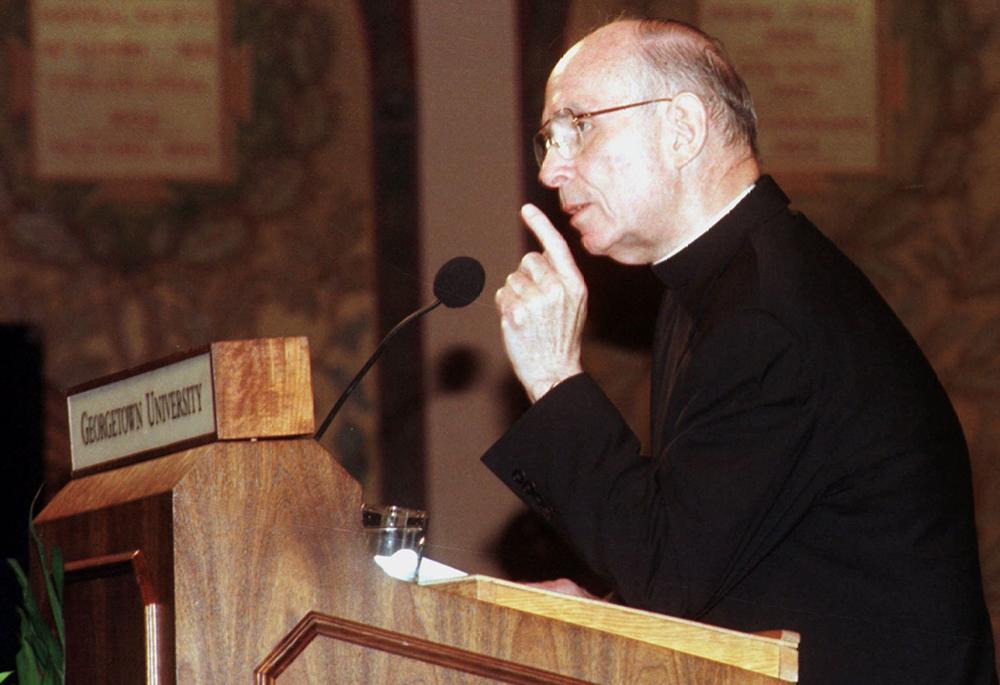
Cardinal Joseph L. Bernardin of Chicago makes a point in his Sept. 9, 1996, talk at Georgetown University. In his speech the cardinal stressed the need to establish a ''consistent ethic of life'' in America and to bring religious values into the nation's public life and culture. (CNS/Bob Roller)
Editor's Note: Two anniversaries coinciding in recent weeks — the 50th anniversary of the 1976 Catholic conference, A Call to Action, and the 30th anniversary of the death of Cardinal Joseph Bernardin — prompted editors to recall an extensive interview the late cardinal granted this paper a few years after that conference.
In 1976, Bernardin was president of the still-nascent National Conference of Catholic Bishops (NCCB), a precursor to the present United States Conference of Catholic Bishops (USCCB), which is meeting this week in Baltimore.
Bernardin would go on to become archbishop of Chicago in 1982, and Pope John Paul II made him a cardinal the following year. Bernardin's influence on the church in the United States was profound.
Catholic Theological Union President Fr. Enzo Del Brocco wrote recently for NCR about Bernardin's efforts "to show that the defense of human life is one fabric" and to weave together a consistent ethic that brought together various Catholic social justice efforts, including "abortion, nuclear war, capital punishment, poverty and care for the dying."
Below is the text from the 1979 interview with Bernardin by Mark Winiarski, who was the news editor for NCR. In it, Bernardin addresses a number of topics that still prompt debate in the church: lay leadership, women's ordination, abortion, engagement with political leaders and what today might be called the synodal way, or broad engagement and dialogue between lay Catholics and ordained leaders.
Bernardin: Bishops ahead of Catholic mainstream
November 12,1979
By Mark Winiarski
NCR News Editor
CINCINNATI — "Some of my friends said I was crazy to do this," said Archbishop Joseph L. Bernardin, sounding somewhat rueful, at the end of a three-hour taped interview with NCR.
Throughout most of the afternoon, the archbishop, 48-year-old president of the National Conference of Catholic Bishops (NCCB), sat at his chancery office conference table, generally unsmiling, cautiously forming his replies, defending his positions but stressing he was not being defensive.
Not until the session was in its third hour did the archbishop relax a little, taking off his glasses and giving an occasional laugh — occasionally turning back a question with a careful barb or a question of his own.
Advertisement
Rarely did he allow his personality to penetrate the barrier of reserve or the curtain of caution that surrounded his personal views.
Nonetheless, the discussion was wide-ranging and periodically candid. Topics included:
- Bernardin's background and his relationship with the late Archbishop Paul Hallinan of Atlanta: "We saw eye to eye."
- NCCB representatives' meetings with the presidential candidates — including his staunch defense of the bishops' role in the campaign: "I make no apologies."
- The bishops' communications problems: "We develop a good document on a good topic, and then we say, 'Well, we've done our job, now it's up to somebody else to do something about it! Then nothing happens, so I think we have to share part of the blame."
- The leadership of the bishops: that they are more committed to social action than most mainstream Catholics.
- The Detroit "Call to Action" conference: Perhaps misnamed, he said, given that the delegates' role was to be consultative.
The transcribed interview runs to more than 60 pages. It has been edited for length in many places. However, the archbishop's statements run sequentially and, although Bernardin could not change quotes, the edited portions were read to him to avoid inadvertently altering the intent of his statements.
***
NCR: [Jesuit Fr.] Avery Dulles, as you know, calls the National Conference of Catholic Bishops just a debating society. Is that accurate?
Bernardin: No, I don't think that is an accurate description, at least if you take the words for what they are worth. I think in describing the conference, you have to nuance it more than that.
It's true that the conference is not a national church. It's true that, per se, the conference does not have jurisdiction over the local churches in this country. The ordinary of the diocese is still the man who is basically responsible for what goes on in the diocese and, while he relates to the national conference in ways that I will mention in a moment, he's directly responsible to the Holy Father. At the same time, however, the conference does play an important role. There is a leadership role the conference can play.
By leadership, you mean for all Catholics?
All Catholics ... but in certain areas we provide leadership for anyone who is willing to listen to us. ... The fact of the matter is that if a majority of bishops think that something should be done in a particular way — that we should take a particular stance on a certain problem — that has an effect on the body of bishops. ...
There are certain areas where the decisions of the conference do have the effect of legislation; they do have a canonical effect — certain things provided for in the law of the church, such as some liturgical matters which become law for the church in this country.
In addition, if the bishops wanted to do something that would have the effect of legislation [but which is] not provided for in the general law of the church, this would be requested of the Holy See, if two-thirds of the bishops vote that way. ... We could decide ... we should do a particular thing and every diocese should be obligated to do it. ... When Avery says it's just a debating society, ... there's an element of truth in that ... the national conference is a forum in which we exchange ideas.
After the May NCB meeting in Chicago, I think it was Archbishop [John] Roach [of St. Paul-Minneapolis] who said that he wished the bishops' statements had more prophetic impact. Then I think it was [Bishop James] Rausch [NCCB executive secretary] who said the conference had its own style of speaking that wasn't the style of the people. Do you feel that the statements of the conference, the prophetic leadership, filter down to the Catholics, say, in St. Stanislaus parish in Buffalo, N.Y.?
I think this is a real problem. ... For example, at the Detroit "Call to Action" conference, several people got up. In one instance, a priest said the bishops should say something about this, that or the other; he mentioned three or four things that we have made statements on in the last year or two, such as housing, employment, a few other things. And he was a priest, see.
Now maybe what he was really saying was that we should do it more effectively, but the context was such that I don't think he. knew what we had said. Some of the people around me said the same thing — "He doesn't know what we have said."
Still, be that as it may, the fact of the matter is that if you take a look at the things we have said, the statements we have made over a period of years, we've talked about a heck of a lot of topics, and I think we have said many good things on those topics. …
I think that in many instances, we've taken a much more progressive position than our Catholics, than the mainstream of the Catholic community.
In fact, the teaching that's in these documents has not filtered down to the grassroots level. Why, I'm not sure, but I think some of the factors are that perhaps we don't do enough to see to it that this gets filtered down. …
We've got the substance, but not the style, maybe, to attract a larger audience. These things have to be written in a more popular style.
Another factor, though, is that at the local level, maybe the bishop doesn't do anything to see to it that the thing is propagated, and maybe the authorities in the local parish — the pastor, the parish council — they don't do anything. Why?
There are a number of reasons. Maybe they're not interested and they don't want to do anything. Or maybe it's because they've got so many things to do that they feel kind of frustrated. But the fact of the matter is that there's a real problem in communicating. We are not communicating as effectively as we should be.
What's your recommendation?
There are a number [of recommendations to be discussed at the NCCB meeting in Washington Nov. 8-11]. One has to do with evangelization. That was the topic that was most discussed [during a study].
There are a number of other proposals to develop models for parishes, and also there's a great communications proposal that's part of this. The only specific proposal under evangelization we will not be voting ... [is that] pertaining to communications. …
It's not going to be voted on and the reason it's not going to be voted on is it involves a collection or some other means of financing. ... We cannot commit our dioceses to a collection or to a large expenditure of money without some kind of consultation.
In general, it is felt that the body of bishops should address issues more from a pastoral and theological perspective. The more technical aspects of the topic should be addressed by some other entity within the conference. Why? Because we may not be experts in the technical aspects ... and why should we as a body of bishops give kind of a magisterial endorsement of something that may be nothing more than a strategy that may have to be changed?
If the pastoral letter on morality [to be considered at the NCCB meeting] is passed — 37 pages long — who down at St. Josaphat's parish is going to read it? ... What kind of impact do you expect that document to have?
I'm going to give you an involved answer. ... In the area of social concerns ... there might be agreement on principle but a difference of opinion on strategy. People totally orthodox and committed might say, "This is not the way to go about it."
A case in point: Up for consideration ... is a document on ... people on the move. ... This document goes on for 26 pages ... the first few pages are all right: facts and principles. Then we start getting into immigration law, whether we should do this or do that.
I said, "Let this be a supporting document. Let us vote on the brief resolution that commits us to this problem in a very clear way, but let's not go beyond that ... this then becomes the working document for the committee and the staff. But we don't have to necessarily agree on every item that's in here." And they accepted that.
So this is presented ... as a background paper and we've got ... a two- or three-page resolution that says we're committed to helping people on the move. Here's what motivates us and we're going to do something about it.
Now we know we'll be working within this context, but we're not putting our full weight, our name behind every word. …
Now the bishops feel much more comfortable when it comes to a document like the document on moral values where they don't get into specifics too much, but just reaffirm traditional —
There's no action, so they feel comfortable?
Well, let's not put it quite like that. There is action contemplated, but what kind of action? ... A change of mind and heart, a willingness of people to work out their lives in the light of these principles which we feel are part of the Gospel. But that's a little bit different from saying we're going to push for law 26-A or from saying this particular thing should be in our foreign policy. If you accept that difference. ... then in certain areas, especially in the area of social concerns where we have to work out strategies and all the rest, we ought to give ourselves a little leeway so ... we can change. …
I don't think we've found the solution yet. I think the whole communications thing is part of the solution, where some of these proposals would be translated into other literary forms and then communicated: Television, the written word, that's part of it.
But now, in some instances, some of these documents don't really have an impact until two to three years later. For example, take the pastoral on education: "To Teach as Jesus Did." I personally think that was a very good document and I think it's having some impact. ... The reason is that, after a period of time, the people who are responsible for education in the various dioceses began reading it and studying it and began using it as a basis for action. ... It took three years.
Why do the bishops need 37 pages to write on morality? At the end of the document are there any action steps, ... any sort of implementation at all?
No, … in its present form it is more an affirmation. ...
Locally I haven't made any plans yet, but as soon as the document is released, I do intend to go to the priests' senate and pastoral council. ... I intend to do that, but l have to be candid and say the kind of plan of action you describe is not attached, and in asking that question you've pinpointed a problem I think we have to cope with.
But ... there is ... another side of the coin. I think some people, even the liberals, expect too much of the bishops. I'm considered to be theologically, at least, quite conservative. At least that's what I read about myself from time to time.
Do you believe what you read?
I'm not going to answer that. But l'd be the first to admit that the bishops are not the church, that we are the leaders of the church. But sometimes I find the very people who talk the most about shared responsibility and subsidiarity and a plurality of thought are the ones who come to me and demand I take unilateral action on something they want to see done, unilateral action against something they are opposed to.
Do you have a specific?
Yes, we had here in this diocese this past summer a little flare-up regarding the consolidation of some schools. And I had difficulty with some of the things that happened and I intervened at certain points.
But the fact ... is there were a lot of people involved — ... the archdiocesan board of education, the parish councils of the parishes involved — and all the rest, you see. But ... some ... demanded that l unilaterally, almost immediately, take action to rectify what they perceived to be wrong. Well, the thing was rectified, ultimately. But I went through the same procedures and structures that had been used to arrive at the decision in the first place.
Is the NCB leading us down the road to socialism?
I feel that in many of these areas there are different approaches which could be considered legitimate and justified, and so l know there is a certain amount of controversy. ... At times you hear the bishops themselves express some reservations about things ... done by the conference or in the name of the conference. Certainly you hear other people express concern.
But in the final analysis I think that what the conference is trying to do — and by conference I mean the bishops in consultation with the various people they consult — [is] trying to adopt the social teaching of the church to the contemporary situation in which we live. Once you leave the level of principle — of general teaching — and you get down to the application of that principle, it's inevitable that there's going to be discussion, dissent. ... This is what we've seen happen. But I believe that our guide is the church's social teachings which have been developed over a number of years.
... When I talk about the social teaching of the church, I refer to the last 85 years beginning with Rerum Novarum in 1891. I do think that perhaps at times we may speak on some of these issues more often than we should, with the result that people tend to listen less. …
We're all for social justice until the blacks move into our neighborhoods and the property values go down. Is it the bishops who are out of step with the laity, or is it the mainstream Catholics who have a lot to learn from the bishops?
I believe that in the area of social concerns frequently we are ahead of the mainstream.
Is that your definition of leadership?
I don't think that the ultimate criterion of good leadership is that you're out in front. For example, there are other issues where there is substantial disagreement and it may look as if the people are ahead of us.
But I don't think you could say because of that we're not exercising leadership.
... I'll use a very specific example, the abortion issue. If everybody disagreed with the church's teaching on abortion and I were the only one left who believed that abortion is a moral evil, I would still feel a moral obligation to express my belief, to proclaim the teaching to which I'm committed. And I would still think in that circumstance that I'm giving leadership, even though there may be a tremendous gap between me and the rest of the population.
… The essential thing is fidelity to the Gospel as we see it. ... So while I would prefer that everybody listen, even if they're not listening, this does not mean necessarily we're not giving leadership.
Was your involvement with the political candidates, especially in view of the outcome — the misperception, perhaps, of your stand on the candidates — a mistake?
I make no apology for our involvement with the political campaign relative to the abortion issue. I make no apology for it.
… I think if you read all of the documents and all of the things I actually said on behalf of the conference, and more specifically in the name of the executive committee, I think you will find that my position has been quite consistent and nothing new was said in the clarifying statement that was issued by the administrative committee on Sept. 16. There are some who say — who have told me — they suspected that I was embarrassed by that clarifying statement.
The New York Times called it a censure.
I do not view that statement in that way. I would view it, or I could view it, as a censure only if that statement said something that I hadn't said, or only if that statement contradicted or reversed something that I might have said or done before. As a matter of fact, the administrative committee made it very clear to me — and the minutes of that meeting will show this — that they were very supportive.
... I'm preaching now, and I don't mean to preach, but I feel very strongly ... I think ... you have to understand ... that right from the beginning we said we were addressing only issues — that we were not as a conference in the position, and never had been, of endorsing candidates or opposing candidates. The meeting with the two candidates took place at their own request. In no way did I ask for such meetings. Moreover —
Let me interrupt. The rumor is that although the candidates invited, some of the initial discussions were in fact initiated by persons within NCCB.
If they were in fact initiated by persons within NCCB, then this was done independently of me. I know that some discussions took place, but these discussions were not initiated by me. But once the invitation came, I felt that it was only proper I should accept ... it was not my understanding that these contacts had been made in order to initiate a meeting.
… As a matter of fact I delayed a response to the invitation from Mr. Carter for many weeks. One thing was: If I went to one, I'd have to do both so it would be perceived as even-handed. And of course that happened and an invitation came from both. But now the fact ... is that all through this I made it clear that whatever we said could not be interpreted as an endorsement or opposition to a candidate.
One thing that came up: [NCR reporter] Rick Casey said that, in the press conference, you and Russell Shaw, perhaps both, discouraged questions on issues other than abortion —
I say that that is not correct, that as a matter of fact my perception of it is totally different. … At the White House press conference, ... I began to read the introductory remarks I had made to the president, which included a brief section on abortion and then a long section on a number of other issues, four to be exact. The press had just been given a copy of that and they said, "We've got this already, don't read it," but I said, "I want to read it."
And I read it precisely because I wanted for them to hear from my own lips what I had said, which formed the basis, at least from our perspective, of the conversation we had had with the president. As soon as l finished reading [the statement], in which we talked about unemployment, illegal aliens and all the rest, the questions began. And not a single question was asked about the other issues. I was hoping that questions would be asked, so I could indicate what I had said. I don't know whether you or Rick has ever taken part in such a press conference, where you have to answer the questions, and I can assure you that you don't control it. … It's true that Russ Shaw said, "Well, one more question," but we do this at every press conference … [Shaw directs the National Catholic Office for Information.]
How comfortable do you feel with the press?
I feel reasonably comfortable with the press. I must admit that the three press conferences — national conferences that I had in connection with the abortion issue after I saw Mr. Carter and after I saw Mr. Ford and then after the executive committee meeting — that they were difficult because of these misperceptions. … I found myself becoming kind of defensive because they were asking questions which were based on assumptions I did not think were correct.
Did you tell them that —
I kept repeating, "I'm not sure I put it precisely in those words." I kept repeating that we had not endorsed anybody, that we had only addressed ourselves to issues, that we were not telling Catholics ... it would be a mortal sin if they voted for one candidate instead of another.
At the moment it seemed to me they were very anxious for me to say that we had done those things. I kept denying it. So, I would be less than candid and less than human if I did not say to you I found those three press conferences difficult. I think you would have found them difficult, too ...
How do you perceive the relationship between NCB and the Carter administration?
We will work with him but, you know, we will continue to address ourselves to the issues, including the issue of abortion, and we will do everything we can to sensitize the new president in his administration to the moral dimension of these issues.
But this has been our task, our role all along. The only new factor this time was that the two candidates asked to speak to us. We spoke to them and to my knowledge this has never happened before.
Let me talk about Detroit a little bit [the bishops' Detroit conference, "A Call to Action"]. We read your statements. What went wrong?
May I just make one statement, or one observation, that is that in the editorial [NCR, Nov. 5], ... the statement is made that both Cardinal Krol and I had to issue a subsequent statement in order to clarify the position or to mollify it or back off from it. I forget exactly the terminology.
I can't speak for Cardinal Krol because I don't know what he did or why he did it, but I can speak for myself and tell you I didn't issue — well, first of all, it wasn't really a statement. The second go-around was answers to questions that had been posed to me.
I was asked by the news service, "Will you please grant this interview?" and I was advised by Russ Shaw's office ... that in a spirit of candor and dialogue I should accept. I did not take the initiative to do that, but the impression was given that somehow after I said what I did, I got cold feet or began having doubts and that I issued something to mollify what I had said before. I'd like for the record to show that I did not do that. …
Will we ever know, though, what American Catholics want?
Yes, I think that we will. I don't think this can be done overnight and I don't think there's any one instrumentality that can do the total job. … It's a lifelong process. … I think that the "Call to Action" conference was a very significant factor or instrument in this process, but it's a much broader and longer process than that.
It was named "Call to Action."
Yes.
Where's the action?
We have to wait and see. …
Now, it may well be, that in the light of the facts ... the name is misleading. That may well be, that the name was misleading. Now you ask, "When will we see any action?" The action will come at the end of the process, which will include one more step.
Did what happened in Detroit evidence a growing gap between the bishops and a large segment of the church?
Let's put it this way. Certainly, in some areas there would be a gap. … I think that almost every year of the church there have been gaps.
[Bernardin began discussing the Detroit women's ordination resolution.]
... I believe personally — and I think the majority of the bishops agree with me and certainly the Holy Father agrees —
I believe there is a theological question here. But what is the will of Christ in this thing?
… The question of the ordination of women is a much more urgent question in North America and in certain countries of western Europe than it is in the rest of the world. Moreover, the research done [by Andrew Greeley] ... indicates that the majority of Catholics in this country are not ready for it.
We take the position that this is a theological question. … Whether any change will ever come, I don't foresee it. … But in any case, I think that the point that I'm making is that certainly there is a gap here between that particular recommendation and where bishops are at the moment. …
After all these years in Washington as an administrator, what are your ideals and what do you live for? What change do you want to see before you die? What do you want to accomplish?
I basically consider myself to be a pastor and I look upon my main job as one of building a community of believers who will confess Jesus as their Lord through their worship, through their expression of concern for all the members of the community and, in general, through their daily life. I know that this sounds very pedestrian, very pious, but that's really how I view my job.
And ... my view of the church and the conference and what the conference should be doing has been tempered a great deal by my pastoral role in the Archdiocese of Cincinnati. ... You're working with people and listening to people, relating to them and helping them to solve their problems and being with them, even though you may not have a solution to their problems. I believe this is extremely important.
And I think — and I'm pretty sure that I'm right — that there is a great deal more vitality in the church than sometimes the critics will give the church credit for.
We bishops are sometimes accused of living in a dream world, not hearing what we don't want to hear. Well, that may be true with some, I don't know. But I think that ... the average bishop ... does know what's going on. If sometimes he takes a position that's unpopular, it's not because he's not in communion with his people. But it's because he can't agree, and I'm not sure that a mark of leadership is agreement with the people whom you are serving on every issue.
If the bishops know what's going on, why do they need this two-year consultative process? Why can't they just go into the street and say, "Hey, what's going on?"
... When I say that the bishops are not operating in a vacuum, I don't mean that at any given moment we know everything that's going on. We know the hopes and aspirations and frustrations of all the people.
For example, I spend all my waking hours, except for the work I do for the conference, here in Cincinnati, dealing with people — going from parish to parish, listening to people, working with priests. l feel that I know them, but certainly don’t know all of them and ... there's a great deal that I have to learn.
And so for this reason I think we must constantly be looking for ways ... to know the people better, both in our own territory and generally. And this is certainly the purpose of some of the canonically established consultative organs that we have, like pastoral councils, parish councils, priests' senates, sisters' senates and so on. In addition, ... I think it's a very valid thing to have special consultations upon particular topics, whether at the local level or the national level.
So, in no sense do I want to give the impression that we know it all, that we don't need to listen. We do need to listen. I think we know a great deal, but we need to know more, we need to listen, and we have to constantly look for instrumentalities which will bring us closer to our people, which will insure that we know what their aspirations are.
Now does that mean, does it follow, that we have to go along with everything that is desired? I would say no. That's not true in any walk of life. It's not true in the church. But I do think this: that if you know that a person disagrees or that a person's position is different from yours, I think if you care about that person, then you have to dialogue with that person about the difference.
No naive little ladies?
I'm told he [Cardinal John Krol of Philadelphia, NCR, Nov. 5] did not say that. I know it was quoted. But was told by Bishop Rausch, who was there, that he did not say that.
Since ordination, have you had any doubts about your priesthood? Your ministry?
No. Fortunately, I have not had to face that problem since ordination. There was a time before ordination, when I was in second philosophy, and for a ... month I was in serious doubt. But that was as a student and I think ... seminarians frequently experience that. But during my years as a seminarian that only happened once.
Once I decided at the beginning to be a priest, it was always pretty clear to me that this was what I wanted to do. Except on that one occasion. Since ordination I've never had serious doubt.
Does this mean that I have not been frustrated? Does this mean that I have not been at my wit's end in dealing with some particular problem? Not at all. But as far as my basic commitment to the priesthood and to the ministry, it's always been there, and I'm constantly looking for new and better ways of exercising my ministry.
One of my big concerns is that sometimes I feel I'm not serving the people as well as I should, and problems do arise, some misunderstandings occur. Especially on the local level. I worry about that. I say, "Well, is there some better way of doing this?" My whole life centers around my priesthood and my ministry. Every waking moment is focused on that.