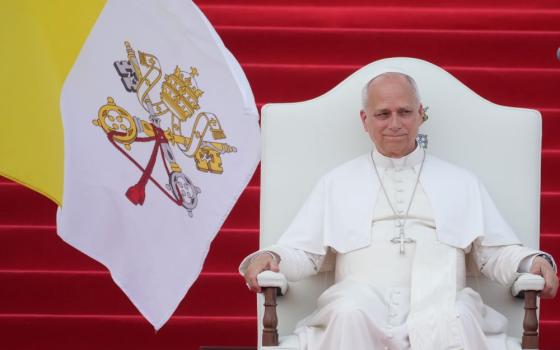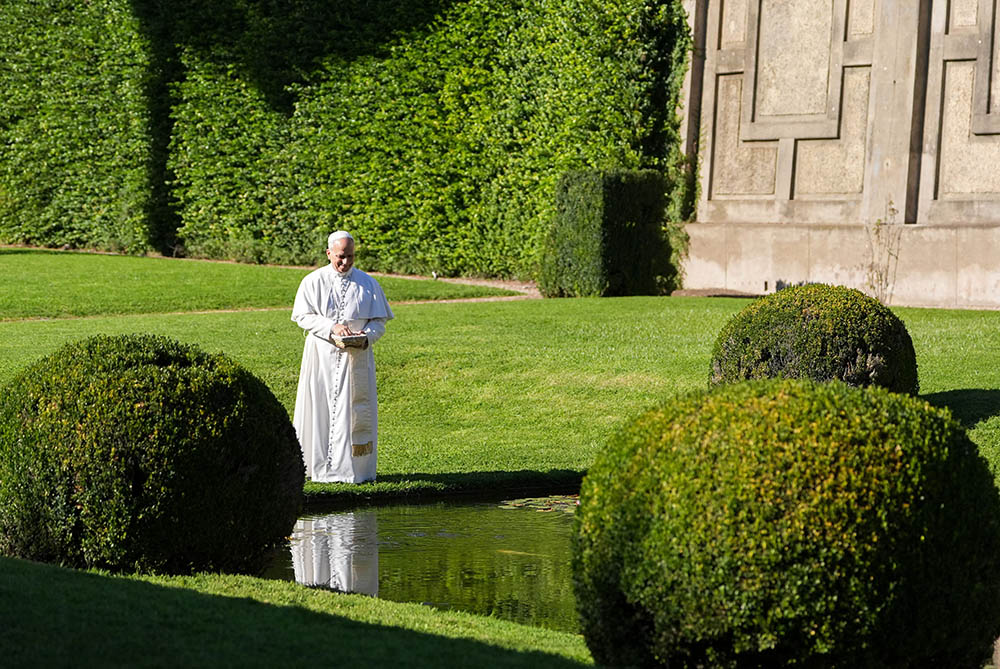
Pope Leo XIV feeds fish at a pond in the Pontifical Gardens of Castel Gandolfo, Italy, Sept. 5, 2025. The pope inaugurated Borgo Laudato Si’ the same day, opening the historic papal residence as a center dedicated to the principles of care for creation and human dignity outlined in Pope Francis’ encyclical Laudato Si’. (CNS/Lola Gomez)

by Chelsea Jordan King
Join the Conversation
Send your thoughts to Letters to the Editor. Learn more
Since Pope Leo XIV assumed the papacy, one of the most closely watched questions has been how he would continue Pope Francis' legacy on climate change.
Dubbed by some as the "climate pope," Francis made care for creation central to Catholic social teaching in the 21st century. In Laudato Si', he reminded us that "everything is connected," and that environmental degradation, human relationships and economic systems are intertwined. He propelled that message further with Laudate Deum, arguing that climate change is not only a scientific or political issue, but a moral and spiritual one.
Francis made a profound and unmistakable imprint. His papacy elevated climate change into a defining moral issue, positioning the church as a global voice urging both political accountability and personal responsibility.
Leo has not retreated from that position. Rather, he is propelling it forward.
From the earliest days of his papacy, he signaled continuity by calling for "urgent action" on climate change and emphasizing humanity's responsibility to live in a "relationship of reciprocity" with the natural world. Over the past year, he has insisted there is "no room for indifference or resignation" in responding to the climate crisis.
Advertisement
Like Francis, Leo has maintained that care for the earth cannot be separated from care for the poor, and has demonstrated a willingness to confront the structural drivers of environmental harm, criticizing economic systems that prioritize extraction and profit over human dignity and ecological health. Leo has pressed policymakers and other leaders to move beyond rhetoric and implement concrete action to address worsening environmental conditions. He has encouraged Catholics not only to support policy change but to demand it by urging the faithful to hold leaders accountable for protecting the common good.
Where Francis sounded the alarm, Leo has remained focused on what he calls ecological conversion: a transformation of heart and mind. This concept, rooted in Laudato Si', underscores that lasting change requires more than policy reform — it requires a reorientation of how people see the world and their place within it.
What struck me most about both Francis and Leo is that neither addressed the environment as a policy issue first, but as a question of heart. They are asking the church to help people see differently: to recognize the earth as a gift, the poor as neighbors, and themselves as participants in a web of relationships rather than consumers moving through a landscape.
Climate change has become deeply entangled in political identity, shaping not only policy debates but individuals' willingness to act. At the same time, younger generations are experiencing the crisis in profoundly personal ways. A recent Sacred Heart University survey found eco-anxiety among Americans ages 19 to 29 to be exceptionally high (68.5%), with respondents expressing both deep concern and a sense of powerlessness.
Leo has acknowledged this reality while also cautioning against the pull of pessimism. In a message to French scouts, he urges them "go forward without losing hope … without becoming discouraged … and without giving in to pessimism," framing ecological anxiety not as a dead end but as a call to renewed commitment. He called for an ecological education that addresses not only biodiversity loss but also global inequality, water scarcity and energy access. This reflects the same "everything is connected" vision articulated by Francis, but with a renewed focus on how that awareness is cultivated.
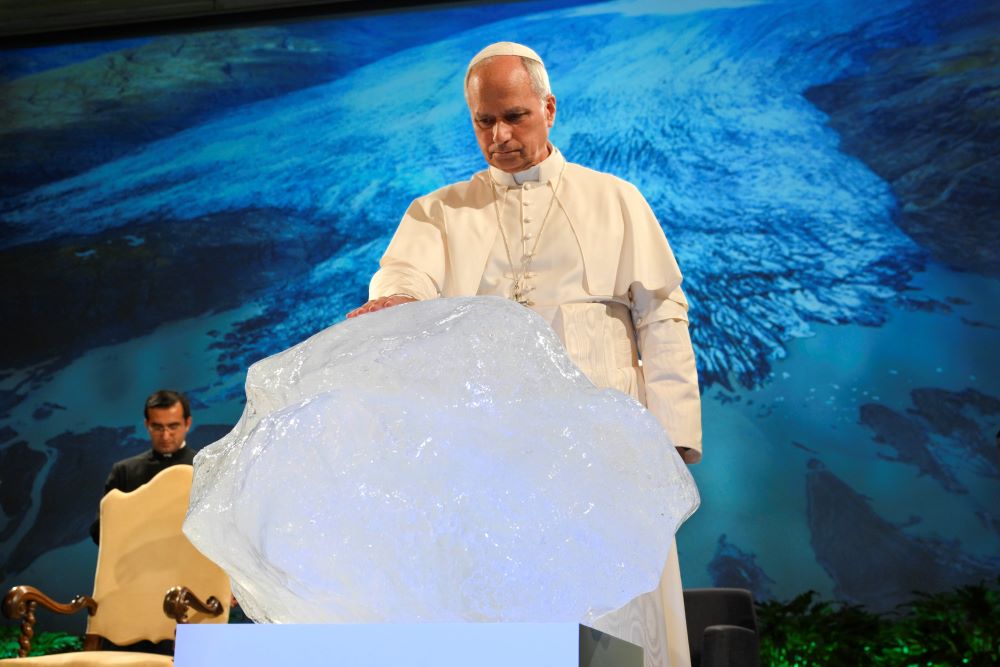
Pope Leo XIV blesses a chunk of ice from a glacier in Greenland during the opening session of an international conference celebrating the 10th anniversary of Pope Francis' encyclical "Laudato Si', on Care for Our Common Home," at the Mariapolis Center in Castel Gandolfo, Italy, Oct. 1. The ice block was fished out of the Nuup Kangerlua fjord in Greenland after becoming detached from the ice sheet. (CNS/Vatican Media)
If Francis helped the church name the urgency of the ecological crisis, Leo appears focused on deepening the response by embedding it more fully in the spiritual, educational and institutional life of the faithful.
Leo speaks about the need for empathy for others, regardless of where they reside, and for us to form a deeper connection with the earth. That includes financial, vocal and actionable support for climate activism, and supporting those who will work toward positive change. He also talks about personal lifestyle changes, for churches to establish their own local projects and programs focused on supporting nature, and political and economic reform through international agreements, renewable energy investments, better resource management and increased corporate responsibility.
Still, the challenges remain immense. Political divisions persist, economic incentives often run counter to environmental goals, and the pace of change continues to lag behind the scale of the crisis.
If Francis helped the church name the urgency of the ecological crisis, Leo appears focused on deepening the response by embedding it more fully in the spiritual, educational and institutional life of the faithful.
In the language of our own time, Jesus was an environmentalist. Many of the people he spoke to were farmers, people who understood the fragility of soil and their dependence on the earth and its resources. His parables remind us that creation is not disposable or separate, but a living partner in our understanding of God.
One year into his papacy, Pope Leo XIV is making clear that this work is ongoing. The church has already found its voice on climate. The question now is how that call to ecological conversion will take root.