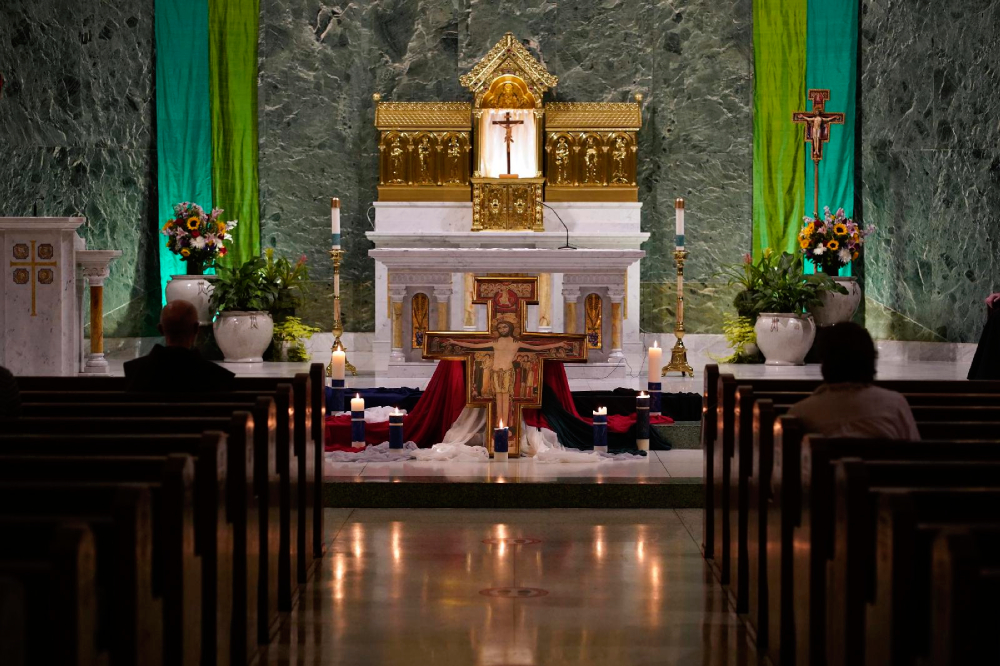
A San Damiano cross is displayed in the sanctuary during a prayer service for Haiti and Afghanistan Aug. 23, 2021 at St. Francis of Assisi Church in New York City. (CNS/Gregory A. Shemitz)

by Vanessa R. Corcoran
Join the Conversation
Send your thoughts to Letters to the Editor. Learn more
St. Francis of Assisi, the 13th-century preacher remembered for his messages about poverty and caring for the environment, is one of the most recognizable figures in medieval history. Following his death in 1226, artists highlighted his distinguishable features: tonsured hair, the brown cloth robes that symbolized a life of poverty, and the knots on his cord that represented the three vows of poverty, chastity, and obedience.
To commemorate the 800th anniversary of his passing, Pope Leo XIV has called for a special Jubilee year, during which the bodily remains of Francis were displayed for the first time in February. In observance of the Jubilee, Leo visited Assisi yesterday, Aug. 6
Art historians estimate that over 20,000 images of Francis were created within a century of his death. An examination of some of the most notable works of Franciscan art will help us better appreciate the legacy of the Italian preacher.
The cross that spoke to Francis: The San Damiano crucifix
The majority of the images included here are posthumous renderings of Francis's life. But there is one religious object that predates Francis which is essential to understanding Franciscan art: the 12th-century San Damiano crucifix. One of the earliest hagiographies of St. Francis, the Legenda Maior (Life of St. Francis), was written by the 13th-century philosopher and theologian St. Bonaventure. In that telling, Francis was praying at the broken-down church of San Damiano when "he heard with his bodily ears a Voice proceeding from that Cross, saying thrice: 'Francis, go and repair My House, which, as thou seest, is falling utterly into ruin.'"
Rather than a literal interpretation of the crumbling remains of that building, Francis took this as a commentary about some of the major criticisms leveled at the Catholic Church in the early 13th century. Namely, opulence had stood as a distraction from living a simple, prayerful life like Jesus. Sometimes referred to as "the legend of the speaking cross," this crucifix is often included in many visual renderings of Francis's life as a critical moment in Francis's ministry.
The San Damiano cross is a Romanesque wooden cross that measures 6 feet tall and 4 feet wide. It is now in the Basilica of St. Clare. Stylistically, it is known as icon crucifix, because it has a series of religious figures on it, including the crucified Jesus and witnesses to the Crucifixion: Mary of Nazareth, John the Evangelist, Mary Magdalene, Mary the mother of James, and the centurion. Because of its association with a transformative moment in Francis's faith, the crucifix appears in many Renaissance frescoes. Even miniaturized ones are sold at the Basilica of San Francesco so that pilgrims can bring a piece of Francis' origin story to their own homes.
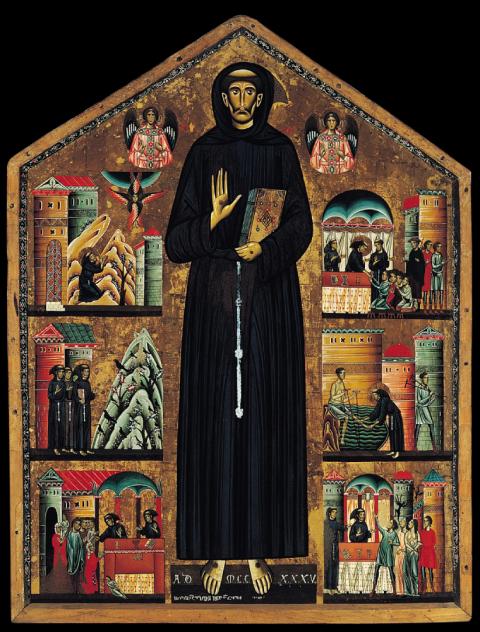
"Saint Francis of Assisi" (1235), by Bonaventura Berlinghieri. (Wikimedia Commons)
Marked like Christ: Francis Receiving the stigmata
One of the most formative moments towards the end of his life, depicted in numerous artistic renderings, is when Francis received the stigmata in 1224. As the first person to receive the stigmata marks, it is one of most of his most identifiable physical traits. Eyewitnesses recounted to Thomas of Celano when Francis received the stigmata: "A little before his death, our brother and father (Francis) appeared as if crucified, bearing in his body the five wounds which are truly the stigmata of Christ." These torturous wounds furthered the idea of Francis as Christ-like — a motif explored often in both devotional writing and art.
The stigmata appear prominently in the first altarpiece containing an image of Francis created in 1235, only nine years after his death. Italian painter Bonvaentura Berlinghieri used Thomas of Celano's biography, Life of Francis, as the textual inspiration for his panels. In this first portrait of Francis is the display of the stigmata: Francis's hands are open, with holes reminiscent of Christ's wounds, and the puncture wounds on his feet also look like Christ's.
Giotto di Bondone, who is better known for his frescos of Francis, also created a portrait of Francis receiving the stigmata, painted between 1295-1300. In the main image, the rays emanating cast direct lines directly onto the hands and feet of Francis. Each of these portraits capture many elements that are now engrained in Franciscan imagery. If we then shift to viewing the fresco cycle of St. Francis within the Basilica of San Francesco, we can gain an even wider appreciation for how early Renaissance artists used devotional writing as templates for their artistic renderings of Francis.
Advertisement
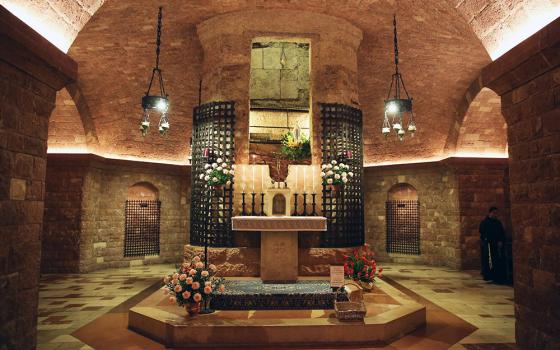
The Basilica of San Francesco, his final resting place
Recognizing Francis's already-widespread popularity, Pope Gregory IX ordered the construction of the Basilica of San Francesco even before Francis was formally canonized in 1228. The lower basilica was completed in remarkably quick time, and Francis's remains were formally interred in 1230. Designed by Maestro Jacopo Tedesco and supervised by Brother Elias of Cortona, one of Francis's early followers, the architecture is breathtaking in its own right. But the fresco cycles in the lower basilica demonstrate how quickly Francis's saintly virtues were illuminated on such a large space. Below each of the 28 frescos created by the "Assisi master" is a brief inscription from Bonaventure's Legenda Maior, demonstrating how text and art were intertwined in the early Renaissance. The Basilica of San Francesco has even managed to survive two massive earthquakes in 1997.
Francis urged his followers to use visualization as a guiding tool in prayer. Fresco cycles offered a suitable space for contemplation. Just as Francis was transformative to medieval spirituality, so was Giotto di Bondone as an influence in the early Italian Renaissance. Giotto's frescos demonstrate a growing mastery in perspective: a shift from the more static Byzantine and Romanesque styles. His fresco cycle of St. Francis in the Bardi Chapel in the Basilica of Santa Croce in Florence (1325-1328) contains six panels on Francis, as well as a large rendering of Francis receiving the stigmata. Instead of the stoicism of the San Damiano crucifix, Giotto was one of the first painters to really capture emotional realism in his subjects, including St. Francis.
We can use Francis not to just understand changes to religious devotion in the later Middle Ages, but how the emotional style of Renaissance painting sought to capture the fantastical life of the 13th-century mendicant friar. Since the Middle Ages, art and devotional writing have been used complementarily to promote the virtues of St. Francis. As pilgrims, including Leo, prepare to visit Assisi for this apostolic jubilee, they can witness how these two crafts form the foundation of the medieval saint whose messages on poverty and the environment still resonate today.