(Unsplash/Immo Wegmann)

by Enzo Del Brocco
Join the Conversation
Send your thoughts to Letters to the Editor. Learn more
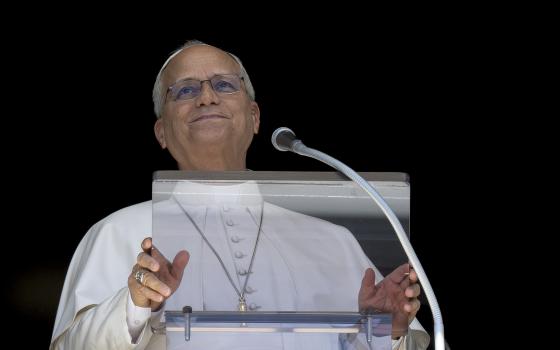
Pope Leo XIV recently addressed UNESCO in Paris on the challenge of education in a world increasingly permeated by artificial intelligence. He observed that abundance of information is not synonymous with wisdom. Despite the capacity and high speed of artificial intelligence in correlating great quantities of data, it cannot answer the deepest questions concerning the meaning of human life.
As the pope said during the Sept. 25 address, "Human beings cannot live without meaning. Meaning is the oxygen of the mind." The search for such meaning is as old as humanity itself. The psalmist looks upon the heavens and asks, "What is man that you are mindful of him?" (Psalm 8:4), and throughout history philosophers, theologians, writers and artists have wrestled with the same fundamental questions: Who are we? Why are we here?
These questions become poignant particularly in times of profound suffering. During the Holocaust, the question of meaning acquired a terrible immediacy. Viktor Frankl, himself a survivor of Nazi concentration camps, highlighted the search for meaning in his famous book Man's Search for Meaning, in which he reflects on how a person might still discover meaning even amid suffering that cannot be avoided. Human beings have never been satisfied simply with knowing how the world works; we also need to ask why we live, what is worth living and dying for, what can make suffering bearable, and toward what ultimate end our lives are directed.
Pope Leo's words deserve particular attention from those working in education, especially theological education. In the age of artificial intelligence, we can acquire ready-made answers with unprecedented ease. But studying theology requires something more than giving the right answers.
It requires the curiosity of Moses who, seeing the bush burning without being consumed, said, "I must turn aside to look at this remarkable sight" (Exodus 3:3). It requires the courage of those who entered Canaan and returned carrying fruit so abundant that a single cluster of grapes had to be borne by two men (Numbers 13:21-24). And it requires wisdom and discernment. Solomon did not discover the mother of the disputed child by mechanically applying a rule; he had to perceive what the words of the two women alone could not reveal (1 Kings 3:16-28).
How can theology schools today cultivate the dispositions of curiosity to look more closely, the courage to venture beyond what is familiar, and the wisdom to discern what lies beneath appearances as the rise of "hasty reading" of AI-generated summaries hollows out our attention spans and the humanities (the very disciplines that help search for meaning) are being canceled across universities?
Advertisement
Recent PISA (Program for International Student Assessment) results, analyzed by The Economist, show declining performance among teenagers in many wealthy countries in mathematics, reading and science with reading skills suffering the most. However, these numbers do not prove that young people are becoming less intelligent, nor should they give rise to lazy cliches about a failing generation. Instead, they expose a structural crisis. Theology faculties need to recognize that their students have been formed within this educational and digital environment.
Artificial intelligence did not create the underlying educational problem; it is simply exposing it. For example, a student without sufficient philosophical formation may struggle to recognize an argument that sounds convincing but does not hold, and if he or she lacks literary formation through reading difficult texts, a polished summary can be easily mistaken for understanding. AI masks these weaknesses because it can produce the appearance of intellectual competence, even when the underlying intellectual formation is lacking or entirely missing.
This should concern professors more than plagiarism does. The fundamental question is not whether a paragraph was generated by a machine, but whether the person presenting it has acquired the intellectual habits that the exercise was intended to develop.
It is important to find creative ways to help students read and remain with a difficult text, to encounter perspectives radically different from their own, to create something genuinely their own and confront moral and existential questions for which no algorithm can assume responsibility.
Theology cannot be reduced to repeating the teachings of the church, however important and essential those teachings are. At its heart it is a search for meaning! It requires the capacity to understand, interpret and give an account of the faith in dialogue with the questions and realities of each age. This is why we must help students approach the Scriptures, the Church Fathers, the great theologians and the magisterium differently than they approach a search engine. Instead of looking for the passage that supplies rote answers, the study of theology must allow a text to unsettle the student and expand their horizons.
And theological formation cannot end with intellectual mastery. Ultimately, the theologian encounters not only texts but God and his people, and must be ready to encounter and speak to those they will serve. Meaning is the oxygen of the mind and it becomes fully alive only when it passes from the page to the human person.
Theological education, therefore, is not simply about acquiring or downloading information; it is about reestablishing the connection between the human spirit and the Holy Spirit. Its task is to form persons who are able to remain open to where the Spirit may be leading. As Jesus tells Nicodemus, the wind "blows where it wills"; "you do not know where it comes from or where it goes" (John 3:8). The theologian cannot command or control that wind. The task of theology is to learn to recognize its movement and to cultivate the courage to follow wherever it leads.