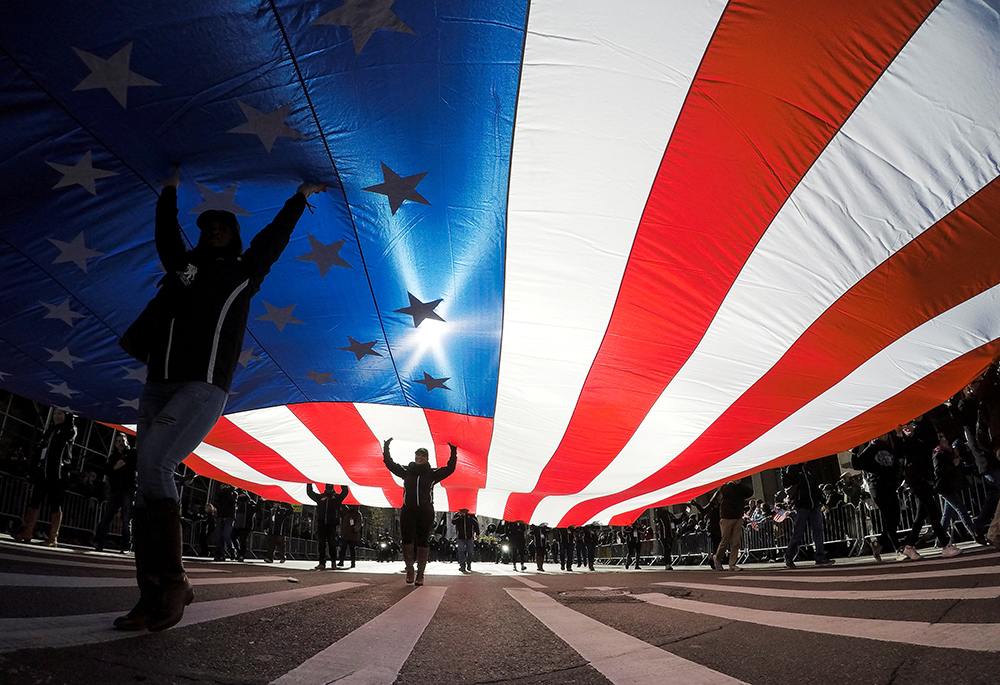
In this 2017 file photo, people in New York City carry the U.S. flag. (CNS/Reuters/Eduardo Munoz)

Join the Conversation
Send your thoughts to Letters to the Editor. Learn more
A group of critics, reporters and editors at The Washington Post compiled a list of the 25 most influential works of culture in U.S. history, one per decade. "No decade can be summed up any more than a country can be summed up, but if we wrote an autobiography not of words but of works — books, music and art, ideas, dress and culture — these 25 would be among the most momentous," art and architecture critic Philip Kennicott explains in introducing the list. In addition to the premier cultural work selected, the critics list a few additional runners-up for each decade.
Perusing the list, you would have no idea that religion has been a consistently important cultural force in the United States. The only item on the list that is specifically religious is Julia Ward Howe's "Battle Hymn of the Republic." But even with that powerful hymn, the authors only allow that her words are an "uplifting, religious and generally patriotic anthem," that is "full of symbolism rooted in the Bible's Book of Revelation." They spend as much ink discussing how different words were set to the tune — "John Brown's body lies a-mouldering in the grave/ His truth is marching on!" and the fact that the chorus has been adapted by "college football crowds and European soccer fans" as they do on the text's profound, thorough, start to finish religiousness.
There are some Christians who rant a lot about secularism. The late Rev. Jerry Falwell made "secular humanism" one of his most consistent bogeymen in his speeches and sermons. I do not believe there is any cabal at work trying to push religion out of American culture but the absence of any other religious works on the list evidences a real lack of understanding of the history of American culture.
So, for example, few would question the selection of the Federalist Papers as the most important cultural work of the decade 1786-1795, but one of the runners-up listed by the Post is Judith Sargent Murray's 1790 essay "On the Equality of the Sexes." Murray's essay may have been prescient, but was it as consequential as George Washington's Letter to the Hebrew Congregation of Newport, Rhode Island written that same year? Washington's letter was cited in a host of civics books and legal opinions throughout our nation's history. Was Sargent's essay similarly cited as a font of the undeniably important women's rights movement?
The Post awards Mark Twain's novel Adventures of Huckleberry Finn the honor of most consequential cultural work of the decade 1876-1885. This truly was a seminal effort "to capture the 'authentic' voice and character of America," as the Post's critics observe. The other items for the decade are: the Harvard Lampoon; Henry James' The Portrait of a Lady; Emma Lazarus' poem, "The New Colossus" and John Singer Sargent's portrait, "Madame X."
What is missing from that decade? How about the decrees of the Third Plenary Council of Baltimore at which the bishops of what would become the nation's largest religious denomination decreed that every parish should have a parochial school and adopted what became known as "the Baltimore Catechism." The significance of Catholic education and of the catechism surely outweighs the four additional items and a case could be made it ranks up there with Twain's novel.
Advertisement
The racist movie "The Birth of a Nation" depicting the founding of the Ku Klux Klan was cited as the most influential cultural work of the decade 1906-1915. It certainly put new wind in the sails of racism in the early 20th century. But was its influence more enduring than the publication of The Fundamentals: A Testimony to the Truth, a collection of essays that became the evangelical Protestant equivalent of the Baltimore Catechism? Thousands of pastors still have these works on their bookshelves and Bible colleges and seminaries throughout much of the country use them as text books.
I love Julia Child as much as the next person, but was her book Mastering the Art of French Cooking really the most influential cultural work of the decade 1956-1965? The same question can be posed to the other items for that decade: Ayn Rand's novel Atlas Shrugged; Leonard Bernstein's musical "West Side Story," Chuck Berry's song "Johnny B. Goode," Rod Serling's television series "The Twilight Zone" and Joseph Heller's novel Catch-22.
Doesn't John F. Kennedy's speech to the Greater Houston Ministerial Association deserve to be on the list of also-rans? Or perhaps the Supreme Court's decision in School District of Abington Township v. Schempp which barred the reading of the Bible and reciting the Lord's Prayer in public schools. I thought Kennedy went a bit far in drawing such a sharp distinction between religion and politics, but his speech made his election possible and Joe Biden's. The court's decision increased the cultural gulf between our nation's elites and a significant percentage, sometimes a majority, of the nation's voters.
If Fox News or EWTN does a segment about this list, they are sure to say it reveals an anti-religious bias. I doubt that. One wishes there really was a cabal at the Post aiming to sideline religion: At least we could debate them. It is actually more frightening that the absence of religion was likely not a conscious decision but the result of the fact that many of the most educated and culturally important actors in our society are simply ignorant of religion's role in shaping the culture. Contemporary educators mostly focus on gender and race to explain American society and those are important to study. They are not the only important things to study. The critics at the Post, like many people who lead other major cultural institutions, simply do not give religion a second thought. Ignorance, in this instance, may be harder to overcome than bias.