(Unsplash/ev)

by Daniel P. Horan
Join the Conversation
Send your thoughts to Letters to the Editor. Learn more
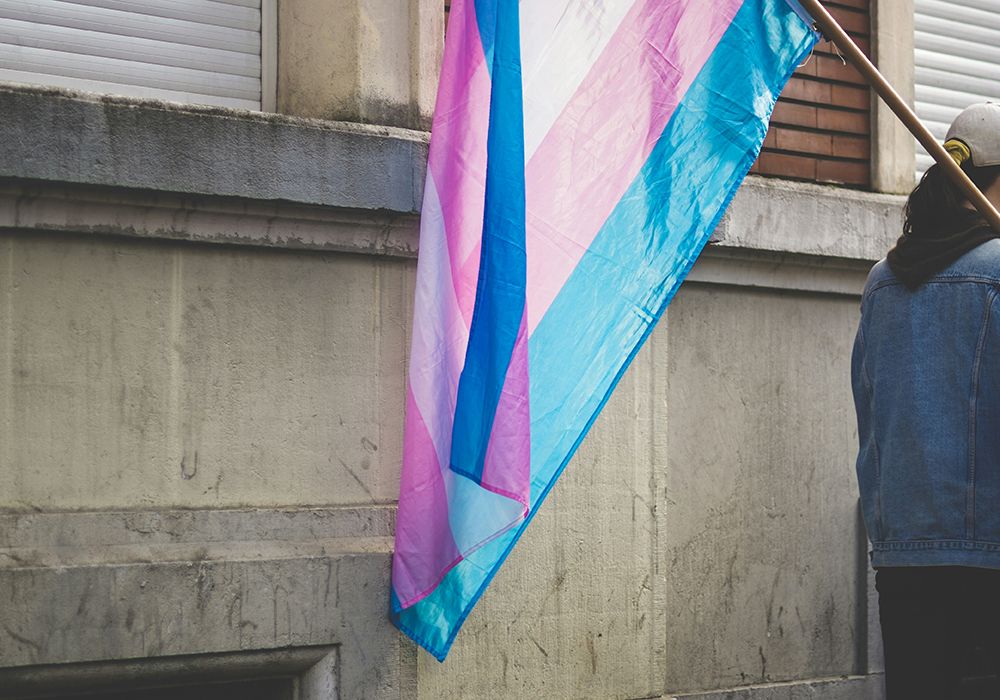
The way that political pundits have been talking about the transgender community, in both the secular and Catholic media, needs to change.
Increasingly, talking heads and opining columnists, political strategists and armchair analysts alike have taken to discussing subjects broadly collected into a category that Rep. Alexandria Ocasio-Cortez recently called "Woke 1.0." While some of the talking points of such backtracking and internecine debates are worth reflection and reconsideration (for example, the unwise adoption of sweeping protest slogans like "defund the police" by political candidates), other subjects that are not merely about language must be treated differently, including the realities of anti-Black racism and transphobia.
People of color, including George Floyd, really were murdered; and transgender men and women really are targeted today. These phenomena are not merely theories to be debated but lives that are affected by real-world policies and practices.
While there may be legitimate reasons to have good-faith debates about how we create more inclusive spaces in our communities, educational institutions, and churches and whether or not acronyms like DEI (for "diversity, equity and inclusion") are helpful or distracting, it is never OK to treat the actual human lives of minoritized and marginalized persons in the same way.
And yet, this is exactly what is happening.
The debates about what political messages are or are not "palatable" and which political candidates are or are not "electable" have put already vulnerable populations in even greater risk. Instead of talking about people, pundits are talking about and dismissing abstractions, which often results in leaving real human beings behind and in danger. While there is much to say about how this is happening to communities of color and other populations who are being affected by this shift in rhetoric and political Monday-morning quarterbacking, I want to focus my attention in this column on the trans community in particular.
I want to draw attention to the insidious trend of treating trans rights as some kind of optional, progressive, out-of-touch agenda at best and as a political or corporate liability at worst instead of treating the need to protect trans rights — including safe access to gender-affirming care — as a fundamental human right.
Predictably, commentators on the political right have framed trans advocacy as a form of "overreach." Take, for example, an article published last month in the The American Conservative magazine with the title "Democrats Can't Kick the Trans Obsession," which argues that the Democratic Party is likely to suffer in races where their candidates defend LGBTQ+ rights. This is in keeping with the Trump administration's unabashed attack on LGBTQ+ rights in general and trans protections in particular since the start of Trump's second administration.
An article published by the American Bar Association recently summarized how "our country has pivoted significantly on trans rights issues" in this way:
The turnaround has been prompted by the political demonization of trans people that some conservative leaders deployed in a successful effort to distract from their economic policies, which favor wealthy elites. For many years, this strategy involved fueling fear of Black people, Muslims, and immigrants; now they are fomenting hysteria against trans people as well, spreading the lies that trans people are dangerous, are trying to recruit our kids to become trans, and are stealing athletic scholarships from our daughters.
But lately it is not just those on the political right who are taking aim at trans people. Those on the political left and moderates are openly debating the prospective short-term political benefits to abandoning the trans community, taking a cue from the conservative playbook.
The way this has appeared most commonly outside of the Republican Party has been the false claim that trans issues are, as my NCR columnist colleague Michael Sean Winters put it recently, "cultural nonsense." He went on to write:
If Democrats need to articulate an economic message that is more revolutionary, on cultural issues they need to stop sounding like they just left the faculty lounge. Insofar as trans issues are the new totem in the culture wars, if the Democrats do not abandon the shrill orthodoxy of the Human Rights Campaign and other related groups, they will keep losing elections. More importantly, the received orthodoxy doesn't pass the common sense smell test.
Like some other commentators, Winters believes that trans issues are something concocted by the academic elite in some sort of cultural theory laboratory. But this kind of transphobic fever dream is the real "nonsense."
First, transgender people, and other sexual and gender minority populations, are neither political totems nor "cultural issues" to be debated. Unlike the abstracted trans specter of such debates, the actual trans people I know are and have always been real people.
As The New York Times columnist M. Gessen, who is trans, recently recounted in a lengthy and powerful essay about the real-life consequences of an anti-trans law taking effect in Kansas, such transphobic rhetoric has been deployed to rally support for truly dehumanizing policies and practices. I encourage everyone to read Gessen's essay and hear from the trans people in the Midwest whose lives are being upended and whose basic human dignity is being eroded.
Advertisement
Second, it is morally wrong to reduce the complex, real and endangered lives of transgender people to a mere "cultural issue," as if their existence was up for discussion, their humanity a question worthy of debate.
The foundational moral principle of the Catholic tradition is the inherent and inalienable dignity of the human person. To treat a minoritized and vulnerable population like the trans community as a political liability, as a population of persons that can be abandoned or denigrated for the sake of potentially scoring political points is sinful and disgusting.
We have seen analogs to this in cases targeting religious minorities, such as what was done to the Jews in 1930s Germany or the Uyghurs in today's China. Dehumanizing language often leads to very real violence! Today, this sort of rhetoric and behavior is widely recognized as a precursor to human rights violations, a form of political violence, and something to be patently condemned.
Finally, people of faith need to stand up against this kind of reductionistic and propagandizing rhetoric that obscures or erases the diverse, complex and very real lives of trans folks in order to create a political scapegoat. We must remember that "trans issues" are not "cultural issues," these are not matters to be debated like tax-policy preferences or personal preferences in art and music, but humans who deserve our love, support and protection.
Support for trans people and the protection of those things necessary for their fundamental human flourishing shouldn't be a political matter at all, but a matter of basic human rights. And regardless of what one's political affiliation is, those who identify as Christian ought to do everything in their power to make sure everybody's human rights are protected and preserved, especially for those in vulnerable populations. At least from the Catholic Christian perspective, that's what common sense looks like.