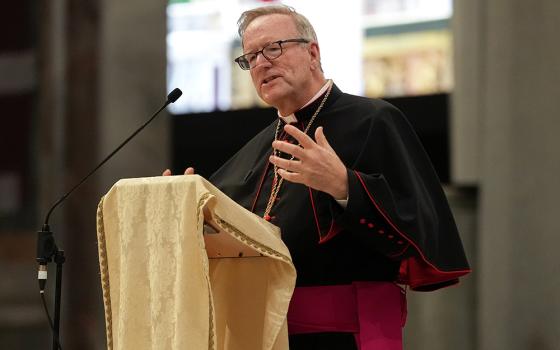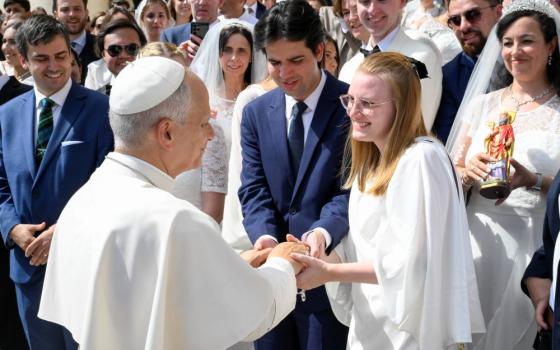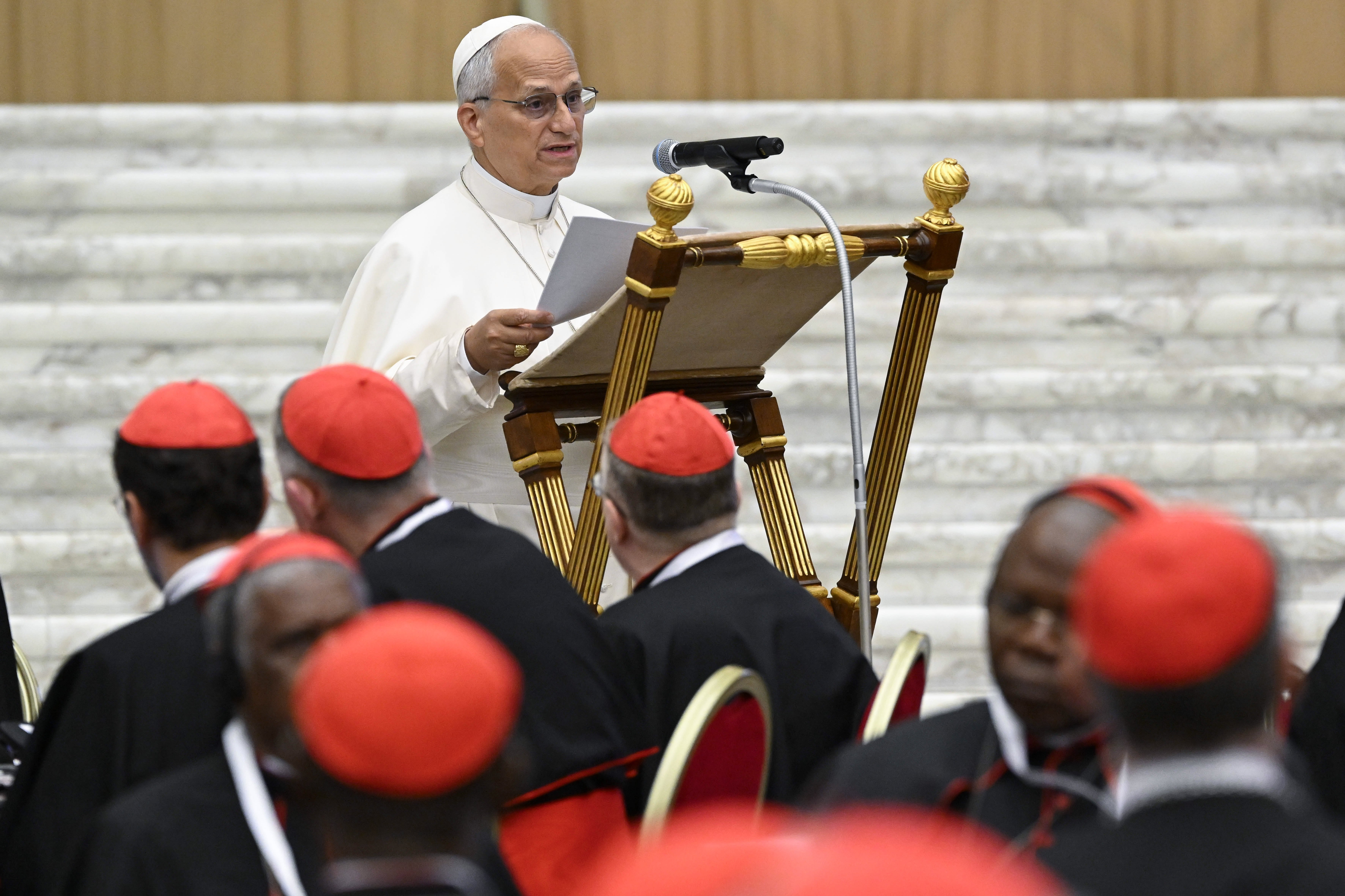
Pope Leo XIV addresses cardinals gathered for the opening working session of his second consistory in the Paul VI Audience Hall at the Vatican June 26, 2026. On June 20, the Vatican announced Leo's appointment of Sr. Alessandra Smerilli as prefect of the Dicastery for Promoting Integral Human Development. (CNS/Vatican Media)
Join the Conversation
Send your thoughts to Letters to the Editor. Learn more
Pope Leo XIV told the world's cardinals gathered in Rome that they were "not here primarily to reflect on the internal life of the church," but to discern how they can bring the Gospel to a world scarred by war and division.
Opening an extraordinary consistory of cardinals — the second such meeting Leo has convened in his 14-month pontificate — the pope said their two days of reflection would revolve around one central question: "How can we help our churches today to proclaim the Gospel with greater faithfulness, freedom and credibility?"
"Mission is not merely one of the church's many tasks," he said. "It is her very reason for existing."
The June 26-27 meeting brought members of the College of Cardinals together behind closed doors for four working sessions: one on the current state of the world, two dedicated to elements of Leo's recent encyclical, Magnifica Humanitas, and another on the state of the synodal process — the push to make the universal church a more listening and participatory body.
Each session was to be introduced by a cardinal: Cardinals Grzegorz Ryś of Kraków; Víctor Manuel Fernández, the Vatican's doctrine chief; Stephen Brislin of Johannesburg; and Mario Grech, head of the Vatican's synod office.
Of the 241 members of the College of Cardinals, 178 were in attendance for the consistory at the Vatican's Paul VI Audience Hall.
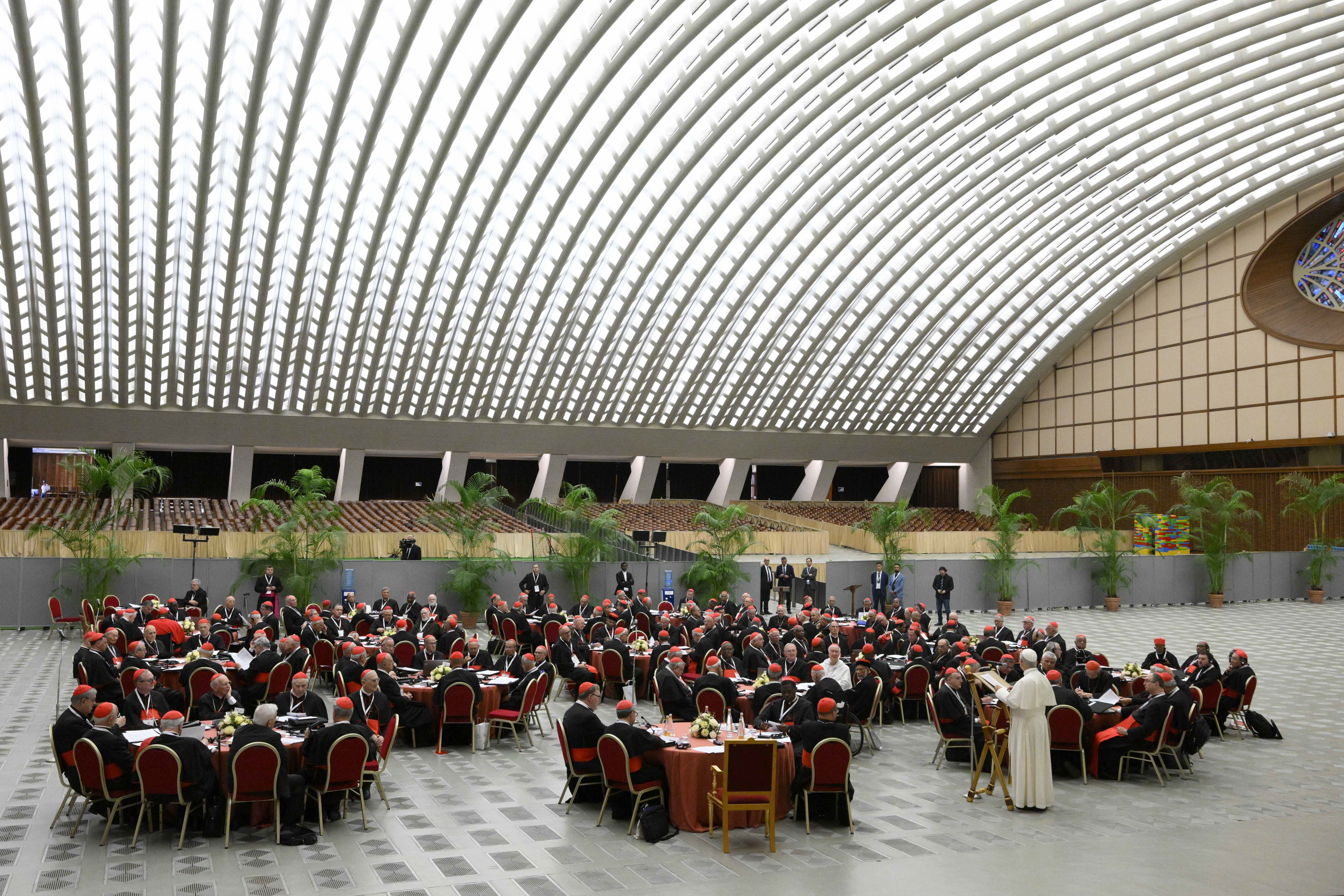
Pope Leo XIV addresses cardinals gathered for the opening working session of his second consistory in the Paul VI Audience Hall at the Vatican June 26, 2026. (CNS photo/Vatican Media)
An outward-looking consistory
Celebrating Mass with the cardinals that morning, Leo set the tone for a consistory expected to include lengthy discussion of the church's response to war, saying in his homily that war "is never blessed by God" because "the creator has endowed us with intelligence and free will to resolve conflicts as human beings and not as beasts."
The prominence of war on the consistory's agenda marked a notable development from the priorities cardinals had identified at their last consistory in January. At that meeting, the cardinals voted to focus the work of the pope and Roman Curia over the next one to two years on the church's evangelizing mission and synodality — a decision that disappointed some traditionalist Catholics who had hoped liturgy would be chosen for deeper discussion.
Advertisement
In April, Leo also sent the cardinals a letter stressing the need to "relaunch Evangelii Gaudium," Pope Francis' apostolic exhortation outlining his vision for a missionary church. Although that document had been selected as a priority for the cardinals' work, it did not explicitly appear on the consistory's agenda.
Instead, the agenda centered heavily on Leo's recent encyclical, including an entire working session dedicated to the section in which he wrote that the church's "just war" teaching is "outdated."
"Many of you come from lands marked by war, violence, and social or religious polarization," Leo said in his opening remarks, recalling the encyclical's treatment of conflict and division.
The pope said he was "particularly keen to hear how these pages resonate within your particular churches, what questions they raise, what perspectives they open up, and what steps they suggest."
Learning synodality through practice
Leo, who made church unity a priority immediately after his election last May, has sought to cool tensions between the pope and the College of Cardinals that developed under Francis, who often preferred to consult a smaller group of cardinal advisers on questions of governance rather than the college as a whole.
In his address he warned cardinals against acting as "guardians of particular interests," urging them to see their role as service to the wider church and to the papacy.
"The ministry that the Lord has entrusted to me cannot be carried out alone. It requires your experience, your pastoral wisdom, and your knowledge of the churches and the people entrusted to you," Leo told the cardinals. "I need your strong, explicit and public support. I need to feel myself supported by you as brothers."
In keeping with the pope's collaborative ethos, the consistory is being carried out in a synodal style, with cardinals divided among 20 small linguistic groups seated at round tables — a format that has drawn criticism from some more conservative cardinals.
Each cardinal is given three minutes to speak in a first round of discussion and two minutes in a follow-up round, after which group synthesis reports are shared with the whole hall.
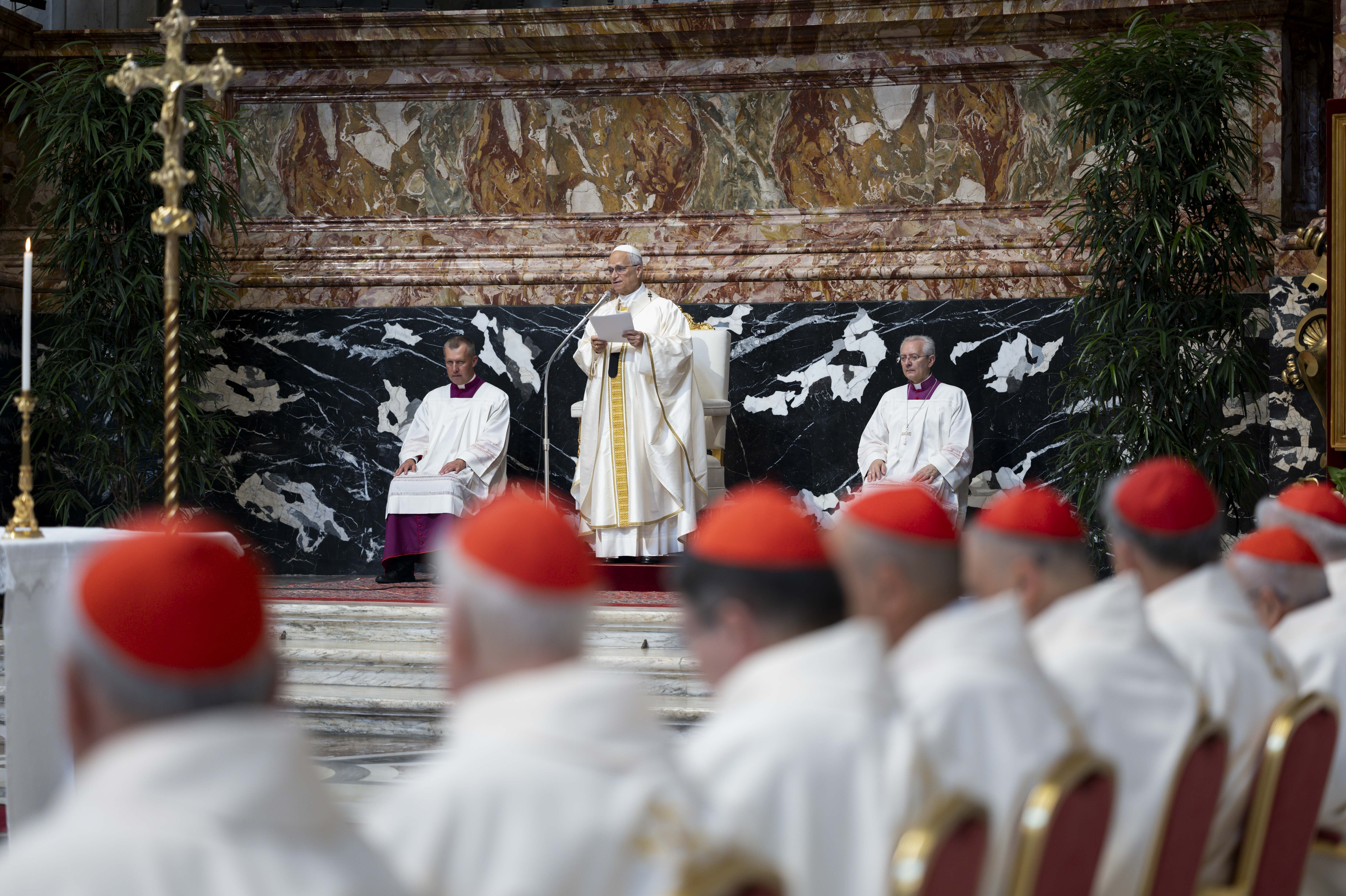
Pope Leo XIV delivers the homily during Mass opening the first day of a consistory with cardinals from around the world in St. Peter's Basilica at the Vatican June 26, 2026. (CNS/Vatican Media)
"I am well aware that, for many of us, this is not the usual way of conducting a consistory," the pope said in his opening remarks, asking the cardinals to "enter into this ecclesial exercise with trust."
From the first moment of the consistory, its format created an image of the communion Leo is preaching. A video feed of the opening session showed U.S. Cardinal Raymond Burke, emblematic of the church's traditionalist wing and an open critic of the late Pope Francis, seated at the same table alongside Cardinals Timothy Radcliffe, an outspoken progressive voice in the church, and Arthur Roche, the head of the Vatican's liturgy office and a frequent target of traditionalist criticism over restrictions on celebrating the pre-Vatican II Latin Mass.
The pope said that cardinals also "learn synodality by practicing it; we learn together to grow in communion."
And addressing a common critique of synodality — that a synodal church threatens the authority of the hierarchy by diluting its power — Leo said synodality actually "helps us understand more deeply the meaning of authority itself, which exists to safeguard communion, foster the participation of all and guide the church's shared journey."
Unlike the last consistory, no press conference is planned for the cardinals to discuss the meetings after their close. The Vatican said in a note to journalists that cardinals were asked not to give statements to the press during the consistory in order to "maintain a climate of fraternal discussion."
This story has been updated to include the number of cardinals who attended the consistory.
The National Catholic Reporter's Rome Bureau is made possible in part by the generosity of Joan and Bob McGrath.