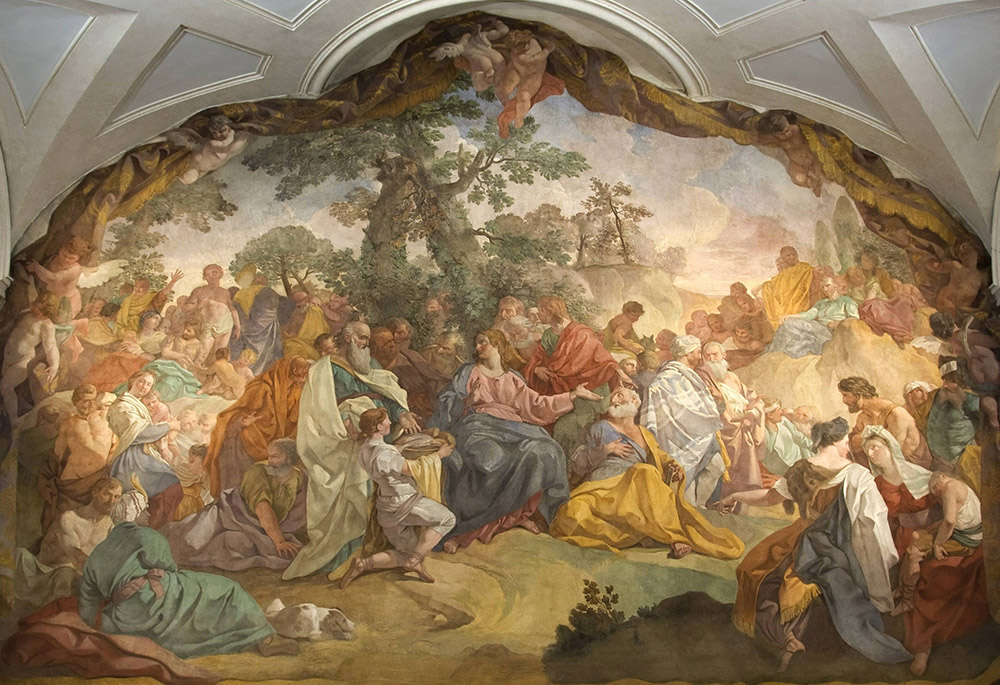
Gregorio Guglielmi's fresco "The Multiplication of the Loaves and Fishes" is seen during an exhibition at the former convent of Sant'Agostino in Rome, Feb. 11, 2009. (CNS/Reuters/Max Rossi)

by Sr. Mary M. McGlone
Join the Conversation
Send your thoughts to Letters to the Editor. Learn more
They all ate and were satisfied. 5,000 men — not even counting women and children! Narrated six times and in all four Gospels, it's the most popular story in the Gospels. Why was it so important to the early Christians?
In his rendition, Matthew sets the stage saying that Jesus wanted to get away. Jesus had just heard of the martyrdom of John the Baptist. He had lost a friend and companion in preaching about the reign of heaven and he realized that John's killing inevitably foreshadowed his own fate. Herod had even identified Jesus as John raised from the dead (Matthew 14:2). Jesus needed time to pray, to take in the experience, to ponder over what it meant for him.
If he was discouraged and wondering about their vocation, the sight of the crowds answered any question he might have had. No sooner did he find the lonely spot he had chosen than he also saw crowds searching for him. Those people too knew that following the popular prophets could be dangerous; many of the religious leaders questioned Jesus' message and saw his followers as gullible dupes or unfaithful Jews. But in spite of the criticism they came to Jesus with their needs, and he satisfied them.
Seeing the people seeking him reinforced Jesus' sense of vocation. People were yearning for his attention, his healing and message. That impelled him to respond. No matter how brokenhearted and tired he was, they reawakened his zeal.
At the end of the day, Jesus hoped that his zeal would be contagious and inspire his disciples. So, when they came to him to tell him it was time to dismiss the crowd, he responded with the absurd idea that they themselves should feed the people. They knew all too well that they were incapable of doing that. Like Jeremiah, who protested that he was too young to be a prophet, they tried to bring him to his senses with an exact inventory of what they had to offer: five loaves and two fish.
When they brought their paltry gifts to Jesus, he did something that sounds familiar to our ears.
"Taking the five loaves and the two fish, and looking up to heaven, he said the blessing, broke the loaves, and gave them to the disciples." In our celebration of the Eucharist, we hear the addition of Jesus' specific command: "Do this in memory of me" (Luke 22:19, and "Do this in remembrance of me" in 1 Corinthians 11:24-26). Somehow the early Christian community saw their vocation reflected in this countryside communion with fish and bread.
As St. Paul reminded the Corinthians (1:26-31), Jesus didn't pick disciples from the nobility, the clever or powerful. He chose "the foolish of the world to shame the wise." Jesus chose ordinary and fallible disciples as a reminder that all power for good comes from God. Jesus' order that the disciples distribute the bread to the crowds is this story's version of "Do this in memory of me."
Advertisement
The early church realized that Jesus did indeed call them to do what seemed impossible. He demonstrated that while they could not accomplish much on their own, with God, all things are possible.
Our other two readings support this idea. Isaiah describes an outrageously generous God who issues a wildly inclusive invitation: "Come! It matters not who others think you are, how you're dressed, your background or current state of grace or hygiene. Come! Here you will find all you need. Why spend your money for what is not bread; your wages for what fails to satisfy?"
Here's the key. "Why spend your wages for what fails to satisfy?" In following Christ, we may not find an abundance of bread or wealth or material security. What we will find is a way of life that satisfies our deepest longings. When we encounter Christ, we begin to understand that, as Paul says, nothing can separate us from the love of God in Christ.
In this popular New Testament story, the apostles and the crowds experienced a parable in action — a happening whose importance could not be exaggerated. They realized that the reign of heaven is populated by people who offer their all and learn that, with the help of the Spirit, they can give exactly what their world needs in their time.
The Word of God is meant to provoke us. Today the readings prod us as individuals and communities of faith to ask a few questions, such as: Am I satisfied with the way I spend my time and energy and resources? Is it fulfilling my deepest longings? Does the memory of Christ come alive in me? Is anything good really impossible?