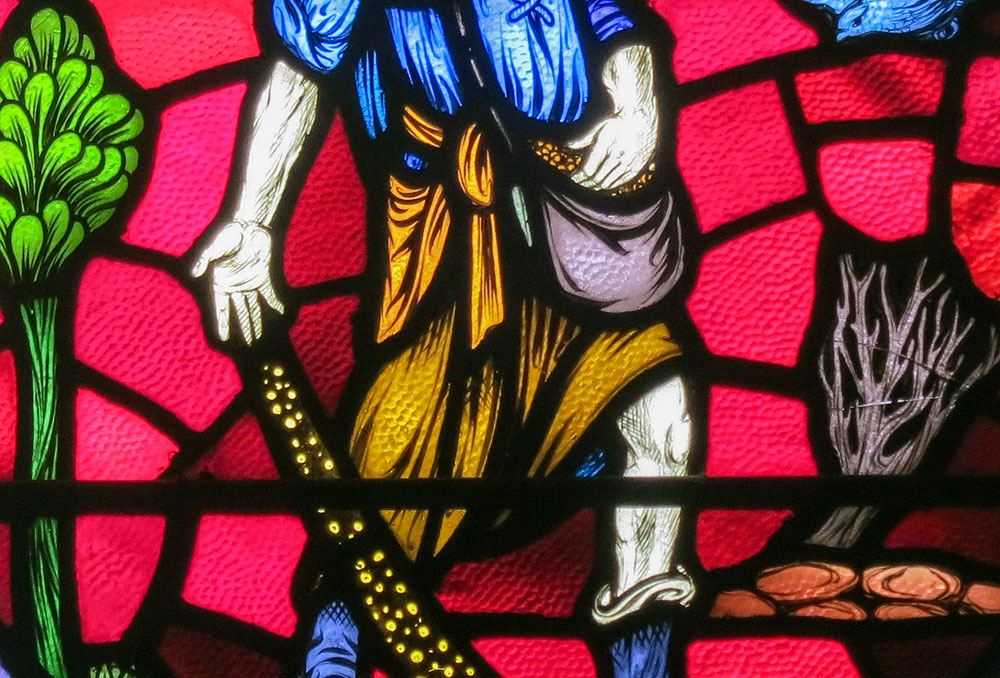
Detail of a stained-glass window of a sower, St. Aloysius Catholic Church in Bowling Green, Ohio (Wikimedia Commons/Nheyob)
by Sr. Mary M. McGlone
Join the Conversation
Send your thoughts to Letters to the Editor. Learn more
By now, the corn should be knee high, at least according to popular wisdom. Even if we haven't been raised on — or even spent time on — a farm, most of us know that farming is a risky business. Good soil, water and weather are the essential ingredients for helping seeds grow strong roots and become plants that feed the world.
Today we hear Jesus' well-known allegory of the sower and seeds. Those who designed our lectionary selected Isaiah 55 to complement that. Isaiah promises that the word of God is always fruitful, but Jesus sounds a little more realistic. He admits that not every seed lands where it should. At the same time, Jesus promises nothing less than a 30-fold yield for those that hit the mark.
These are wonderful readings for summertime. A trip to the country gives us a glance of how our hills and plains are responding to farmers' efforts, and summer is typically a time for vacation, a time to ponder life a bit more than usual. We can meditate, watching tomatoes grow rather than shoveling snow.
Today, St. Paul takes us from the slow growth of seeds to his cosmic vision of creation's trajectory. First, let's put Paul in his context: He's writing from Greece around the year 56 to Christians in Rome, a community he doesn't know. He planned to take financial help from Corinth to Jerusalem and then go on to Rome where he hoped to recruit companions to join him in an evangelizing venture in Spain.
Times were tough when Paul wrote. Some of his fellow Jews regarded him as a heretic. Worse, among the followers of Jesus, there was no lack of dissension. Add to it that Christians and Jews were being persecuted in Rome. It was not the best of times.
How much is our current situation like the woeful circumstances Paul knew? He talks about seeing the futility of created things. What if he saw our climate change and forced migration? He talks about corruption, something we've suffered in church and society. What about new weapons and what Pope Francis called a "world war fought piecemeal"?
Paul never could have imagined the world we live in, with our staggering power to do good or evil. Would he still be able to say, "I consider that the sufferings of this present time are as nothing compared with the glory to be revealed for us?"
Pope Leo XIV says yes. True to his Augustinian tradition, in his encyclical Magnifica Humanitas, Leo wrote, "God has inscribed in our hearts a desire for happiness that embraces all the dimensions of life." That echoes Paul's awareness that all of creation is "groaning in labor pains" waiting to be set free. Both remind us that we are part of creation's coming to fulfillment.
It's easy to be pessimistic or cynical. It relieves us of responsibility. We can say, "there's nothing I can do; it's all controlled by people enthralled to powerful, corrupt and heartless forces." Can we hope?
Advertisement
In 2025, Francis called the world to hope, saying that hope is both a gift and a task. The gift is the God-given urge for life — like the power of seed, soil and water. The seed, with its amazing potential, is a mini-sacrament of hope.
Leo outlines the task of hope in Magnifica Humanitas, saying that humanity "is facing a pivotal choice: either to construct a new Tower of Babel or to build the city in which God and humanity dwell together."
The choice is ours. We have the seeds in hand. Both Francis in "Laudato Si', on Care for Our Common Home" and Leo quoting him in Magnifica Humanitas remind us of the urgency of the moment, saying, "Never has humanity had such power over itself."
From the time we learned to walk, we've wanted big successes. Isn't it surprising that Jesus seems content with a small proportion of seeds that come to fruition? Jesus didn't bank on success: Only one of 10 people healed of leprosy came back, one of his chosen 12 betrayed him, his hometown folks tried to throw him off a cliff, and more. But he trusted that some seeds would grow, that the kingdom of heaven surrounds us and, like seed on good ground, it can yield a hundredfold.
Jesus told his disciples, "Blessed are your eyes, because they see, and your ears, because they hear." Our task as ambassadors of hope is to discern the deep yearnings of our groaning creation and to encourage every person and movement that hastens the coming of the kingdom of heaven.
We'll probably not see immense success. The corn won't be as high as an elephant's eye, but we can be seed, water, sun or soil that helps the kingdom of heaven become more visible.